West Baton Rouge Parish↗ET posted the largest proportional improvement among five parish systems named in a public attendance-pilot announcement. Its chronic absenteeism rate fell from 18.7% in 2023-24 to 13.0% in 2024-25. The 5.7-point decline was a 30.5% reduction.
That result did not begin from a blank slate. Superintendent Chandler Smith described an existing local system of attendance recovery, family-service referrals and truancy-court referrals in a WBRZ report. The pilot added another way to identify and contact families, but the available data cannot separate its effect from West Baton Rouge's other attendance work.
Smith described that work in an email to The LAEdTribune in June. "We stay on top of it daily at the school and district level," he wrote. "Schools have systems and processes in place for Tier 1, 2, and 3 approaches for attendance and that has helped tremendously."
The public pilot announcement named the five parish systems examined here and also named Zachary Community among the participating systems. This analysis is narrower than the full pilot: it compares only Calcasieu, East Baton Rouge, Jefferson, Tangipahoa and West Baton Rouge against Louisiana's complete parish-system universe.
Improvement reached every system in the group
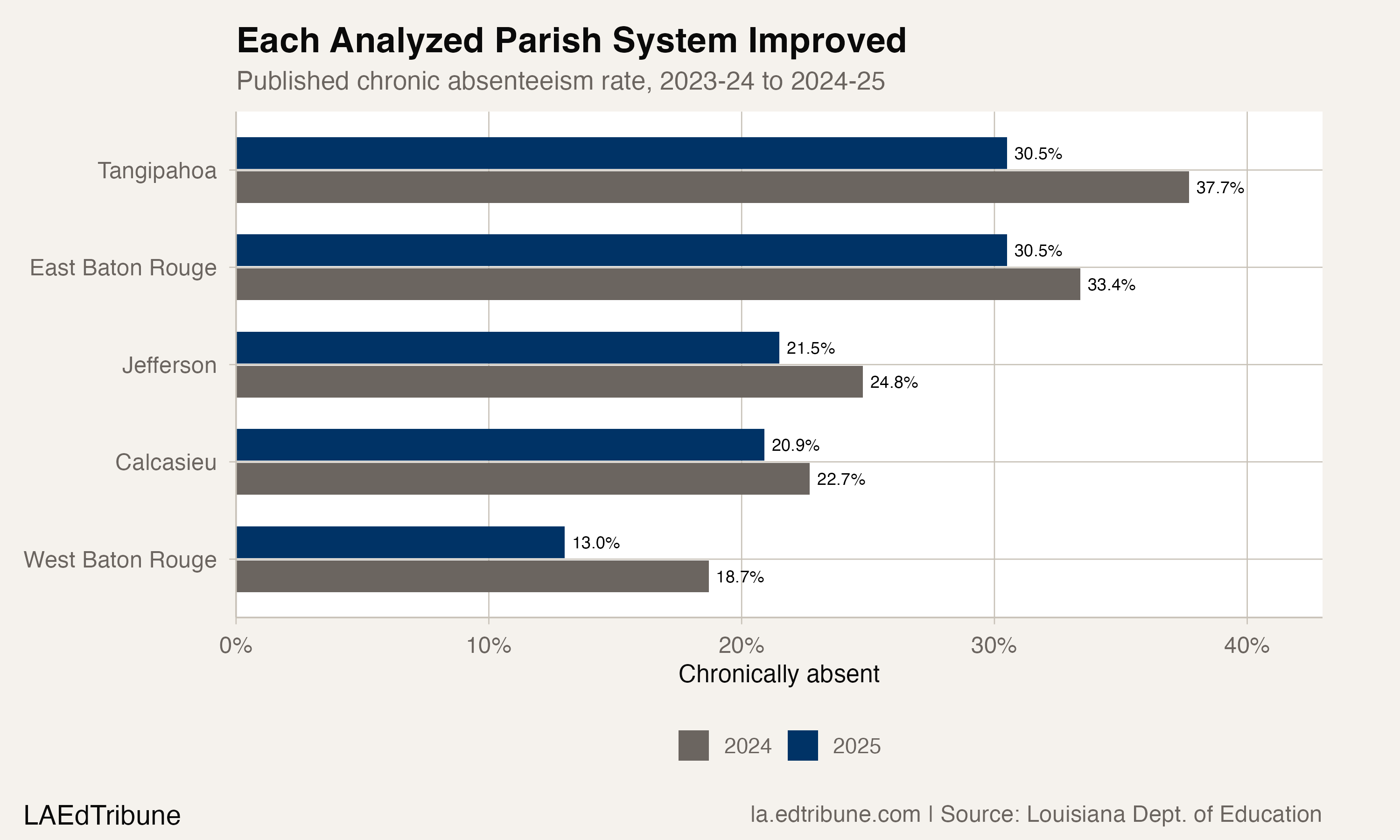
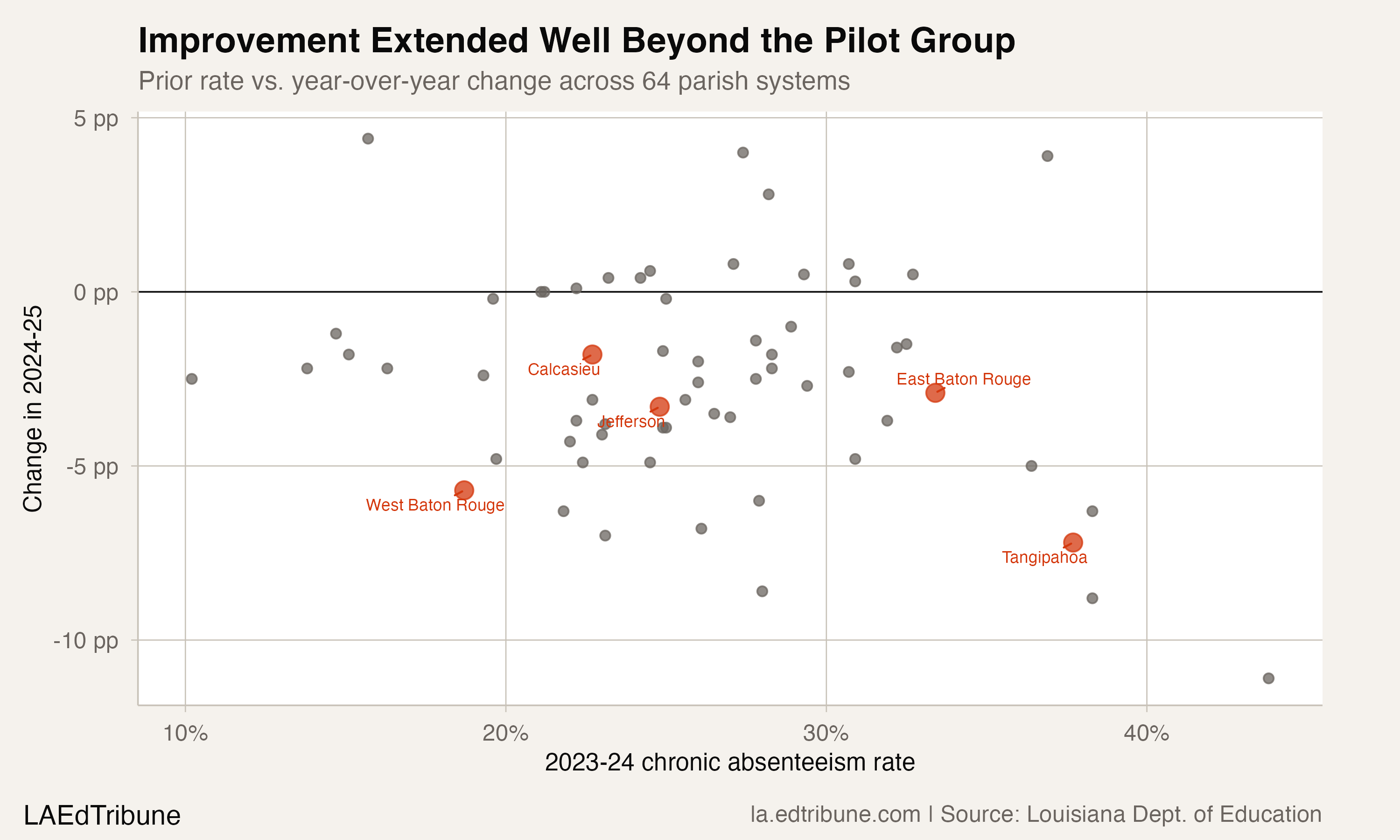
All five parish systems improved from 2023-24 to 2024-25, though the size of the change varied.
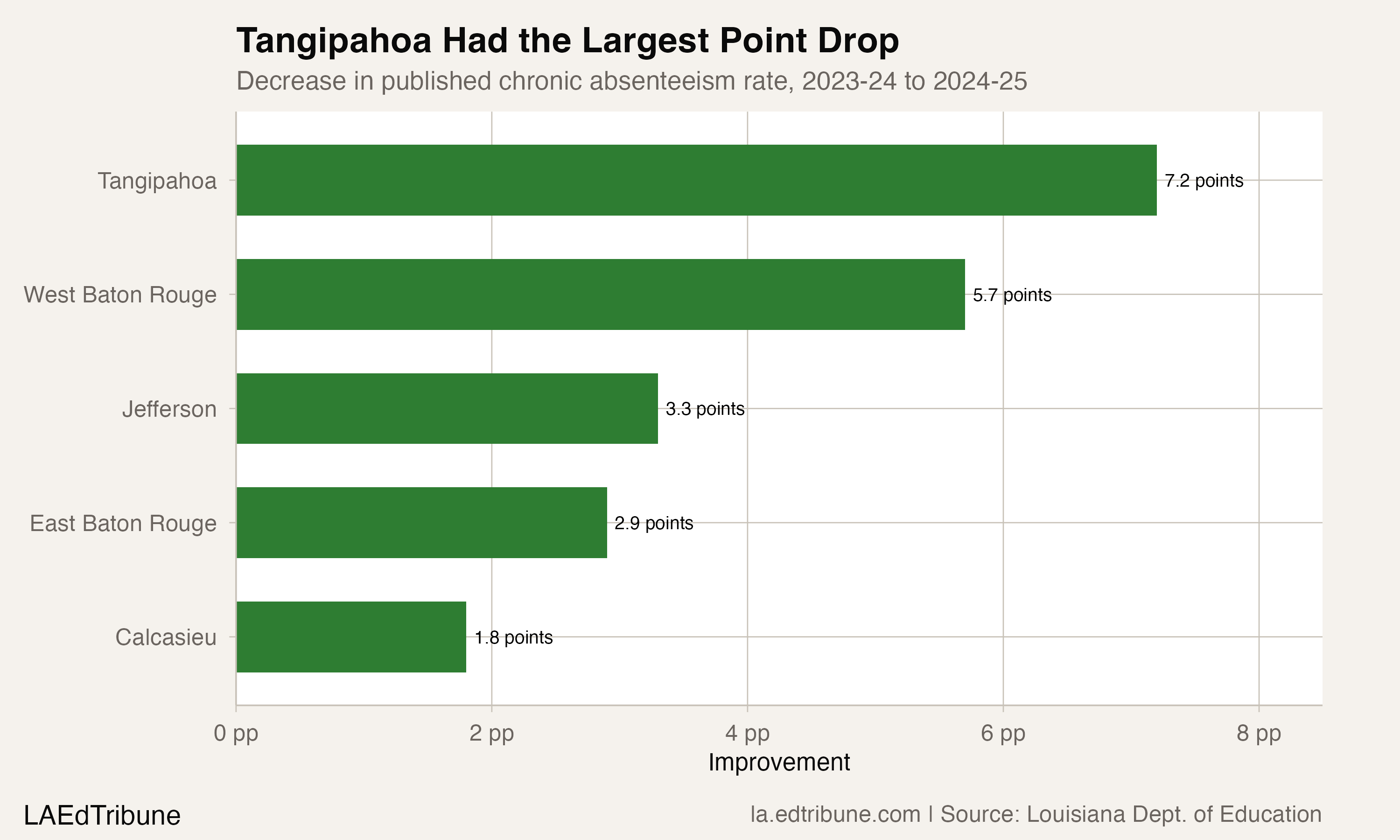
Tangipahoa Parish↗ET had the largest point decline, falling 7.2 points from 37.7% to 30.5%. Jefferson Parish↗ET fell 3.3 points to 21.5%. East Baton Rouge Parish↗ET fell 2.9 points to 30.5%, and Calcasieu Parish↗ET fell 1.8 points to 20.9%.
The five-system average decline was 4.2 percentage points. Louisiana's other 59 parish systems averaged a 2.4-point decline, making the selected group's mean improvement 73% larger. That is an association, not an estimate of program impact. Forty-nine of the state's 64 parish systems improved in the same reporting transition, so a broader favorable shift was underway.
The statewide context also keeps the result in perspective. Louisiana's published chronic absenteeism rate was 22.5% in 2024-25, still 4.9 points above its 17.6% rate in 2018-19. East Baton Rouge and Tangipahoa each ended at 30.5%, eight points above the state rate.
West Baton Rouge brought momentum into the pilot
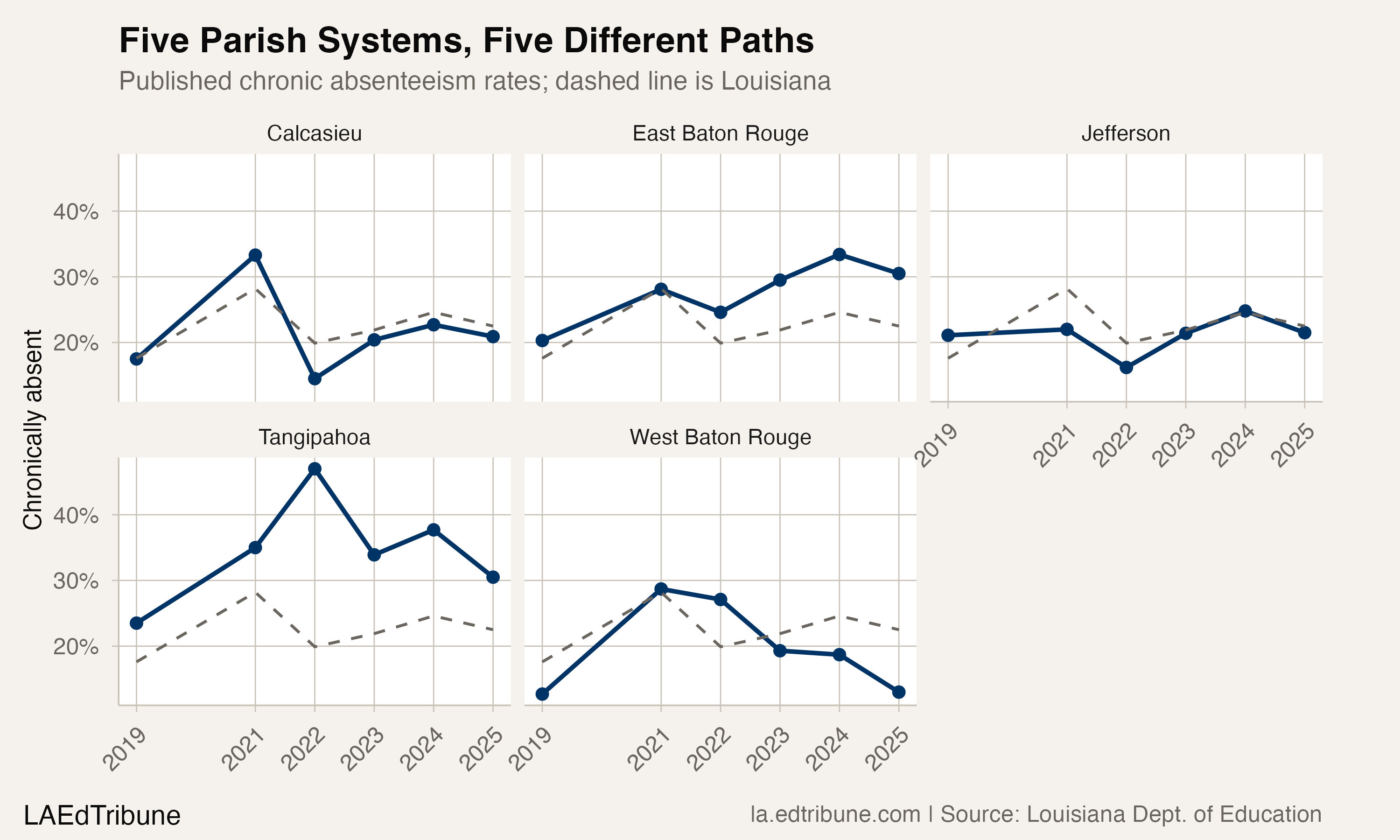
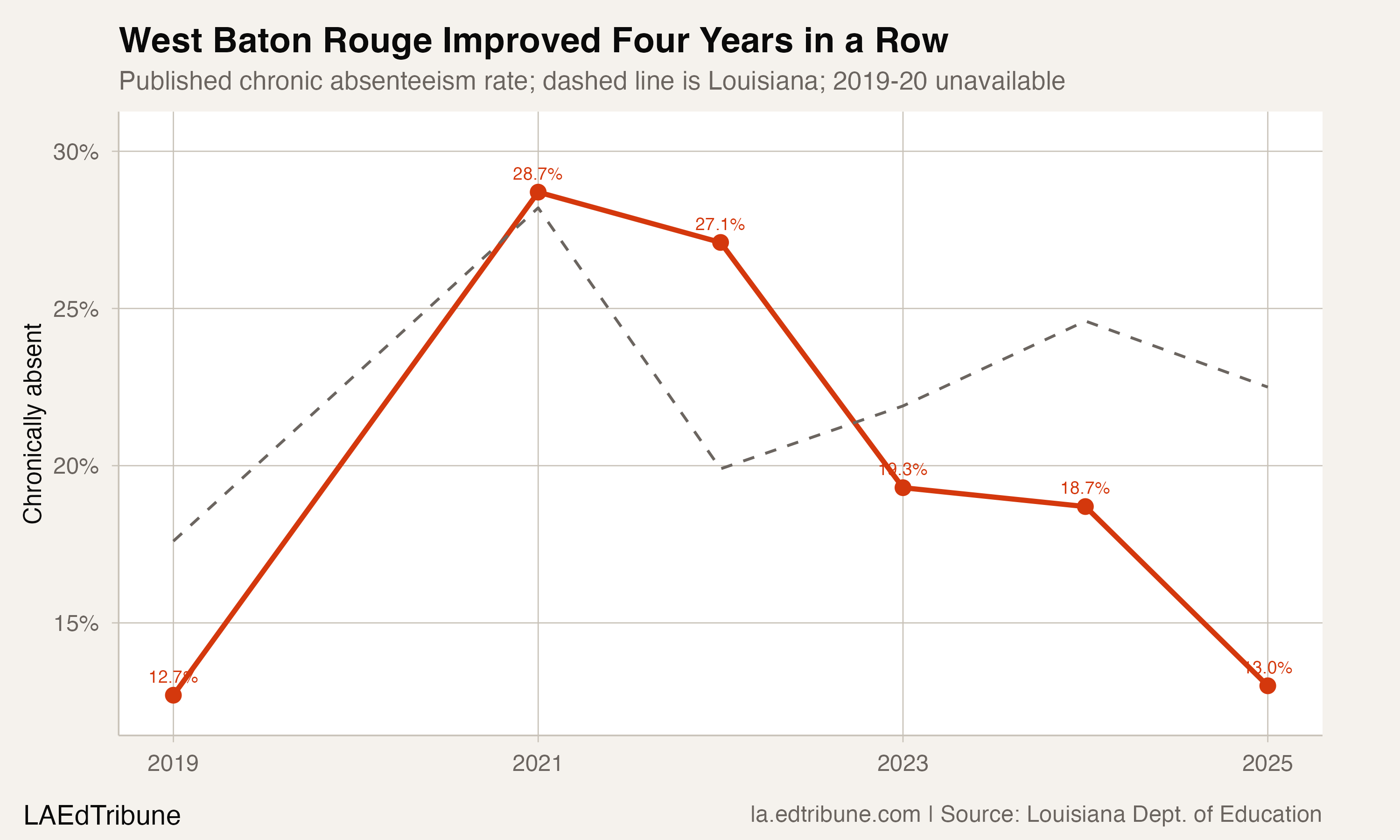
West Baton Rouge's latest decline continued a longer pattern. Its rate moved from 28.7% in 2020-21 to 27.1%, 19.3%, 18.7% and 13.0% over the next four reporting years. It was the only one of Louisiana's 64 parish systems to record four consecutive annual improvements across that five-year span.
On what comes after the grant, Smith wrote: "We will stay the course (despite not having the continued grant funding) and work to grow our daily attendance and get our chronic absenteeism below 10%."
The latest rate was just 0.3 points above West Baton Rouge's 12.7% rate in 2018-19. Jefferson also finished close to its earlier mark: its 21.5% rate was 0.4 points above 2018-19. The other three systems remained farther above their earlier rates. Tangipahoa was seven points above, East Baton Rouge was 10.2 points above and Calcasieu was 3.4 points above.
Tangipahoa's path was especially uneven. Its rate reached 47.0% in 2021-22, dropped, rose again, then fell to 30.5% in 2024-25. The latest improvement is substantial, but the six available reporting periods do not support a steady-recovery description.
What the program changed, and what the data cannot say
The clearest evidence about the program concerns its operations. East Baton Rouge said EveryDay Labs handled routine attendance updates and reminders so district staff could devote more time to family engagement and barriers. Tirzah Smith, the district's supervisor of child welfare and attendance, said in an EveryDay Labs partner spotlight that the outreach "takes that load off of us and allows us to stay focused on engagement, removing barriers, and supporting families."
In West Baton Rouge, the superintendent pointed to what the messages showed parents. "The tech. nudges that EveryDay Labs did were great," Chandler Smith wrote. "They really helped parents see the importance of attendance and the comparison of their child to others helped a lot."
Those accounts explain how work changed inside individual systems. They do not prove that automated messages produced East Baton Rouge's 2.9-point decline or West Baton Rouge's drop. The same limitation applies to the five-system average. There was no randomly assigned comparison group in the published education data, and the other parish systems were improving at the same time.
Scale further complicates a simple program story. West Baton Rouge enrolled 4,211 students in 2024-25, while Calcasieu enrolled 28,588, about 6.8 times as many. Jefferson enrolled 47,459 and East Baton Rouge enrolled 39,711. A common intervention operates inside systems with very different staffing, geography and existing attendance practices. The enrollment data describe that contrast but do not identify which feature explains the different results.
Louisiana's attendance strategy also extends beyond this pilot. The state's attendance task force recommendations called for school teams to monitor attendance data and for a discretionary referral process involving the justice system. West Baton Rouge's recovery and referral structure shows what that wider framework can look like locally.
The strongest conclusion is narrower than a claim that one program caused five improvements. Each analyzed parish system moved in the right direction, and West Baton Rouge combined the largest proportional decline with the only four-year improvement streak among Louisiana's parish systems. Whether the pilot produced the gap between systems remains unanswered by the published data.
Chronic absenteeism and enrollment figures come from the Louisiana Department of Education's data and reports.
Detailed code that reproduces the analysis and figures in this article is available exclusively to EdTribune subscribers.
Discussion
Sign in to join the discussion.
Loading comments...