St. Charles Parish↗ET reported Louisiana's lowest published chronic absenteeism rate among its 64 parish systems. Its 7.7% rate in 2024-25, the most recent published absence year used here, was about a third of Louisiana's 22.5% rate.
The result followed three consecutive annual improvements after the parish's rate peaked at 17.5% in 2021-22. St. Charles enrolled about 9,100 students in 2024-25. Its experience offers a concrete attendance case for other districts, but the data alone cannot isolate which local practice produced the change.
A sharp reversal after the peak
St. Charles' published rate rose from 6.4% in 2018-19 to 17.1% in 2020-21 and 17.5% in 2021-22. The data used here has no 2019-20 figure, so that missing year is not treated as an annual transition.
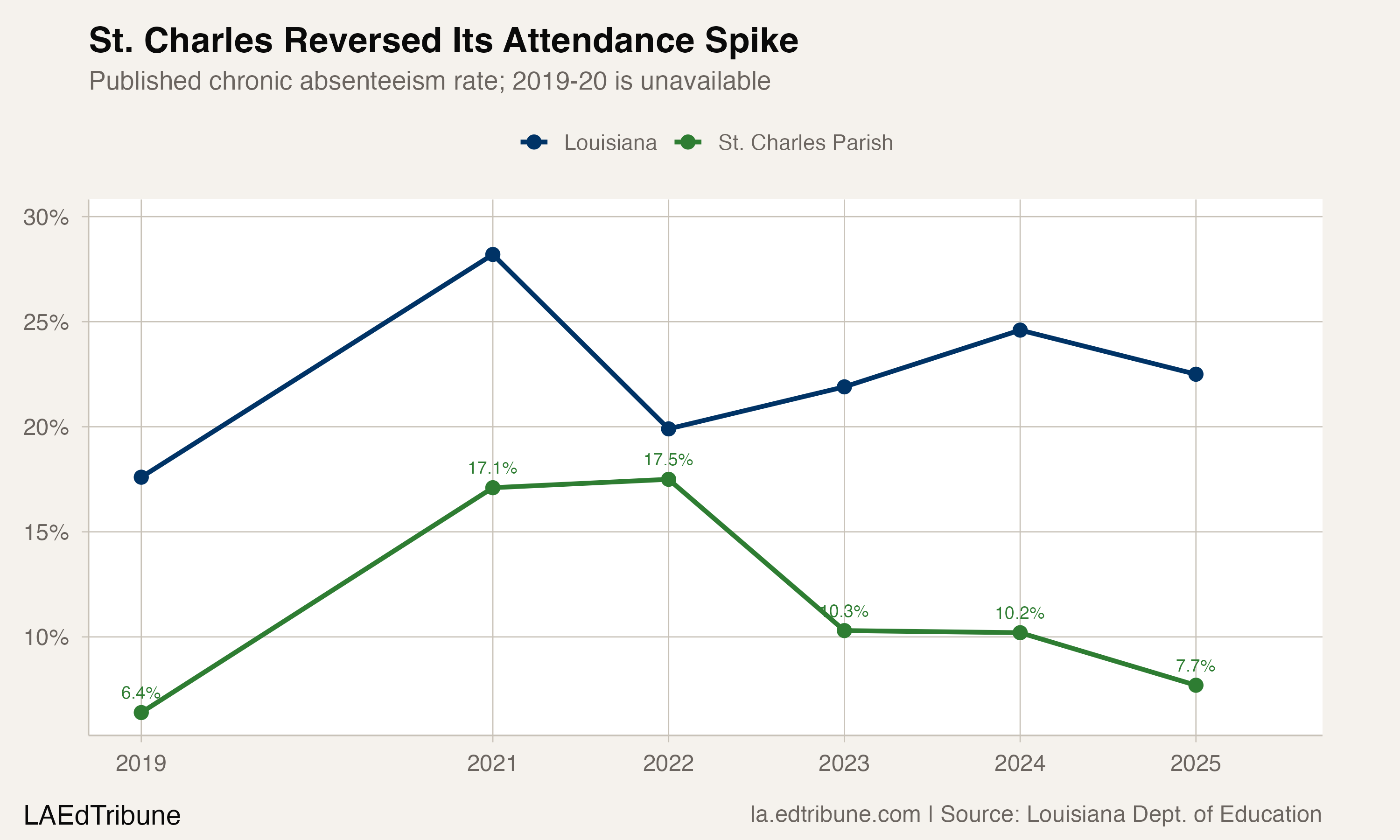
From the 2021-22 peak to 2024-25, the parish rate fell 9.8 percentage points. That reversed 88.3% of the increase from its pre-pandemic baseline. Louisiana reversed 53.8% of its own increase from its published peak to 2024-25.
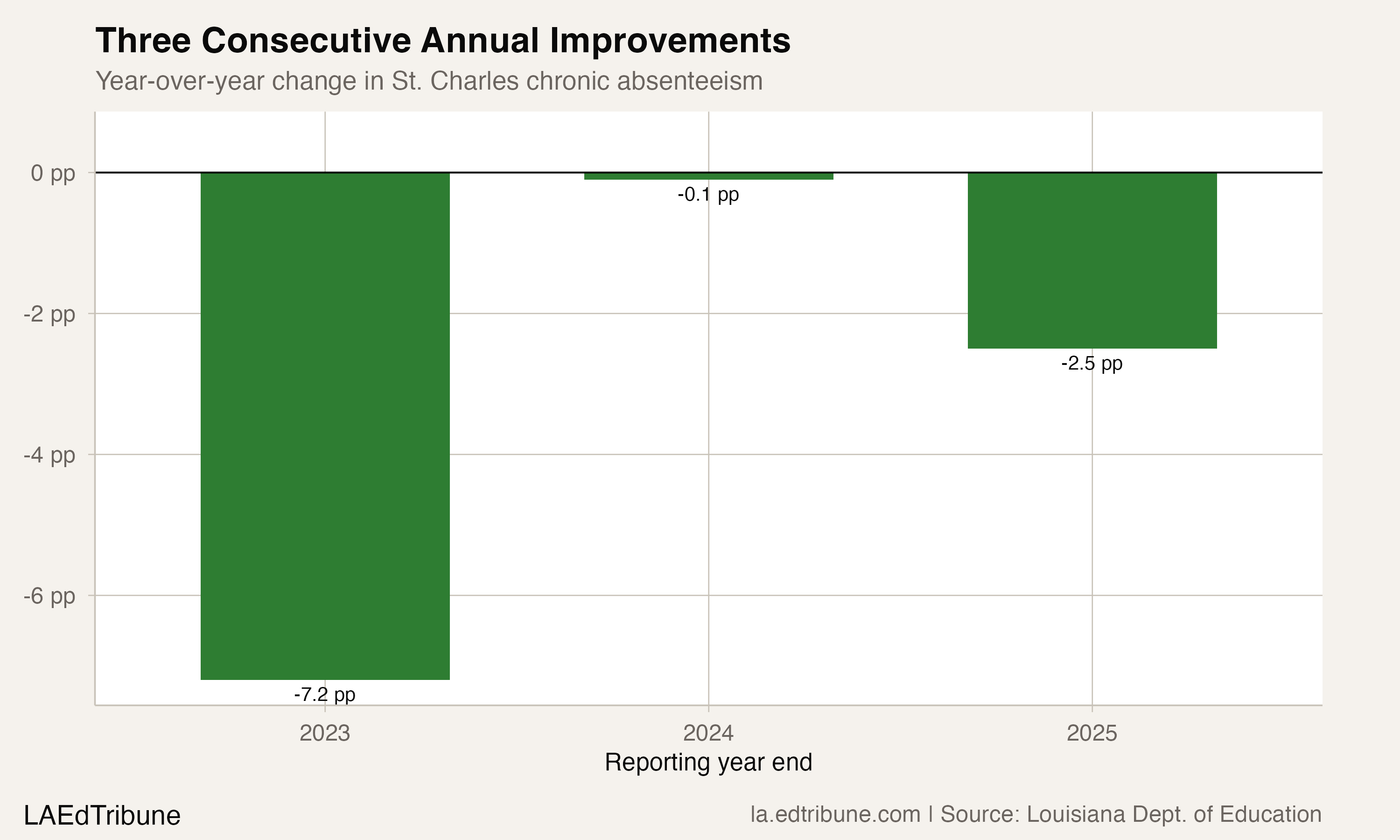
St. Charles improved even as the statewide rate rose in the next two reporting transitions. In 2022-23, Louisiana moved from 19.9% to 21.9%, while St. Charles fell from 17.5% to 10.3%, a 7.2-point improvement. In 2023-24, the statewide rate rose again to 24.6%, while St. Charles edged down to 10.2%. The parish then improved another 2.5 points in 2024-25.
The local system behind the numbers
The district's attendance requirements tie attendance to promotion and course credit. That policy establishes clear consequences, but the published rates do not show how much those rules contributed to the decline.
Dr. Ken Oertling described a wider support network in a written response to The LAEdTribune. He pointed to judges, the Sheriff's Office, district attorney representatives, nonprofits, student-support staff, and the district's Child Welfare and Attendance Department.
The St. Charles Coalition brings district and community partners together each quarter to review attendance data, identify barriers and adjust interventions, Oertling said. He also described student advocates working with families through school meetings, home visits, outreach and court proceedings when needed. In his account, the judicial partnership and support work operate together rather than as competing approaches.
Oertling's account describes the district's practice; it does not measure its effect on attendance. Local conditions, student needs, enrollment and other interventions could also have contributed to the decline.
A comparison among parish systems
Ascension Parish↗ET had the second-lowest parish-system rate at 11.6%, 3.9 points above St. Charles. St. James Parish↗ET was at 13.5%, and St. John the Baptist Parish↗ET was at 19.4%.
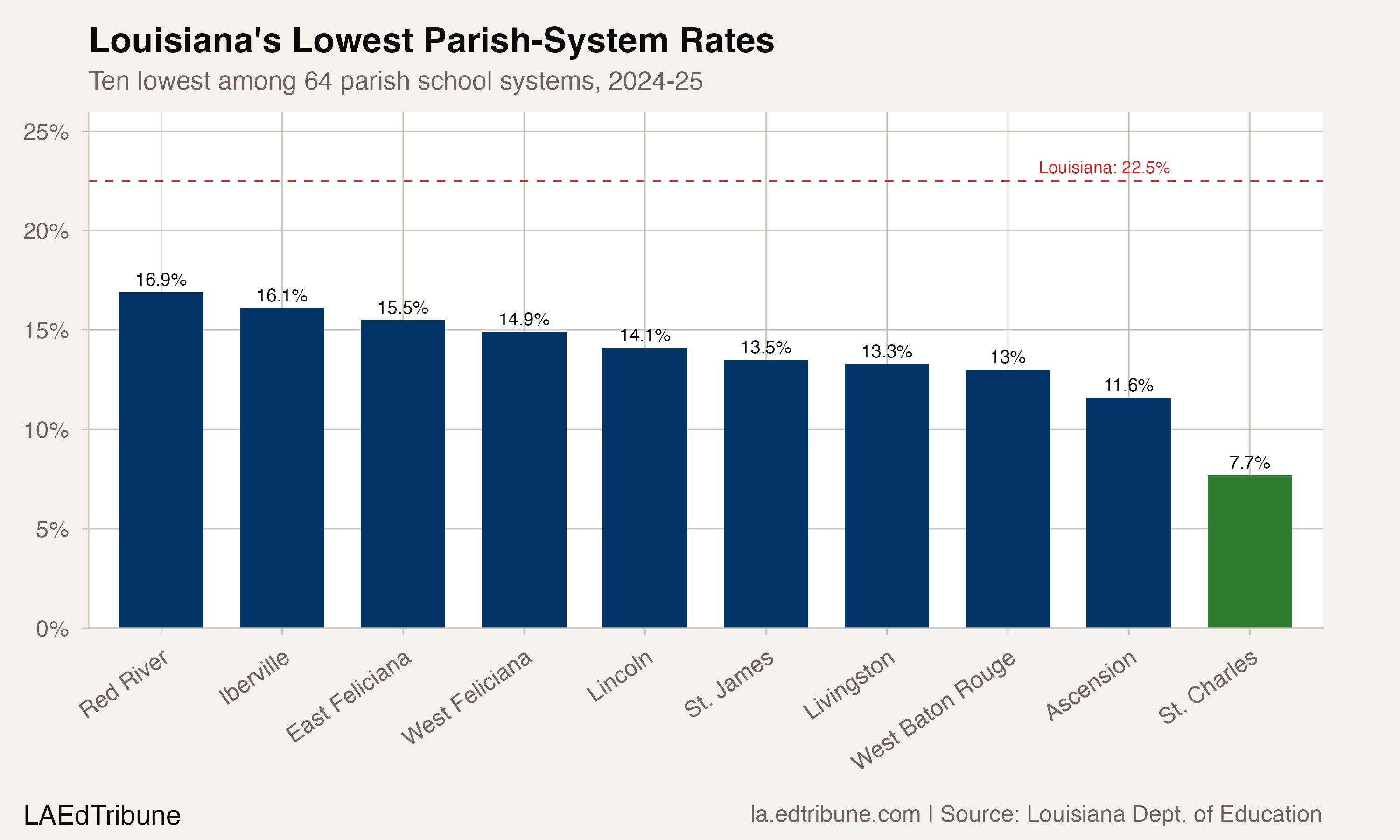
Those four nearby systems span 11.7 percentage points. The comparison establishes that different outcomes coexist within the same broad region. It does not establish that geography, economics or any single policy explains the differences.
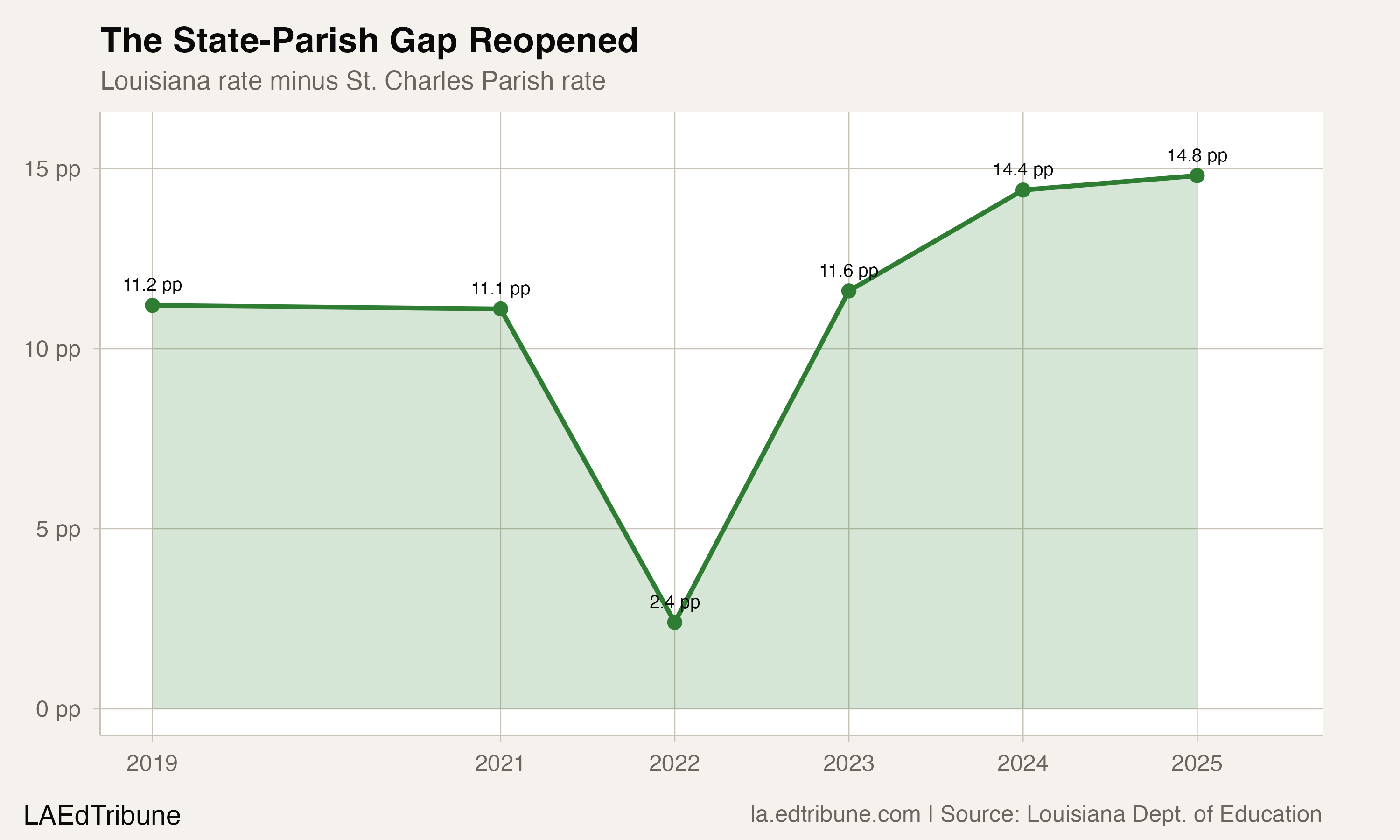
Before the pandemic, St. Charles' rate was 11.2 points below Louisiana's. At the parish's 2021-22 peak, that gap narrowed to 2.4 points. By 2024-25, it had reopened to 14.8 points.
Louisiana has since launched The Power of Presence, a statewide framework centered on prevention, intervention and community partnership. BESE and the Louisiana Supreme Court also convened education and judicial leaders to coordinate attendance work.
Oertling has framed St. Charles' progress as sustained local focus rather than a contest with other districts. That account matches the continuity in the data: after its peak, the parish did not rely on a single rebound year. It improved across three consecutive annual transitions.
The published rates make St. Charles a useful case for other parish systems to examine, with their own scale, student needs and local partnerships in mind. They do not turn it into a universal formula.
Chronic absenteeism and enrollment figures come from the Louisiana Department of Education's data and reports.
Detailed code that reproduces the analysis and figures in this article is available exclusively to EdTribune subscribers.
Discussion
Sign in to join the discussion.
Loading comments...