Louisiana's graduation rate has climbed to an all-time high of 85%. East Baton Rouge Parish↗ET, the state's second-largest school system, has not kept pace.
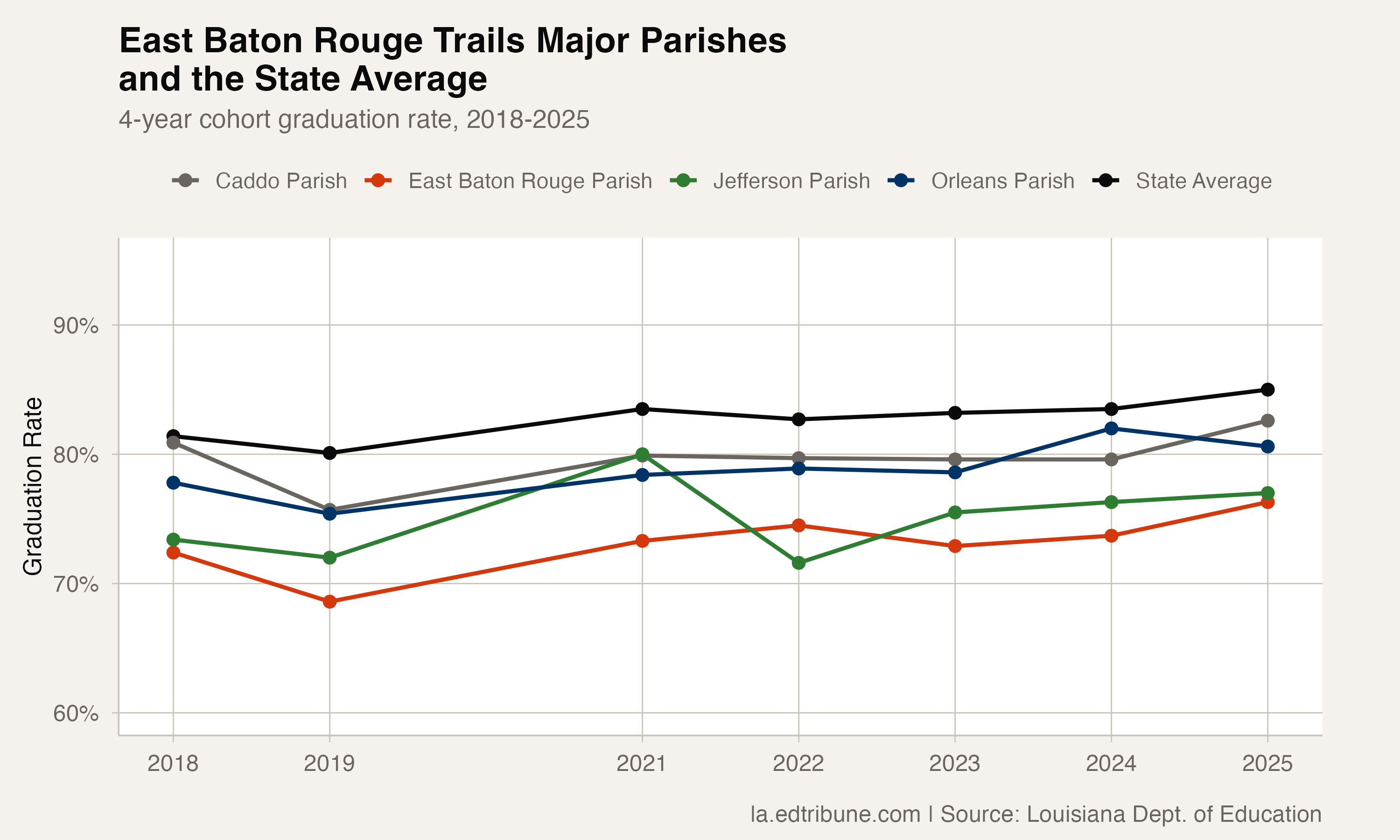
The parish graduated 76.3% of its students in 2025, a rate that sits 8.7 percentage points below the state average and lands it at the bottom of every major-parish comparison. Orleans Parish↗ET graduated 80.6%. Jefferson Parish↗ET hit 77%. Caddo Parish↗ET reached 82.6%. Calcasieu Parish↗ET posted 93.2%.
East Baton Rouge is not in crisis. Its rate has improved 3.9 points since 2018. But the rest of the state has moved faster, and the parish's pattern reveals something more frustrating than decline: stagnation.
Seven years of oscillation
The East Baton Rouge graduation rate has moved in a narrow band between 68.6% and 76.3% for seven years. It dropped from 72.4% to 68.6% in 2019, bounced to 73.3% in 2021, inched up to 74.5% in 2022, fell back to 72.9% in 2023, and has climbed to 73.7% and then 76.3% over the past two years.
The 2025 rate of 76.3% is the parish's highest on record. But it took seven years to gain 3.9 points while the state gained 3.6 points in a comparable period, meaning EBR has barely closed the gap.
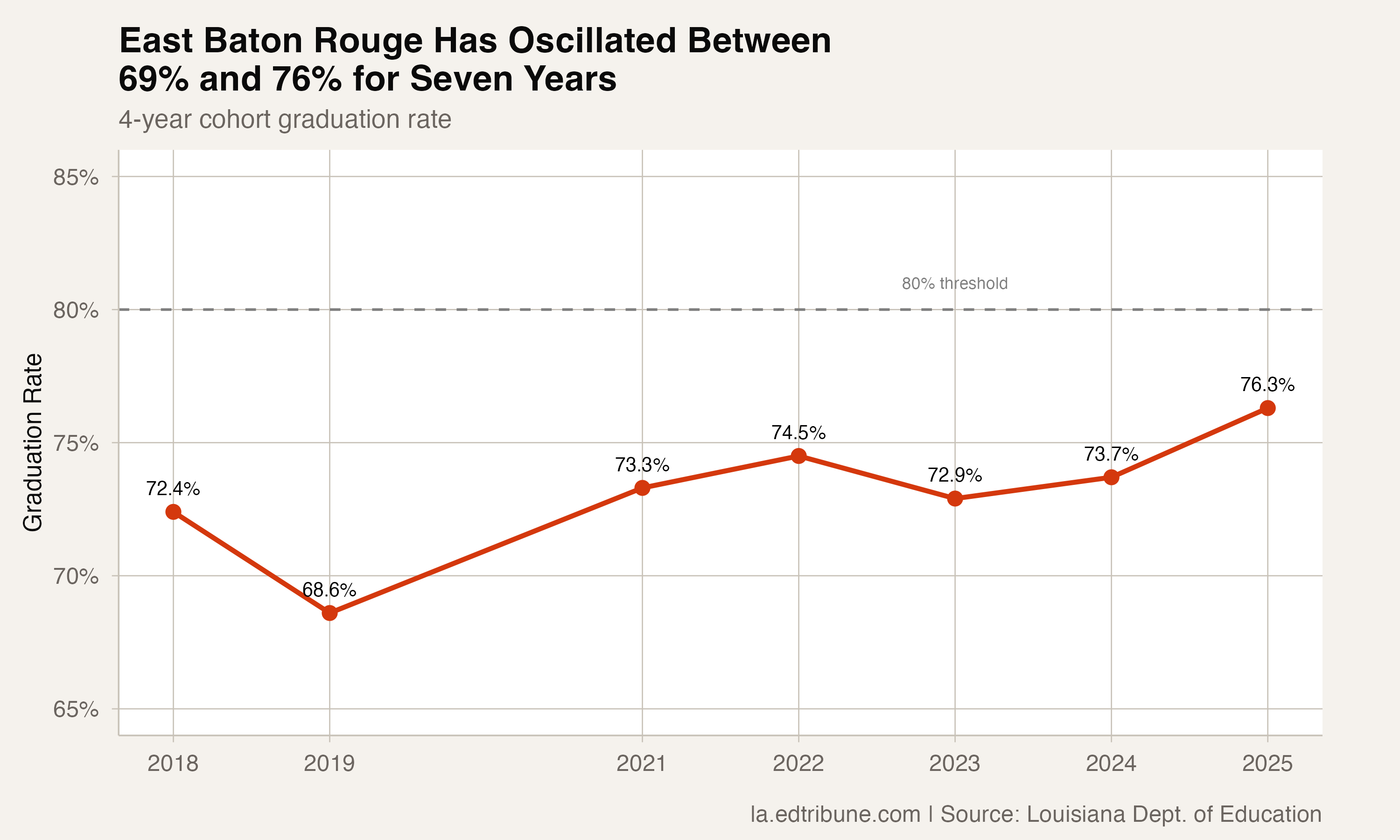
The up-down-up-down pattern is characteristic of a system where no single intervention has stuck. Two consecutive years of improvement (2024, 2025) offer some hope, but the parish has posted consecutive-year gains before (2021-2022) only to give them back.
Equity gaps inside the parish
The overall rate masks sharper disparities within the parish.
White students in East Baton Rouge graduate at 88.1%, just slightly below the state's white rate of 89.6%. Black students graduate at 77.5%, below the state's Black rate of 82.9%. The intra-parish white-Black gap of 10.6 points is wider than the statewide gap of 6.7 points.
Hispanic students face the steepest challenge. The 56.6% Hispanic graduation rate in East Baton Rouge is 16.2 points below the statewide Hispanic rate of 72.8% and nearly 20 points below the parish's overall rate. English learners graduate at an even lower 42.9%.
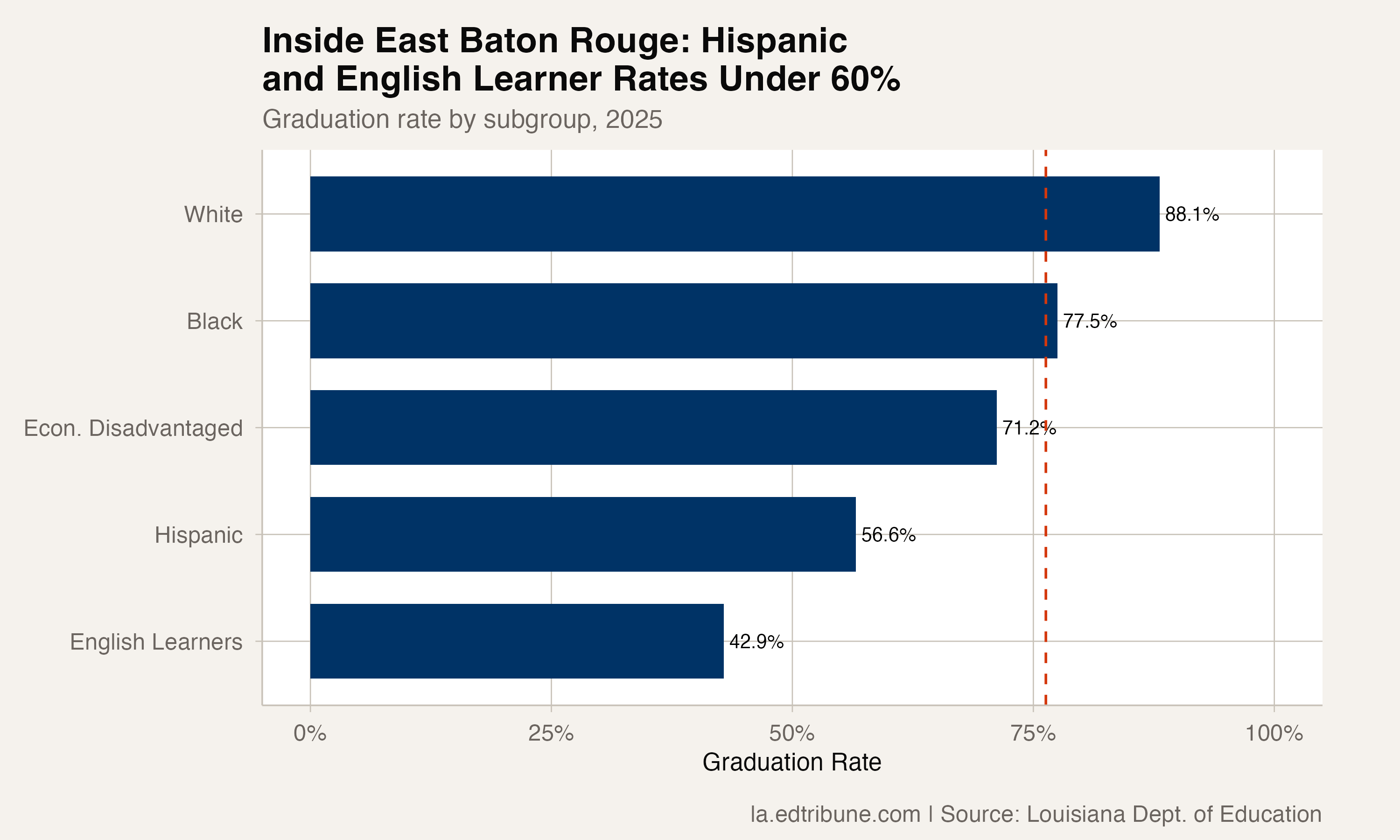
The economically disadvantaged rate of 71.2% is 9 points below the statewide econ_disadv rate of 80.2%, suggesting that poverty-related barriers operate more powerfully in East Baton Rouge than in the state as a whole.
The Recovery School District complication
East Baton Rouge's graduation data carries a structural wrinkle. The Recovery School District, which the state operated in Baton Rouge for years, appears as a separate entity in some data years. The standard "East Baton Rouge Parish" entry reflects the traditional parish school system, while "East Baton Rouge Parish - EBR and RSD" is a separate row. This analysis uses the standard parish entry, which is consistent across all years.
The RSD's presence and eventual re-consolidation may contribute to the parish's oscillating pattern. Transfers between the two systems, changes in which students are counted in which entity, and the phasing out of the RSD all introduce noise that makes it harder to identify a true underlying trend.
The 80% barrier
East Baton Rouge has never reached 80%. The 76.3% rate in 2025 is the closest it has come, and the two consecutive years of improvement suggest momentum. But the parish is still nearly 4 points from a threshold that Orleans, Caddo, and even the recovering Jefferson Parish have already crossed.
For a parish of East Baton Rouge's size, urban challenges, and demographic complexity, 76.3% is not a failing mark. It is a stubborn one.
Detailed code that reproduces the analysis and figures in this article is available exclusively to EdTribune subscribers.
Discussion
Sign in to join the discussion.
Loading comments...