Correction (May 31, 2026): An earlier version reported "five of the eight schools above 55% are traditional high schools." The correct figures are ten schools above 55%, seven of which are traditional high schools (Istrouma, Capitol, Tara, Broadmoor, Glen Oaks, McKinley, and Belaire). Scotlandville Magnet High School was incorrectly categorized as a traditional high school; Glen Oaks, McKinley, and Belaire were omitted.
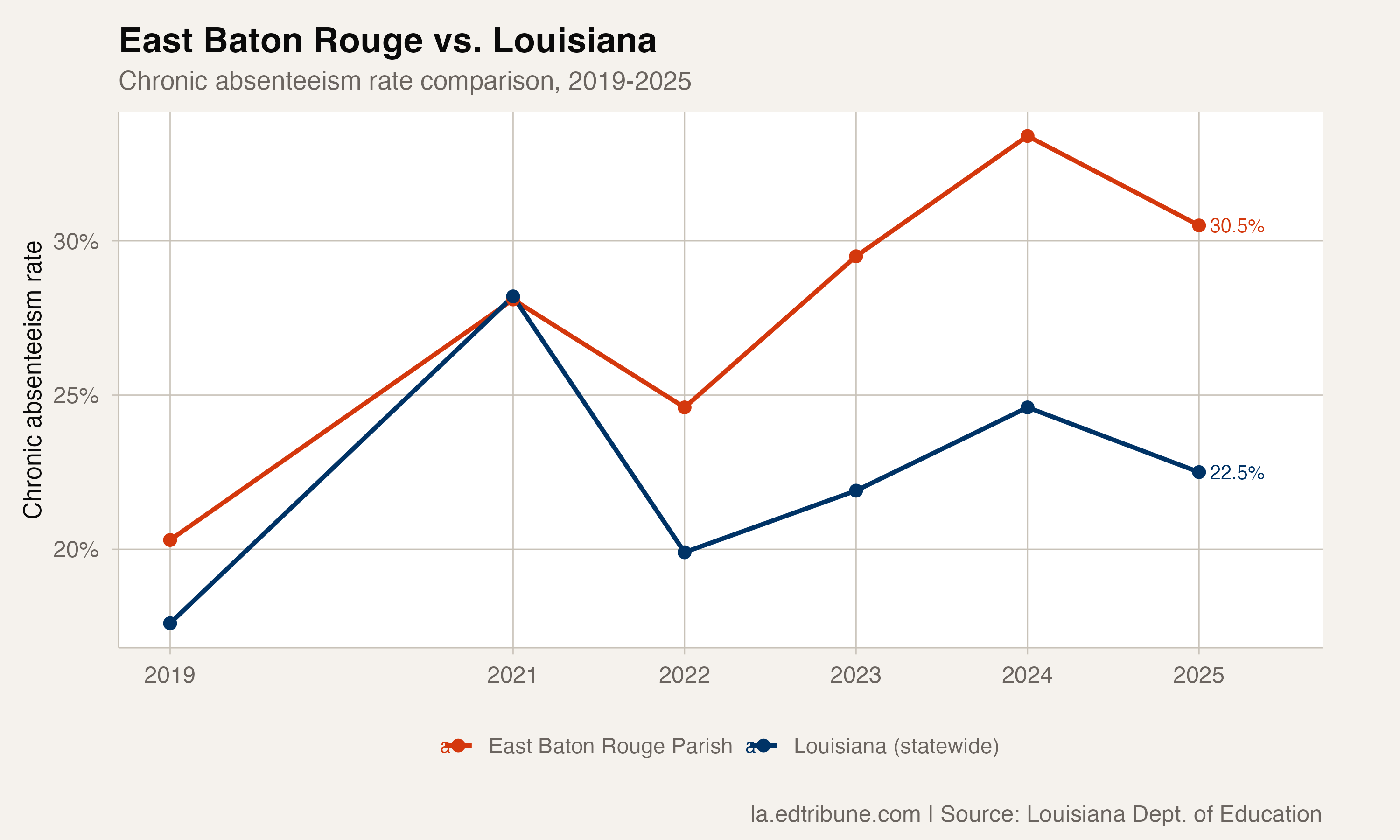
In the 2023-24 school year, one in three students in East Baton Rouge Parish↗ET was chronically absent. The 33.4% rate marked the worst on record for Louisiana's second-largest school district, and a dramatic deterioration from the 20.3% rate it posted before the pandemic.
The 2024-25 data brings the first break in that climb. EBR's rate dropped to 30.5%, a 2.9 percentage point improvement. But the parish still sits more than 10 points above its pre-COVID baseline, and the school-level numbers reveal where the crisis is concentrated.
The two Baton Rouges
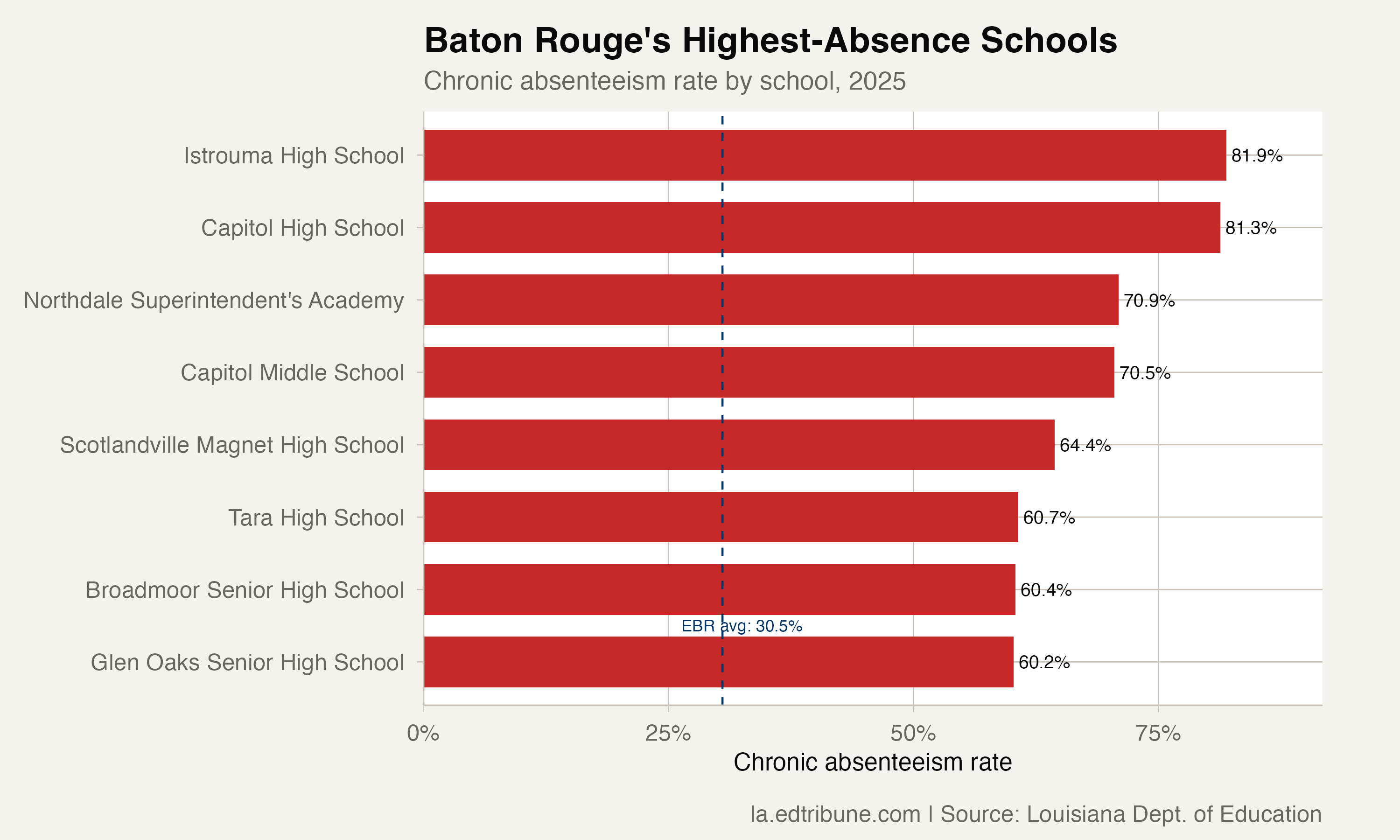
The gap between EBR's best and worst schools is staggering. Istrouma High School posted an 81.9% chronic absenteeism rate in 2025, more than four in five students missing at least 10% of the school year. Capitol High is nearly identical at 81.3%. Scotlandville Magnet High sits at 64.4%, Tara High at 60.7%, and Broadmoor Senior High at 60.4%.
At the other end: Westdale Heights Academic Magnet at 1.5%. Mayfair Laboratory School at 2.5%. Baton Rouge Magnet High at 5.8%.
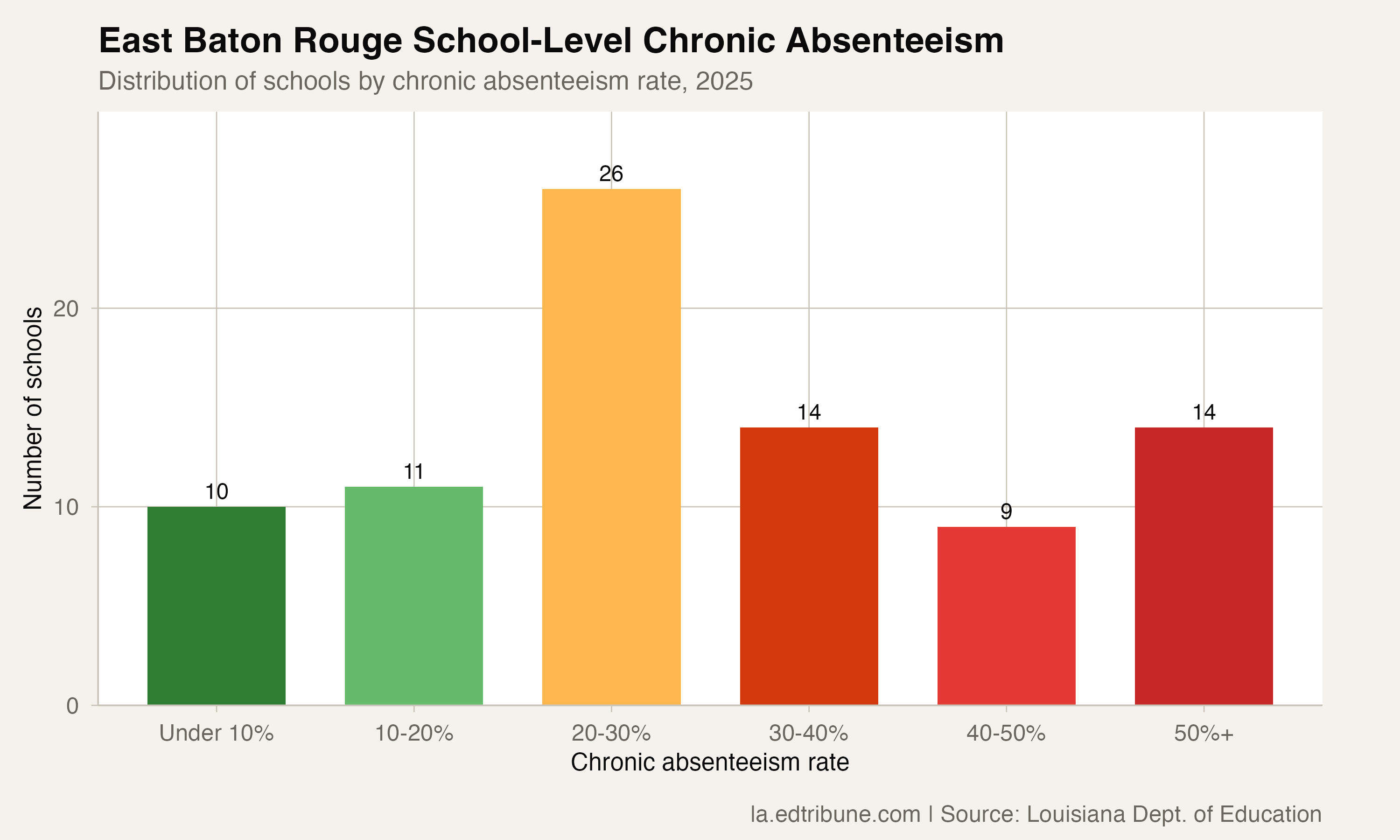
Of the parish's 84 schools with data, 14 have chronic absenteeism rates above 50%. Another 15 sit below 15%. The distribution isn't a bell curve. It's two clusters separated by a chasm.
Tracking wider than the state
EBR's chronic absenteeism rate has consistently run above the state average, and the gap widened during the post-COVID period. In 2019, the parish was 2.7 percentage points above the state's 17.6%. By 2025, that gap had grown to 8.0 points: 30.5% versus the state's 22.5%.
The trajectory diverged most sharply after 2022. While the state managed to hold relatively steady (albeit above pre-COVID), EBR kept climbing, from 24.6% in 2022 to 29.5% in 2023 to 33.4% in 2024 before the 2025 improvement.
EveryDay Labs and the 2025 improvement
EBR Schools partnered with EveryDay Labs, a research-based attendance intervention program, and the 2025 data suggests the effort may be gaining traction. The 2.9 percentage point drop outpaced the state's 2.1-point improvement, narrowing the gap slightly.
But context matters. EBR started from a higher peak, so a larger absolute drop doesn't necessarily indicate faster proportional recovery. The parish has recovered just 22.2% of the gap between its pre-COVID rate and its 2024 peak. At that pace, a full recovery would take more than a decade.
A high school problem
The worst-performing schools in EBR are overwhelmingly high schools. Seven of the ten schools above 55% are traditional high schools, not alternative programs or specialized facilities. Istrouma, Capitol, Tara, Broadmoor, Glen Oaks, McKinley, and Belaire are neighborhood high schools where the majority of enrolled students are missing significant amounts of class time.
Research consistently links chronic absenteeism at the high school level to higher dropout rates, lower graduation rates, and reduced college enrollment. At schools where 60% to 80% of students are chronically absent, the norm of daily attendance has effectively collapsed. Rebuilding that norm, one student at a time, may be the defining challenge for EBR schools in the years ahead.
The 2025 numbers offer the first evidence that the direction has started to shift. Whether a 2.9-point improvement is the beginning of sustained recovery or a one-year blip in a deepening crisis won't be clear until the 2026 data arrives.
Detailed code that reproduces the analysis and figures in this article is available exclusively to EdTribune subscribers.
Discussion
Sign in to join the discussion.
Loading comments...