In this series: Louisiana 2025-26 Enrollment.
Jefferson Parish↗ET enrolled 45,406 students in 2025-26. That is the lowest figure in the eight-year data window, and it arrived with force: a single-year loss of 2,053 students, a 4.3% drop that is more than double the statewide rate of 2.0%. The parish had appeared to stabilize between 2022 and 2025, hovering near 47,500. That stability is gone.
What makes Jefferson's decline distinct is not just its depth but its composition. The district lost students from every racial group in 2026, including a sharp reversal in Hispanic enrollment that had been the parish's only growth story for years. The decline coincides with intensified federal immigration enforcement in southeast Louisiana, a new statewide voucher program, and a shrinking pipeline of kindergartners that suggests the worst may not be over.
A plateau, then a cliff
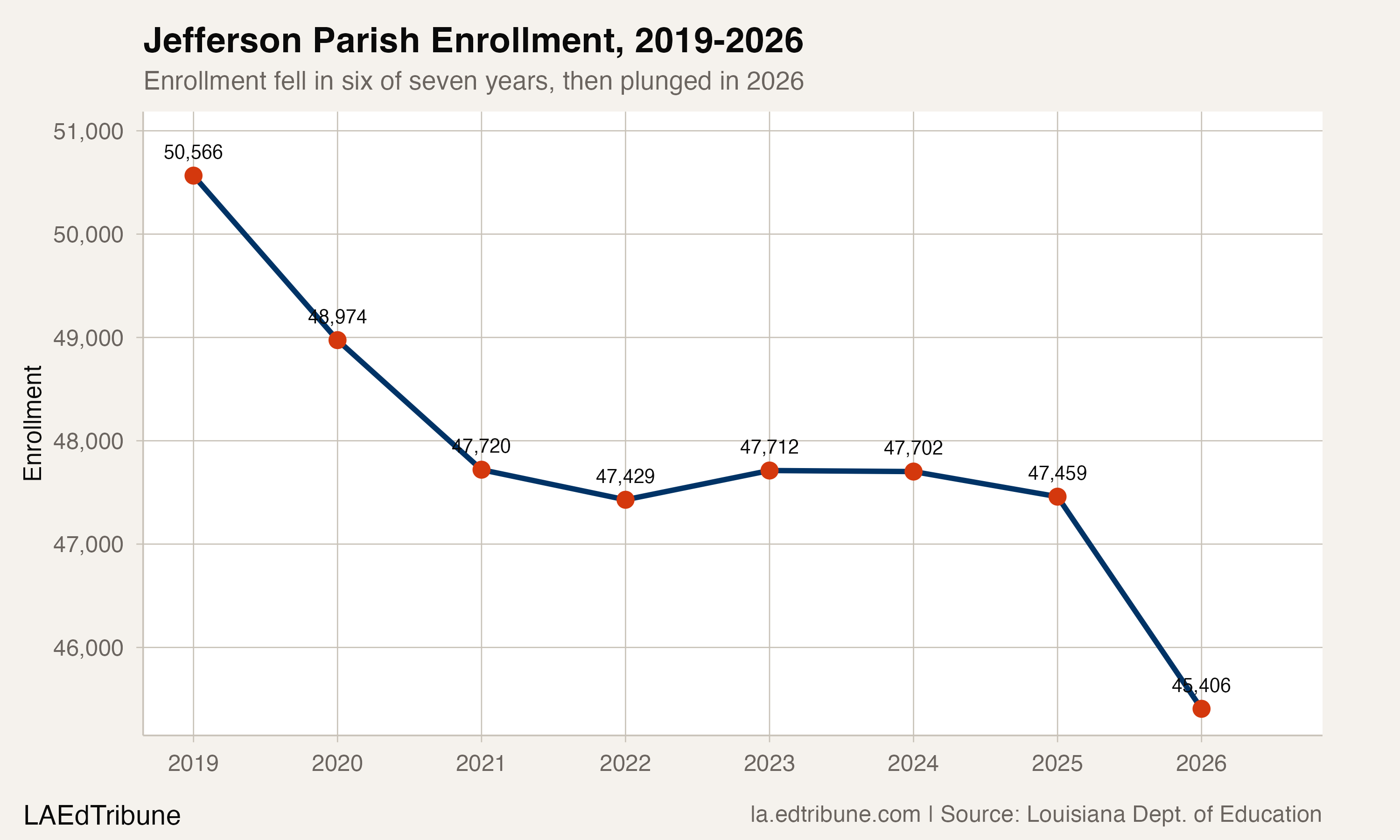
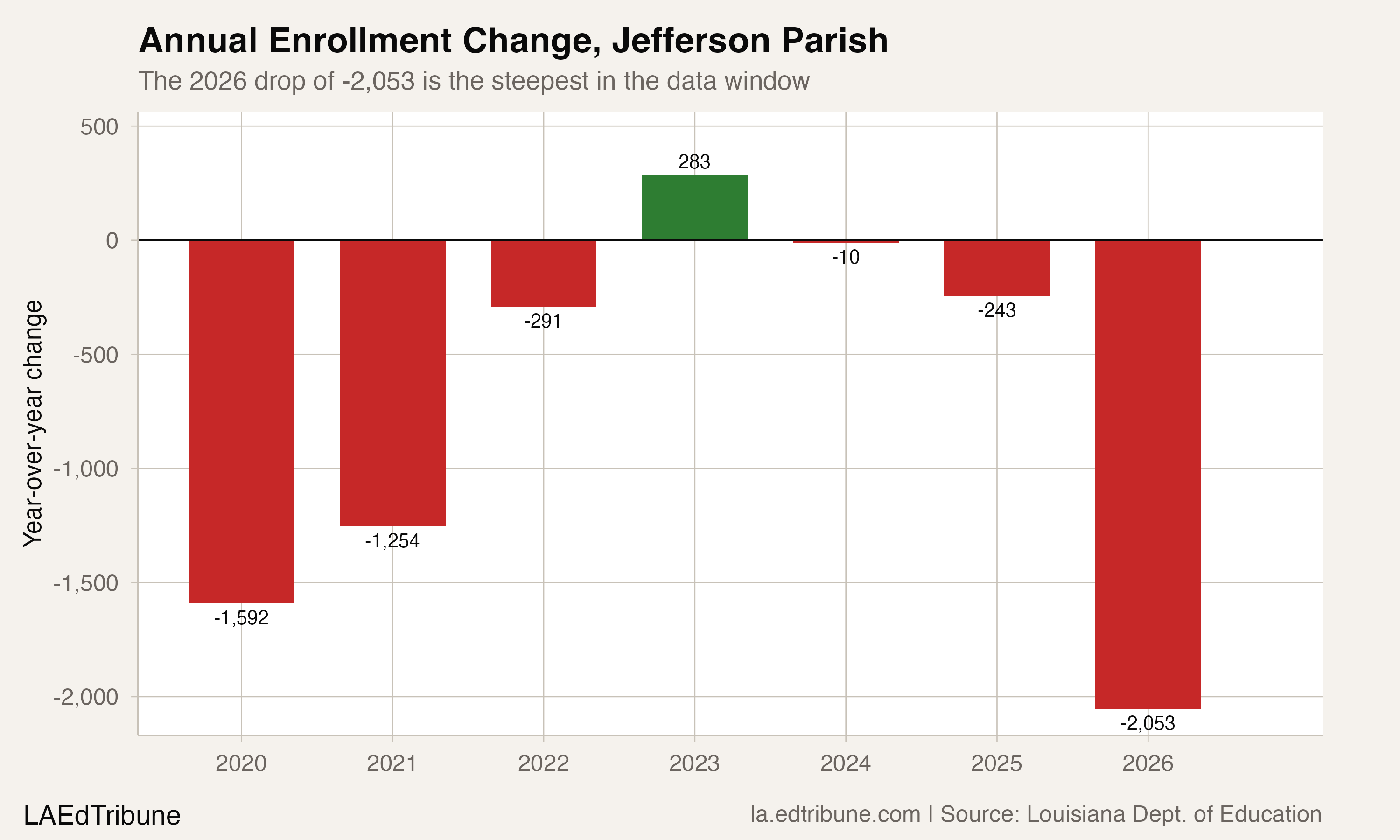
Jefferson Parish started the data window at 50,566 students in 2018-19, lost nearly 2,850 students during the pandemic's first two years, and then appeared to find a floor. Between 2022 and 2025, enrollment fluctuated in a narrow band: a small gain of 283 in 2022-23, a negligible loss of 10 the following year, and a modest decline of 243 in 2024-25. For a district watching peers like Caddo Parish↗ET lose 14.8% over the same span, Jefferson's post-pandemic plateau looked almost like resilience.
The 2025-26 data ended that reading. The 2,053-student drop is the steepest single-year loss in the data window, exceeding even the pandemic-year decline of 1,592. Since 2019, the parish has lost 5,160 students, a 10.2% decline that erases all of the enrollment growth the district had accumulated during the 2012-2019 expansion.
Jefferson remains Louisiana's largest traditional school district at 45,406 students, ahead of East Baton Rouge Parish↗ET at 38,008 and St. Tammany Parish↗ET at 35,375. But the gap is narrowing. Jefferson's share of statewide enrollment fell from 7.9% in 2019 to 6.9% in 2026.
The 2026 reversal nobody expected
The most striking feature of the 2026 data is not that white or Black enrollment continued to fall. Those trends have been consistent for years. It is that Hispanic enrollment, which had grown from 15,888 in 2019 to a peak of 18,705 in 2023-24, dropped by 1,369 students in a single year, falling to 17,239. That is a 7.4% one-year decline in a population that had been growing at roughly 3-4% annually.
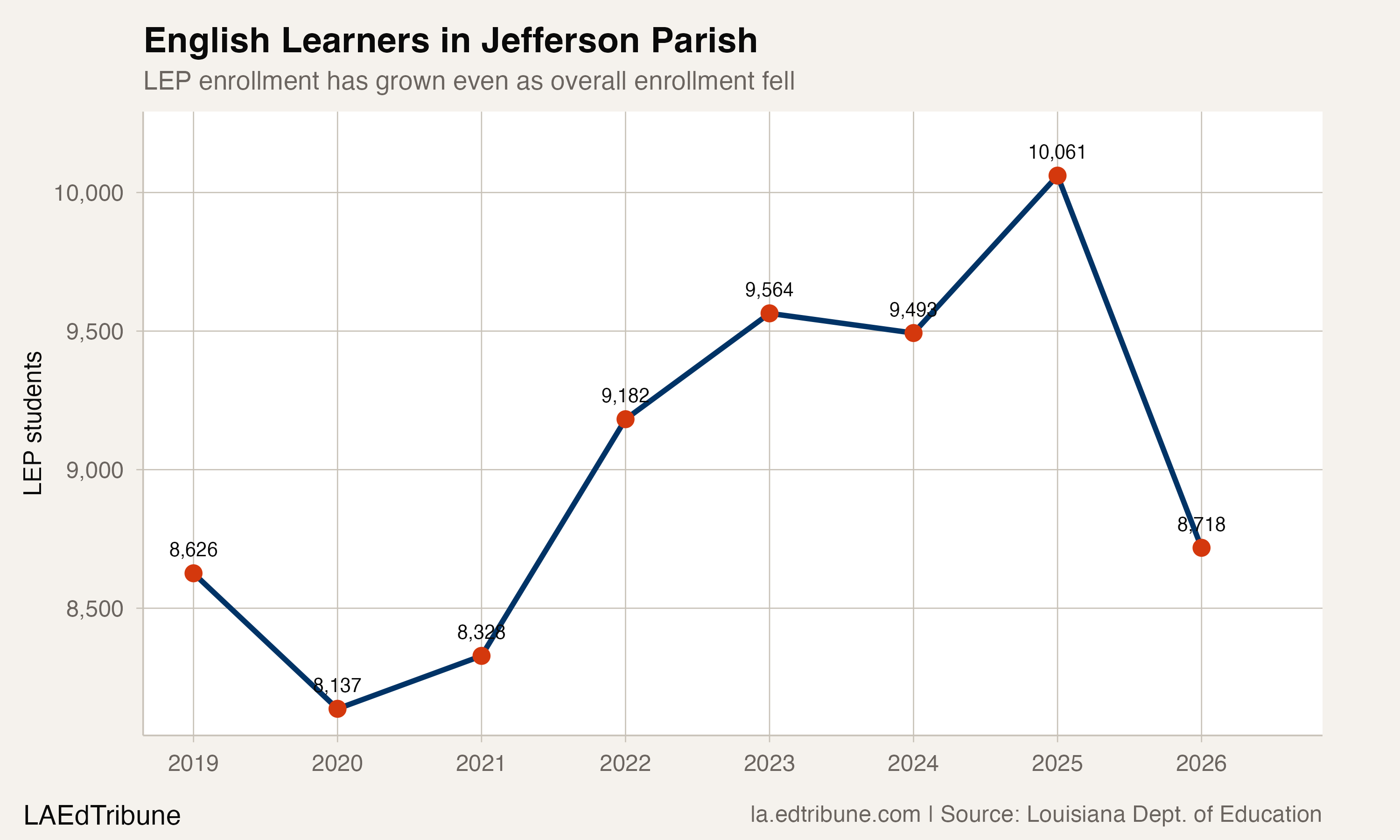
Separately, the English learner population, which overlaps heavily with Hispanic students, showed a parallel collapse. LEP enrollment peaked at 10,061 in 2024-25 and fell to 8,718 in 2025-26, a loss of 1,343 students (13.3%). At 19.2% of total enrollment, Jefferson's English learner concentration remains nearly four times the statewide rate of 5.0%.
The timing aligns with Operation Catahoula Crunch, the intensified federal immigration enforcement action in southeast Louisiana that began in December 2025. Jefferson Parish is the epicenter: the Jefferson Parish Correctional Center led the state in ICE detainer requests during the first 10 months of 2025, and the Kenner city jail ranked second. About 5,400 Jefferson Parish students, roughly 12% of the district, were absent the day after the crackdown started, according to attendance data reported by WWLTV. At Terrytown Elementary, where 79% of students are Hispanic, 41% did not come to school that first Monday.
Whether the enrollment drop reflects families who left the parish, families who withdrew from public schools, or families who were counted on a low-attendance day is unclear from the data. But the scale of the Hispanic and LEP reversals, both of which are unprecedented in the data window, is consistent with the fear-driven withdrawal that educators across the region described in late 2025.
"Many people are terrified to come out." -- Louisiana Illuminator, Dec. 2025
A different district than seven years ago
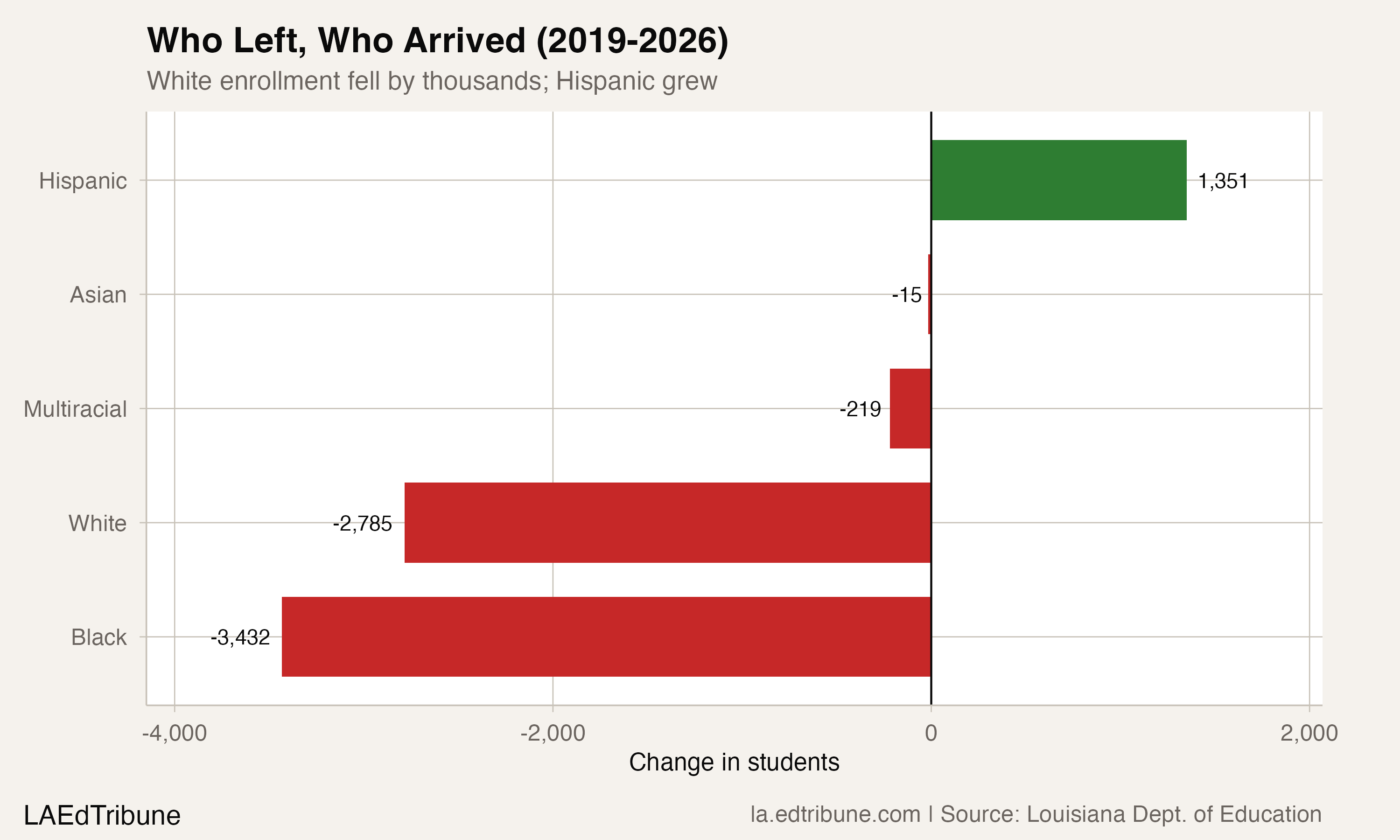
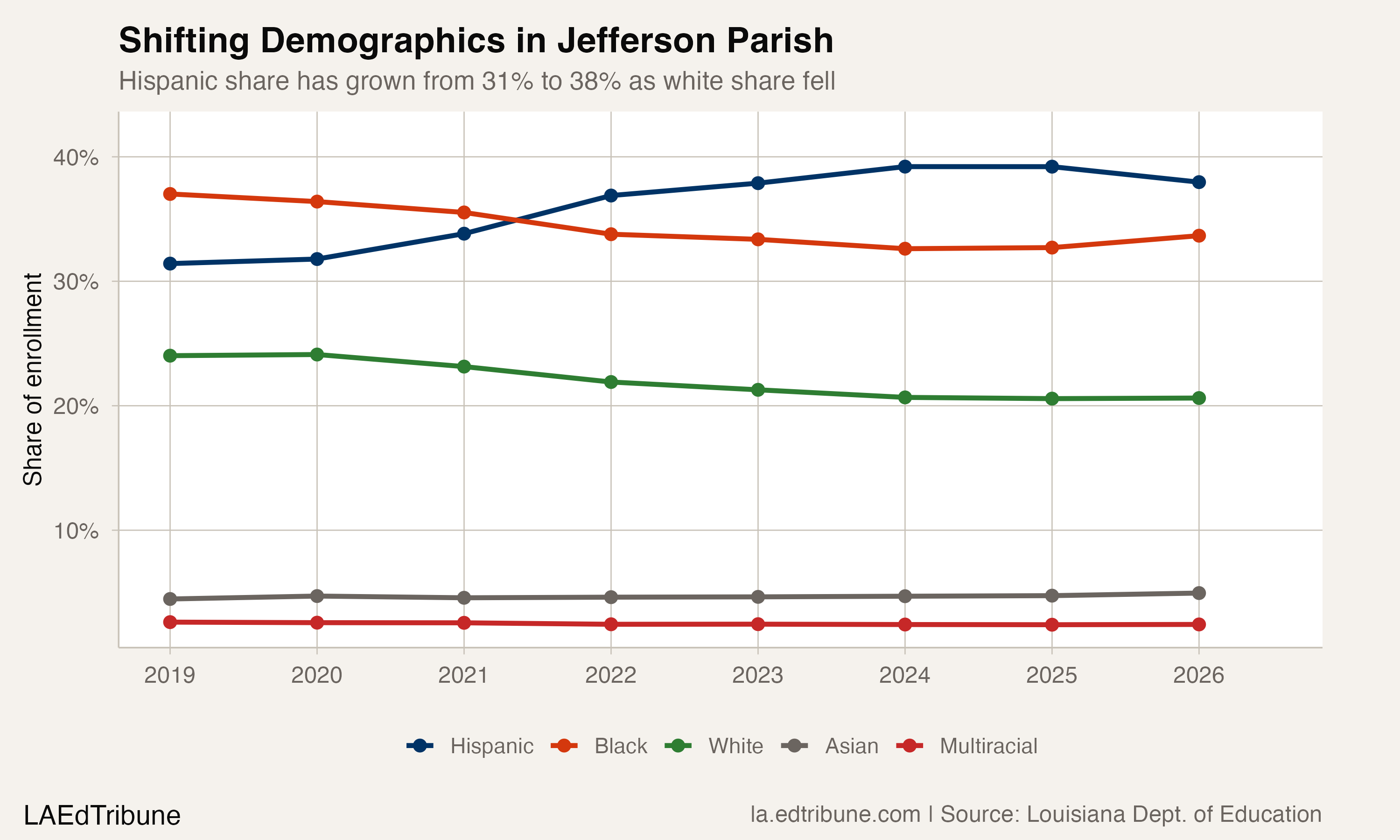
Even with the 2026 Hispanic reversal, the long-term demographic transformation of Jefferson Parish is unmistakable. Since 2019, Black enrollment has fallen by 3,432 students (18.3%), the largest absolute loss of any group. White enrollment has dropped by 2,785, a 22.9% decline that is steeper in percentage terms than the Black loss. Hispanic enrollment is still up 1,351 (8.5%) net over the period, and Hispanic students now make up 38.0% of the district, up from 31.4% in 2019. Black enrollment fell from 37.0% to 33.7% of the total. White enrollment fell from 24.0% to 20.6%.
This shift mirrors the broader community. Jefferson Parish's Hispanic population grew from 7% in 2000 to 18.2% by 2023, driven by Honduran, Mexican, and Cuban families drawn to Kenner and the West Bank by affordable housing and construction-sector jobs after Hurricanes Katrina, Laura, Delta, and Ida. The parish gained about 25,400 Hispanic residents in the 2010s, a larger jump than any other parish in the state saw in two decades.
The result is a school system that serves a fundamentally different population than its facilities were built for. Jefferson's English learner concentration, at 19.2%, means nearly one in five students is classified as limited English proficient. The instructional programs these students receive carry higher per-pupil costs, and the district's Office of Multilingual Learning relies on a combination of certified ESL teachers and bilingual paraprofessionals to deliver instruction.
Seven schools closed, more likely ahead
Jefferson Parish has already been consolidating in response to declining enrollment. A 2023 restructuring plan driven by consultants closed six schools, relocated two others, and built two new pre-K through eighth-grade campuses. A seventh school, George Cox Elementary, closed at the end of 2024-25.
The closures drew a federal civil rights investigation after the Southern Poverty Law Center alleged that the shuttered schools disproportionately served Black and Hispanic students. Board members have warned that more closures will be necessary as the enrollment base continues to erode. An additional 2,053 students lost in a single year will accelerate that timeline.
The kindergarten pipeline offers no relief. Jefferson enrolled 3,324 kindergartners in 2025-26, down 13.7% from 3,853 in 2018-19. Louisiana as a whole recorded about 10,000 fewer births in 2024 than a decade earlier, a 17% decline. Jefferson Parish itself lost more than 7,000 residents between 2020 and 2024, with nearly two-thirds of Louisiana's parishes losing population in that span.
A new pressure arrived in fall 2025: the LA GATOR Scholarship Program, Louisiana's first education savings account initiative, which served roughly 6,000 students statewide with an average account value of $7,250 in its first year, funded through the state's public school funding formula. The program is set to reach universal eligibility by 2027-28. Its impact on Jefferson Parish enrollment is not yet isolable in the data, but the direction of the incentive is clear: it gives families who are already leaving an additional mechanism to do so with public funding attached.
What the next count will reveal
The 2026-27 school year will be the first full year under the combined pressure of expanded vouchers, continued immigration enforcement, and a shrinking birth cohort. Jefferson's 2026 loss of 2,053 students came after three years of near-stability.
Between 2021 and 2024, Hispanic families arriving in Jefferson Parish partially offset the departure of white and Black students. That counterweight masked the underlying erosion. The 2026 data removed the mask: Hispanic enrollment fell 1,369 in a single year, and suddenly Jefferson's total loss rate matched Caddo's. At Terrytown Elementary, where 79% of students are Hispanic and 41% stayed home the Monday after Operation Catahoula Crunch began, the enrollment numbers capture something real about what happens when a community's sense of safety collapses. Whether those families come back will shape Jefferson Parish's next decade.
Detailed code that reproduces the analysis and figures in this article is available exclusively to EdTribune subscribers.
Discussion
Sign in to join the discussion.
Loading comments...