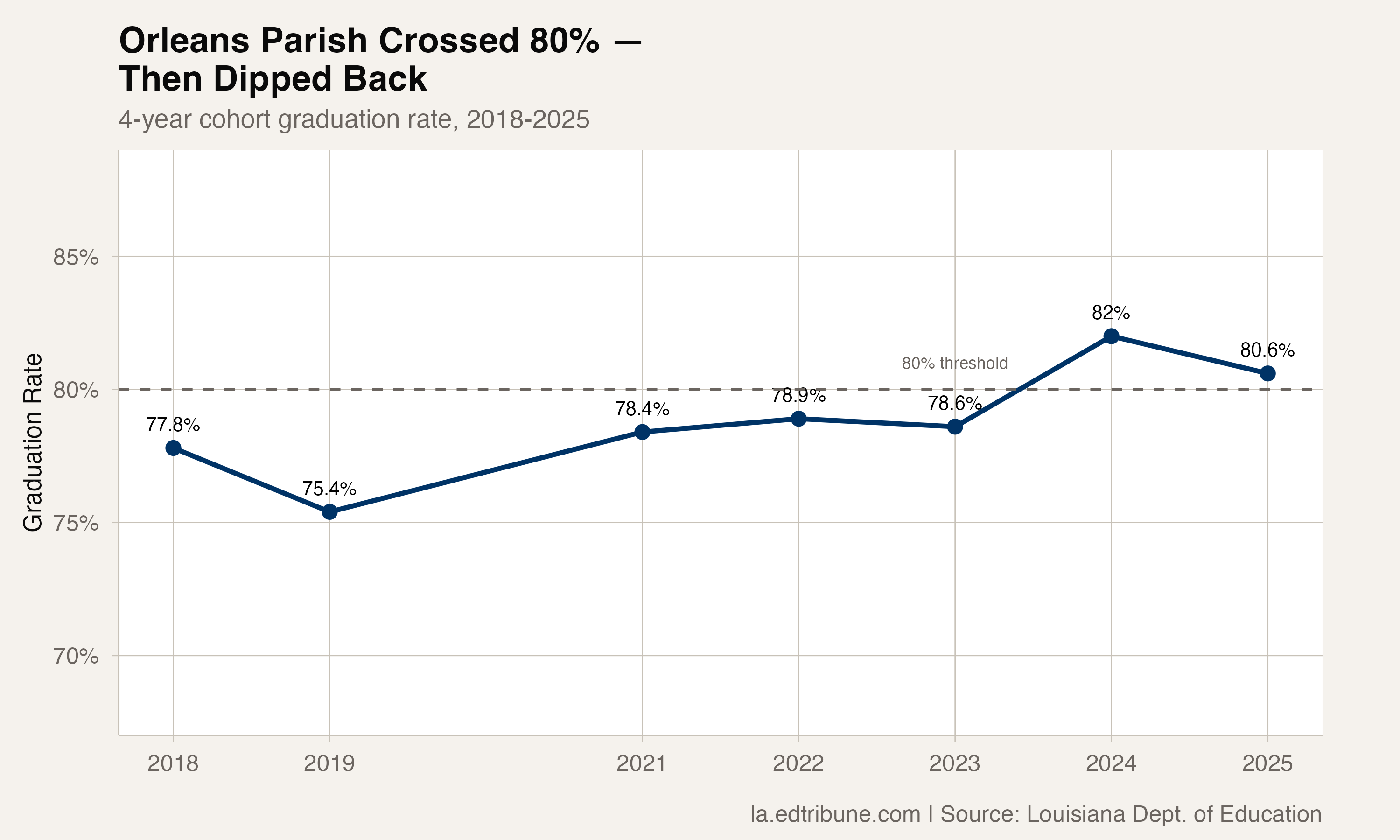
Orleans Parish↗ET crossed 80% for the first time in 2024, posting an 82% graduation rate that represented the all-charter district's highest mark on record. In 2025, the rate settled to 80.6%, a slight retreat but still above the threshold that eluded the parish for years.
The trajectory from 75.4% in 2019 to 80.6% in 2025 represents meaningful progress for a school system rebuilt from scratch after Hurricane Katrina. Twenty years into the all-charter experiment, New Orleans is graduating four out of five students.
But the aggregate masks one of the widest equity gaps of any major parish in Louisiana.
The gap inside Orleans
White students in Orleans Parish graduated at 95% in 2025, a rate that would rank among the highest parish rates in the state if it were the overall number. Black students graduated at 81.8%, closely tracking the parish average.
Hispanic students graduated at 61.3%.
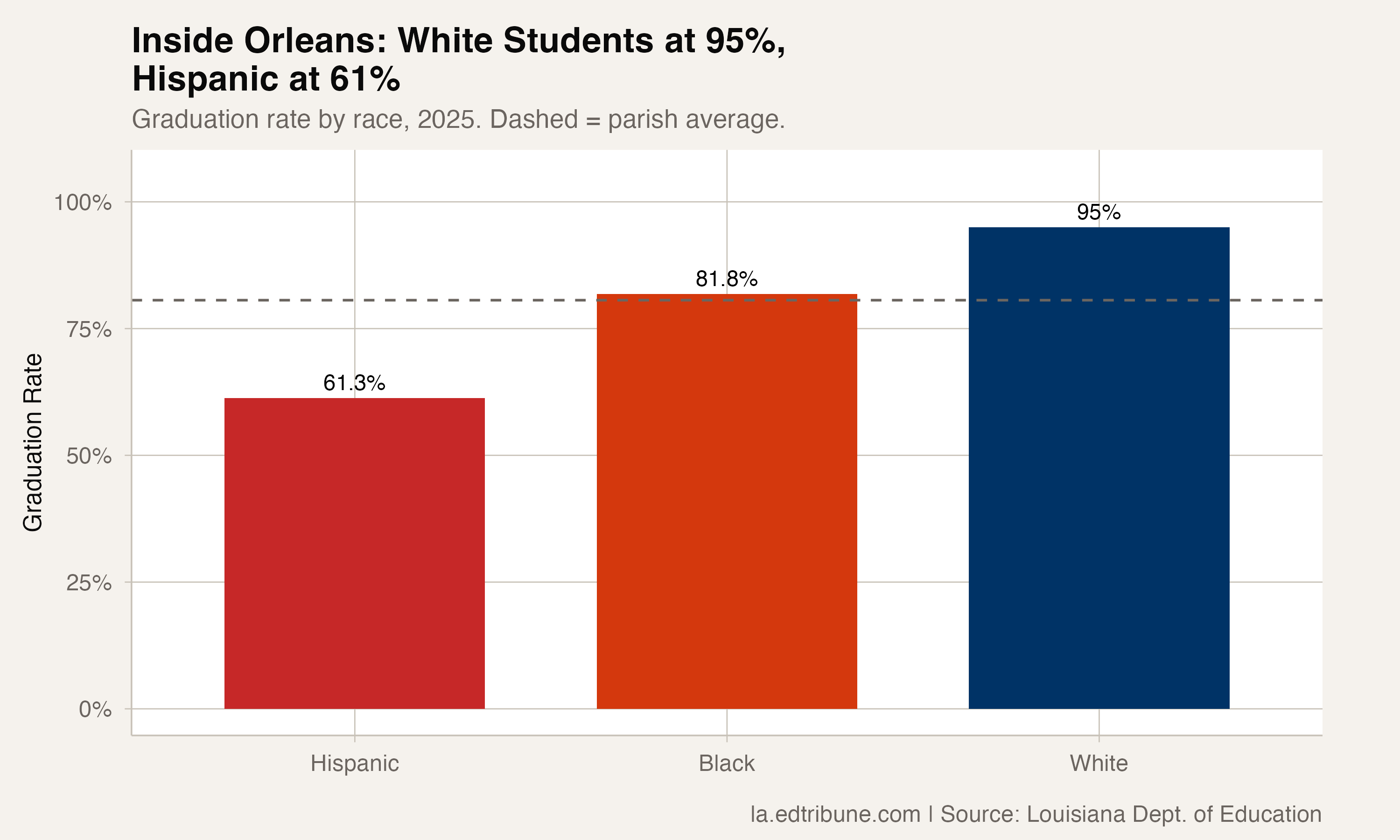
The 33.7-point gap between white and Hispanic students within a single school district is extraordinary. It exceeds the statewide white-Hispanic gap (16.8 points) by nearly double. English learners in Orleans graduated at an even lower 44.9%.
A volatile Hispanic trajectory
The parish-level Hispanic graduation rate in Orleans has been wildly unstable:
- 2018: 44.9%
- 2019: 46.5%
- 2021: 60.5%
- 2022: 59%
- 2023: 55.1%
- 2024: 69.8%
- 2025: 61.3%
The rate jumped 14 points in 2021, held near 60%, collapsed to 55% in 2023, surged to nearly 70% in 2024, then fell back to 61% in 2025. The swings are large enough to suggest a small cohort where individual outcomes move the rate by double digits.
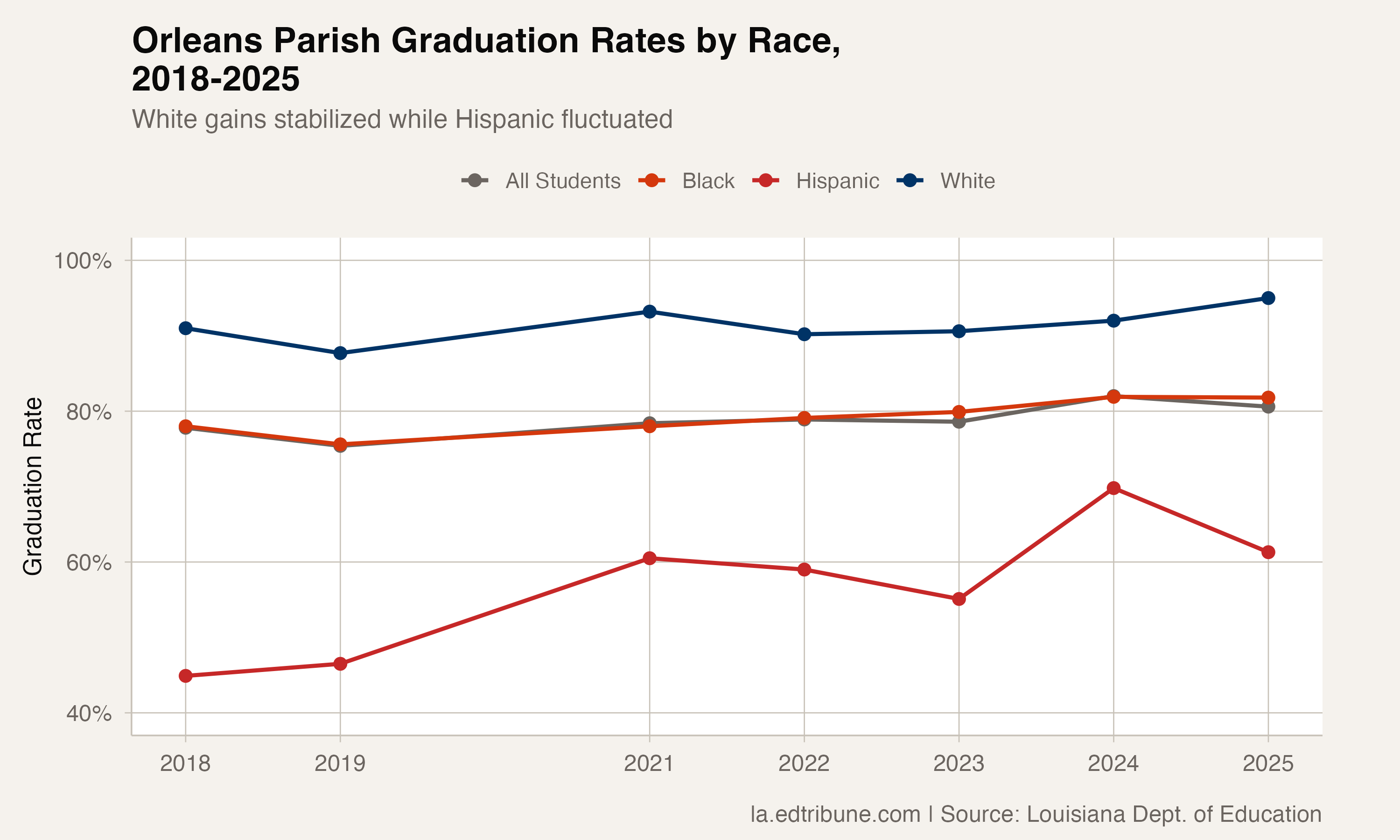
The Hispanic trajectory in Orleans stands in sharp contrast to the Black trajectory, which has climbed steadily from 78% to 81.8% over the same period. Black students in Orleans now graduate at rates close to the state Black average (82.9%). Hispanic students in Orleans graduate at rates far below both the state Hispanic average (72.8%) and the parish's own overall rate.
The charter system context
Orleans Parish operates as an all-charter system under NOLA Public Schools. The 80% milestone carries particular significance because it demonstrates that a fully decentralized school model can produce competitive graduation outcomes at the aggregate level.
The equity challenge is a harder test. Charter systems are designed around school choice and competition, mechanisms that may work well for families with the information and resources to navigate the system. Hispanic families, particularly those with limited English proficiency, may face higher barriers to accessing the highest-performing charter options.
The 44.9% LEP graduation rate in Orleans reinforces this concern. Language access in a choice-based system is a structural issue that individual school improvement cannot solve.
Still trailing the state
At 80.6%, Orleans sits 4.4 points below the state average of 85%. The gap has widened slightly from 3.6 points in 2018 (when the state was at 81.4%), meaning Orleans has improved at roughly the same pace as the state rather than closing ground.
For a parish that has attracted national attention and significant philanthropic investment over two decades, 80.6% is progress but not the vindication that reform advocates might have hoped for. The more telling metric may be the equity gaps within, where the distance between the best-served and worst-served students is wider in Orleans than in almost any other Louisiana parish.
Detailed code that reproduces the analysis and figures in this article is available exclusively to EdTribune subscribers.
Discussion
Sign in to join the discussion.
Loading comments...