In this series: Louisiana 2025-26 Enrollment.
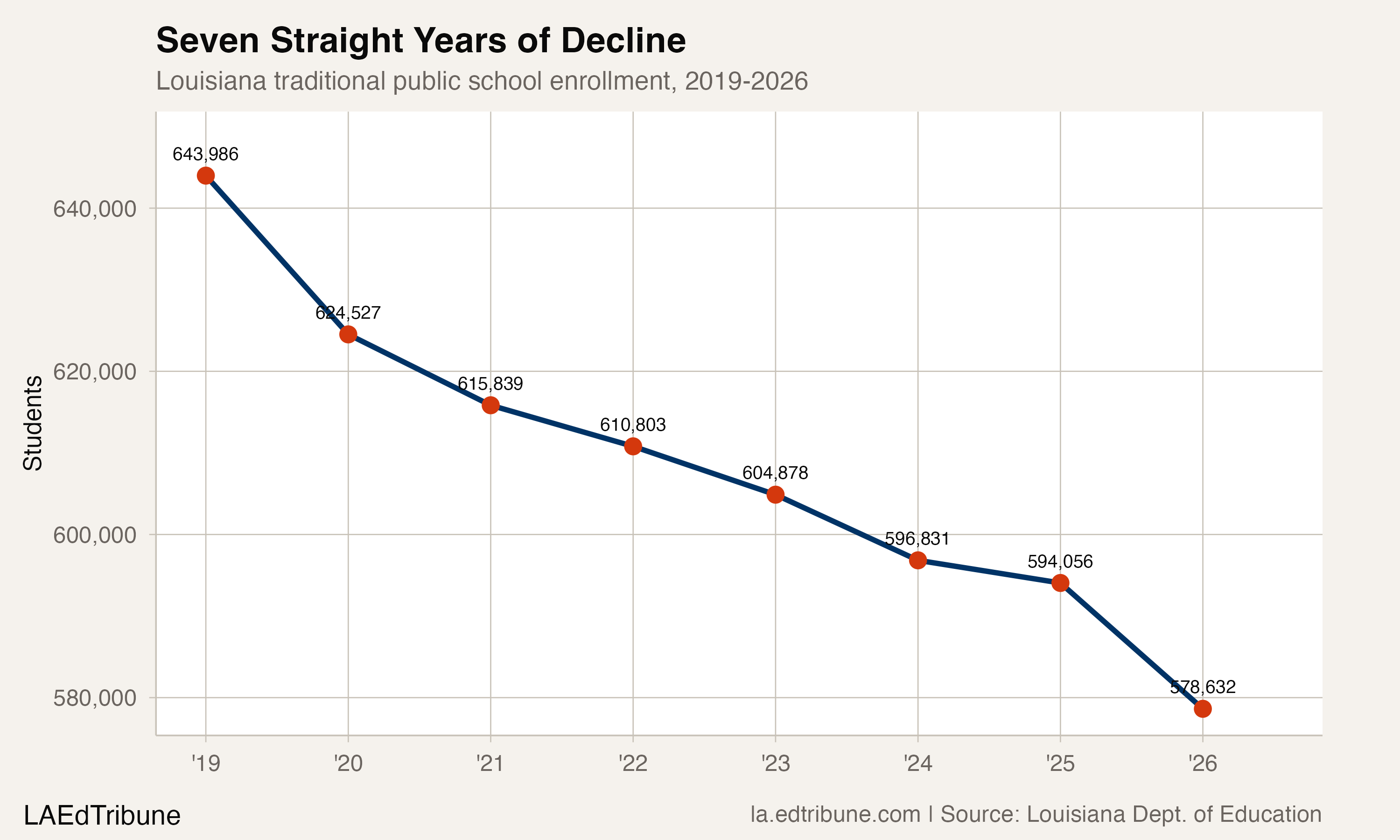
Of Louisiana's 74 traditional parishes with complete enrollment records stretching back to 2019, six managed to hold steady or gain students over those seven years. Six out of 74. Livingston Parish↗ET added 232. Ascension Parish added 13. The other 68 parishes lost ground, and the state as a whole shed 65,354 students from its traditional public schools, a decline of 10.1%.
There has not been a single year of recovery. Not after the worst of COVID passed. Not after the economy reopened. Every year from 2020 through 2026 posted a loss, and the 2025-26 school year brought the steepest post-pandemic drop yet: 15,424 students gone in a single year, a 2.6% decline.
The acceleration no one expected
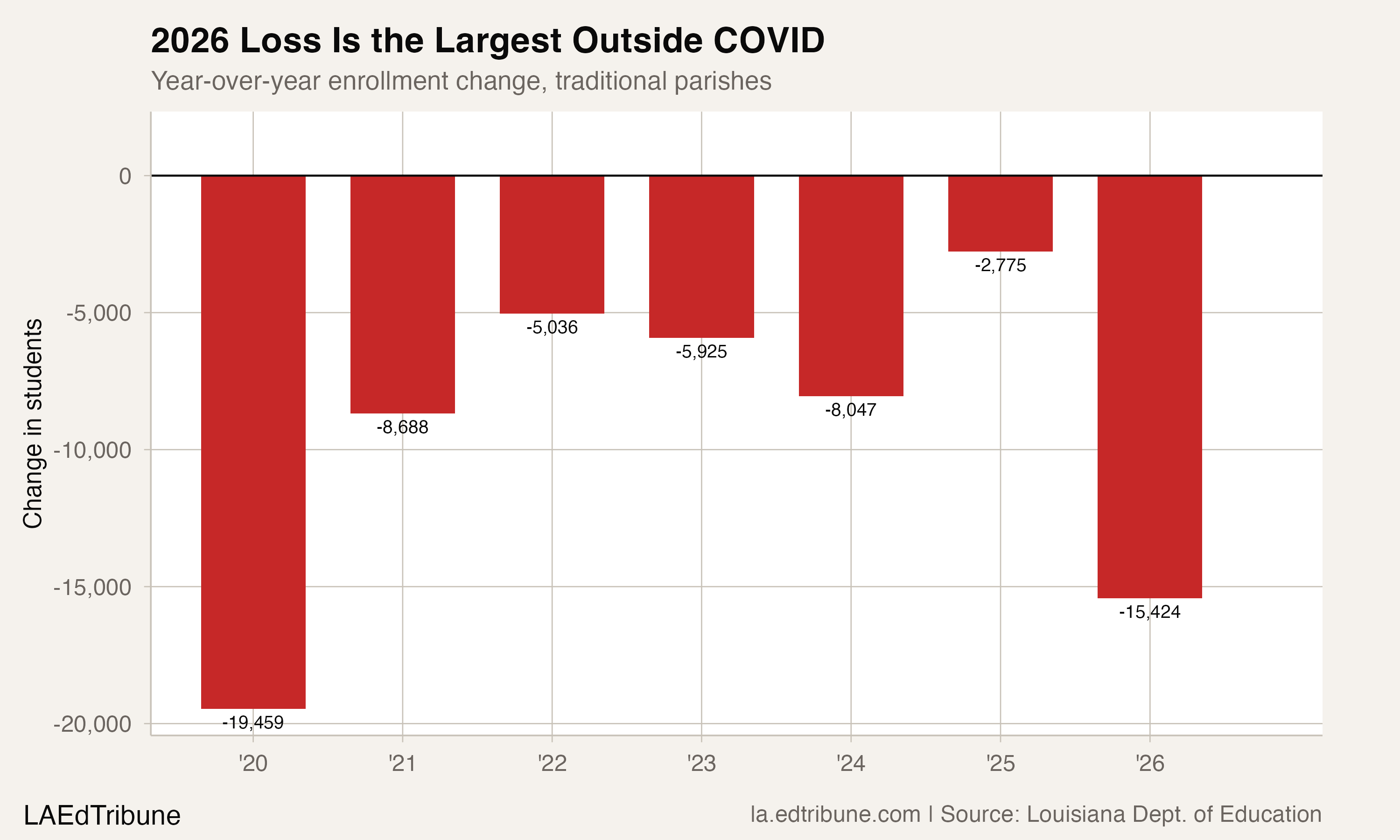
The annual losses followed a pattern that, until 2025-26, suggested stabilization. The largest single-year drop came in 2019-20, when 19,459 students disappeared, a loss that predates COVID and reflects structural population decline already underway. The pandemic year (2020-21) added another 8,688 to the deficit. From there, losses decelerated: 5,036 in 2022, 5,925 in 2023. By 2024-25, the annual loss had shrunk to just 2,775, less than half a percent. Superintendents across the state had reason to believe the worst was over.
Then 2025-26 arrived. The 15,424-student loss is more than five times larger than the previous year's drop and the second-largest annual loss in the eight-year data window. Only the 2019-20 figure was worse.
The pattern resembles what engineers call a dead cat bounce. After a sharp initial drop, the system appeared to recover, losses shrank, and a brief plateau formed. But the underlying structural forces never reversed. They compounded. And the 2026 collapse suggests the plateau was not a floor but a pause.
Where the students disappeared
The losses are not concentrated in any one corner of the state. Caddo Parish↗ET, anchoring northwest Louisiana, lost 5,611 students since 2019, a 14.8% decline. Jefferson Parish↗ET, the state's largest traditional district, lost 5,160 (10.2%). East Baton Rouge Parish↗ET lost 3,629 (8.7%). Of the 10 largest parishes by enrollment, seven recorded their lowest enrollment in the data window in 2026. Calcasieu, Livingston, and Ascension are exceptions.
Statewide, 55 of 75 traditional parishes, 73.3%, hit all-time lows in 2025-26.
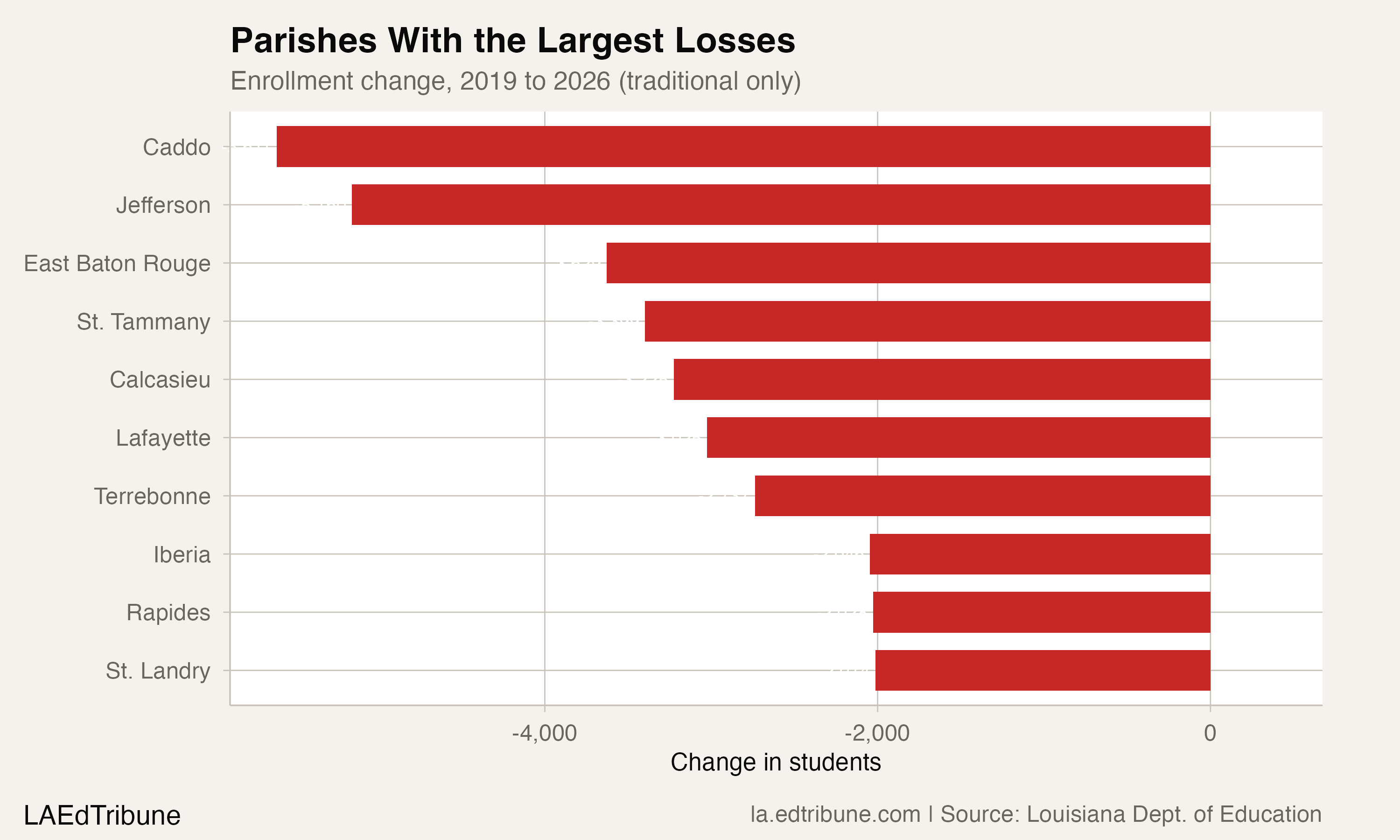
The rate of loss varies geographically but the direction does not. Small rural parishes in north and central Louisiana lost the highest percentages: West Carroll Parish dropped 29.4%, Catahoula Parish 28.0%, and the City of Bogalusa school system 27.6%. In a state where per-pupil funding follows students, each departure compounds the fiscal strain on the students who remain.
Calcasieu Parish↗ET stands out as a partial exception. After Hurricane Laura devastated Lake Charles in August 2020 and drove enrollment down by 3,614 students in a single year, the parish partially recovered, climbing from a low of 27,681 in 2021 back to 28,654 in 2026. But even with that recovery, Calcasieu remains 3,225 students below its 2019 level, a 10.1% decline.
An emptying pipeline
The age structure of the loss points to a problem that will not self-correct. Kindergarten enrollment across traditional parishes fell from 48,556 in 2019 to 41,885 in 2026, a 13.7% decline. Grade 12 enrollment fell by just 4.5% over the same period. The ratio of kindergartners to 12th graders dropped from 120 to 108. Fewer children are entering the system than are exiting it, and the gap between inflows and outflows is not narrowing.
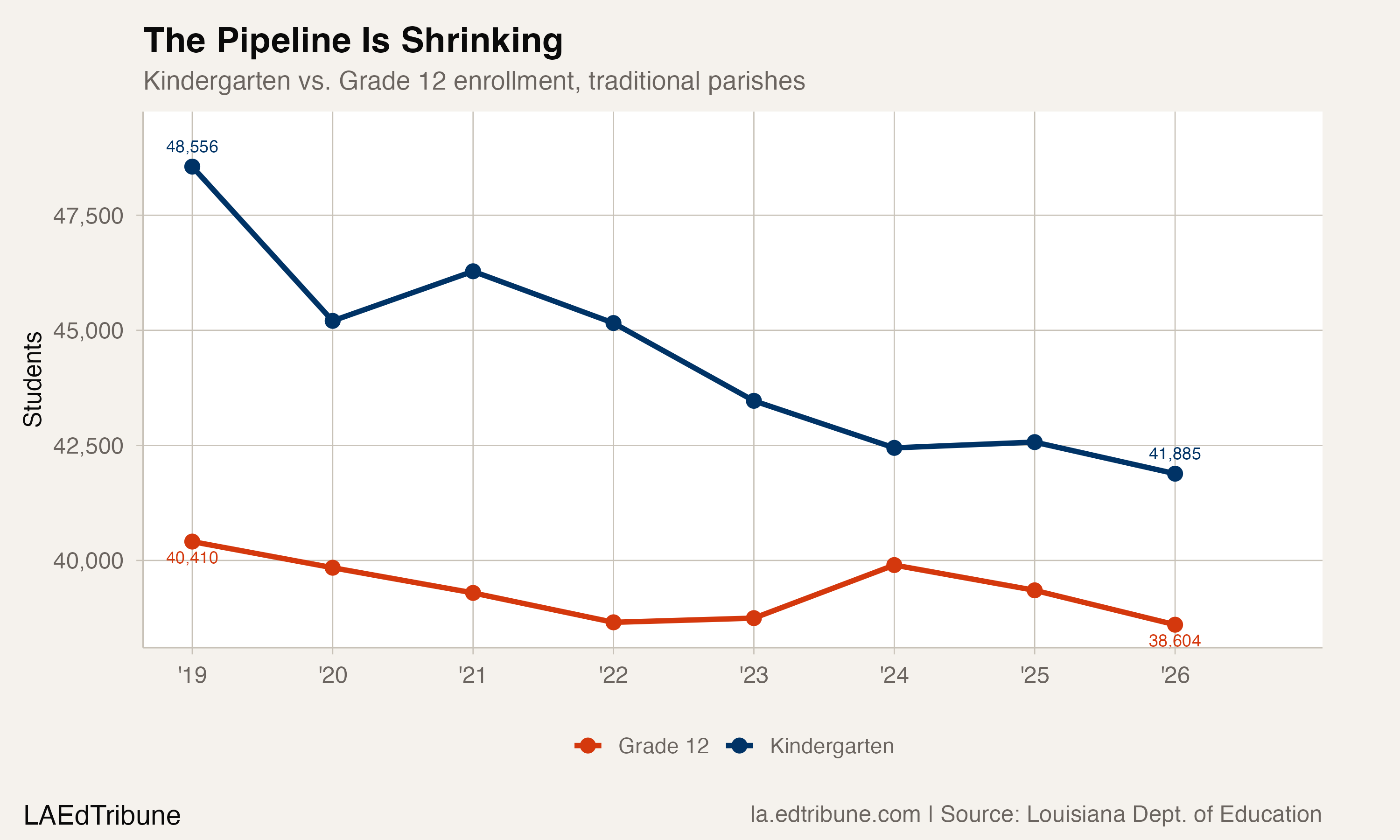
This means the current losses are locked in for at least a decade. A student who did not enter kindergarten in 2025 will not appear in first grade in 2026 or in 12th grade in 2037. The pipeline is shrinking from the bottom, and the larger graduating classes of the next several years will widen the gap further before it has any chance of closing.
Three forces, one direction
No single factor explains a 65,000-student decline. The most likely drivers are reinforcing each other.
The strongest evidence points to population loss. Louisiana lost more than 84,000 residents between 2020 and 2023, with its population peaking at 4.65 million in 2020 and declining each year through 2023. In 2024, population dropped in two-thirds of Louisiana's parishes, with Caddo and Orleans among the top five counties nationally for losses among those with 100,000 or more residents. Allison Plyer, chief demographer at The Data Center, put it bluntly:
"Louisiana has had one of the weakest economies in the country for decades now. It's not surprising that we're losing population." -- Red River Radio, March 2025
State Superintendent Cade Brumley has framed the decline as demographic rather than educational, telling The Advocate that "the drop in enrollment isn't necessarily an educational issue" and that "people are leaving the state." The Census data supports this interpretation, but it is not the only factor.
Homeschooling has also grown steadily. The state registered roughly 13,672 homeschool students in 2019 and 17,241 in 2024, a 74% increase over the past decade that now accounts for about 6% of school-aged children. That gain of roughly 3,500 students since 2019 explains a fraction of the 65,000 lost. It is a contributing factor, not the primary one.
The newest variable is school choice policy. Louisiana's LA GATOR Scholarship Program, a universal education savings account launched in 2025, replaces the existing voucher program that served roughly 5,500 students. Phase 1 is limited to families earning under 250% of the federal poverty level, incoming kindergarteners, and students transferring from public schools. The program is too new to appear in the enrollment data analyzed here, but its phased expansion to universal eligibility could accelerate the decline in subsequent years.
What New Orleans reveals
The fiscal consequences of sustained enrollment decline are already visible in New Orleans, where the all-charter system has watched enrollment fall for years. WWNO reported in February 2025 that nine schools had at least 20% of their seats empty, and nine schools had already closed.
"We're gonna end up with neighborhoods that don't have a school." -- Carlos Zervigon, New Orleans school board member, WWNO, February 2025
Because Louisiana funds schools on a per-pupil basis, enrollment loss creates a compounding problem: fixed costs for facilities, transportation, and administration do not shrink proportionally with the student body. A parish that loses 500 students does not lose 500 students' worth of building maintenance or bus routes. The 9,336 students Louisiana's traditional parishes are losing annually, on average, is roughly the enrollment of a mid-size parish like Vernon or St. Bernard.
Counting backward from the cliff

The 2026 cliff shattered any assumption that Louisiana's enrollment decline was decelerating toward a soft landing. The state lost more students in 2025-26 than in any single year since the initial COVID shock, and the kindergarten pipeline offers no sign that incoming cohorts will reverse the trajectory.
At the seven-year average pace of roughly 9,300 lost per year, Louisiana's traditional public schools would fall below 550,000 students by 2030. At the 2026 pace, they would get there by 2028. Either way, the Minimum Foundation Program's base per-pupil amount has not budged since 2019, and the $47 increase now before the legislature would be the first in 17 years. Parish superintendents are not managing a downturn. They are managing a permanent contraction, and the funding formula has not caught up.
Detailed code that reproduces the analysis and figures in this article is available exclusively to EdTribune subscribers.
Discussion
Sign in to join the discussion.
Loading comments...