In this series: Louisiana 2025-26 Enrollment.
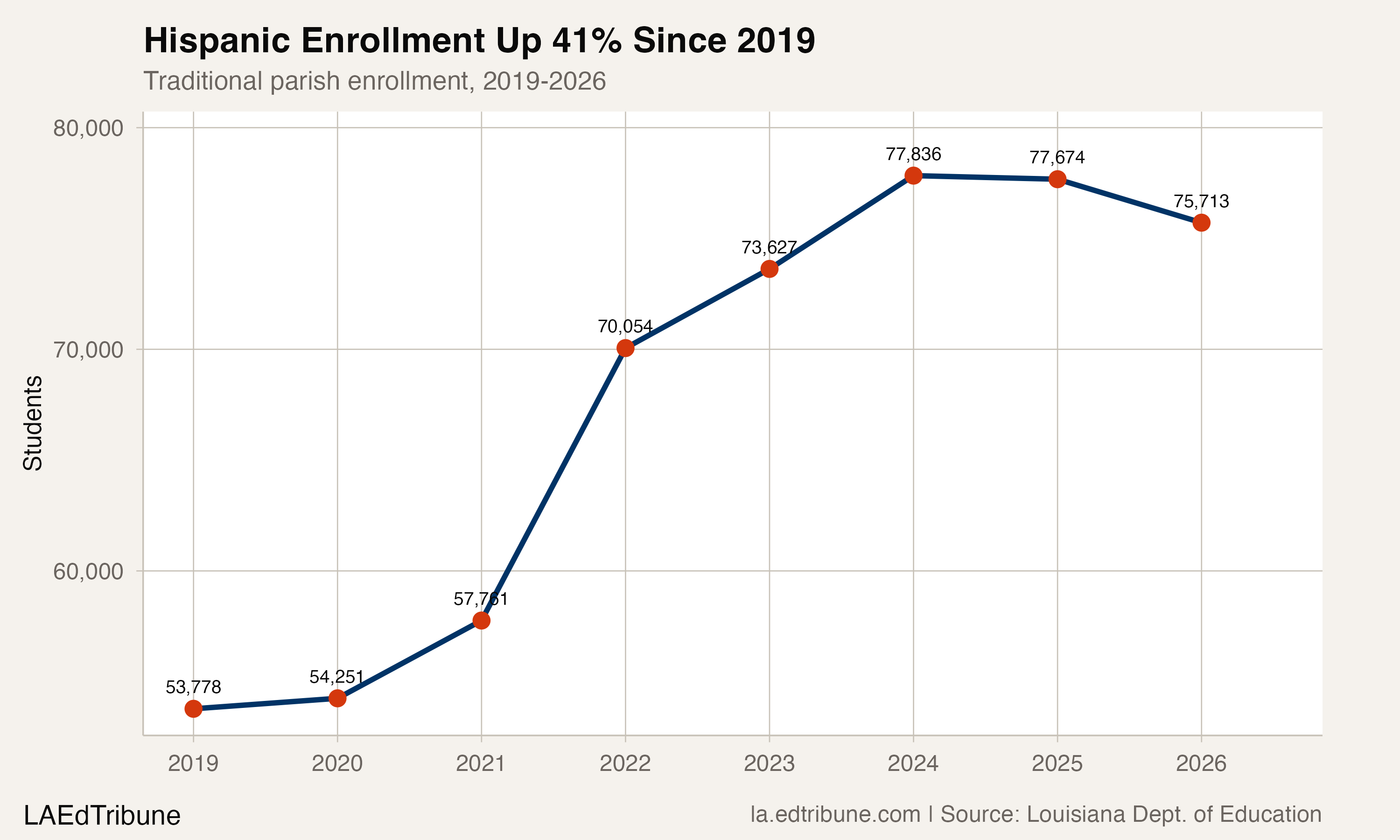
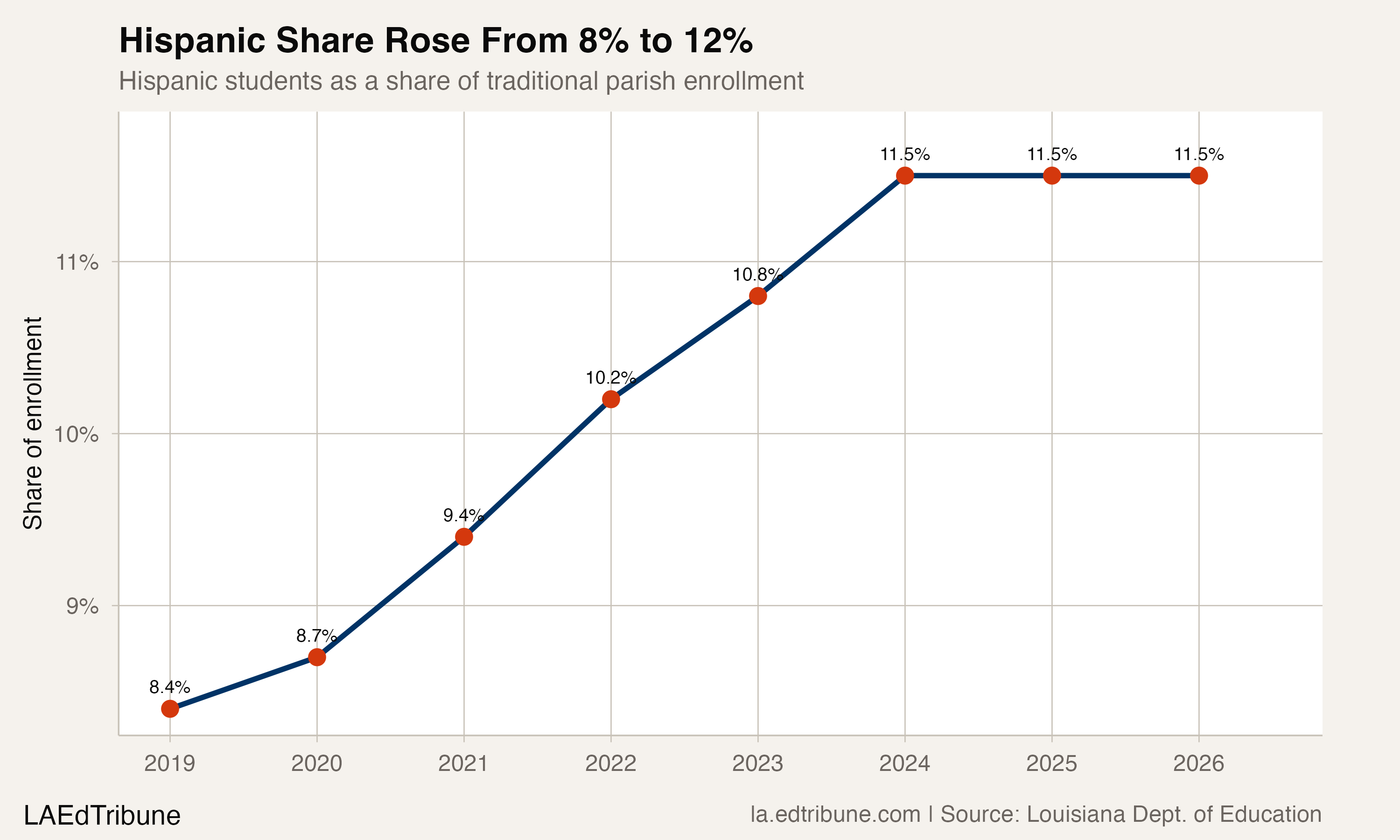
In a state losing students almost everywhere, Hispanic enrollment grew by 21,935 between 2019 and 2026, a 40.8% increase. Louisiana now counts 75,713 Hispanic students in its public schools, up from 53,778 seven years ago. Their share of enrollment climbed from 8.4% to 11.5%, a 3.1 percentage-point shift that has occurred quietly, without a single year of statewide decline until 2025.
That growth happened while white enrollment dropped by 37,717 students, a 12.4% loss. It is the second-largest absolute gain of any racial group in the state, trailing only Black enrollment, which added 24,821 students over the same period. Together, Hispanic and multiracial students (up 41.7%) are rewriting the demographic profile of Louisiana's schools at a pace that outstrips how quickly the state can hire the teachers to serve them.
Seven years of growth, then a plateau
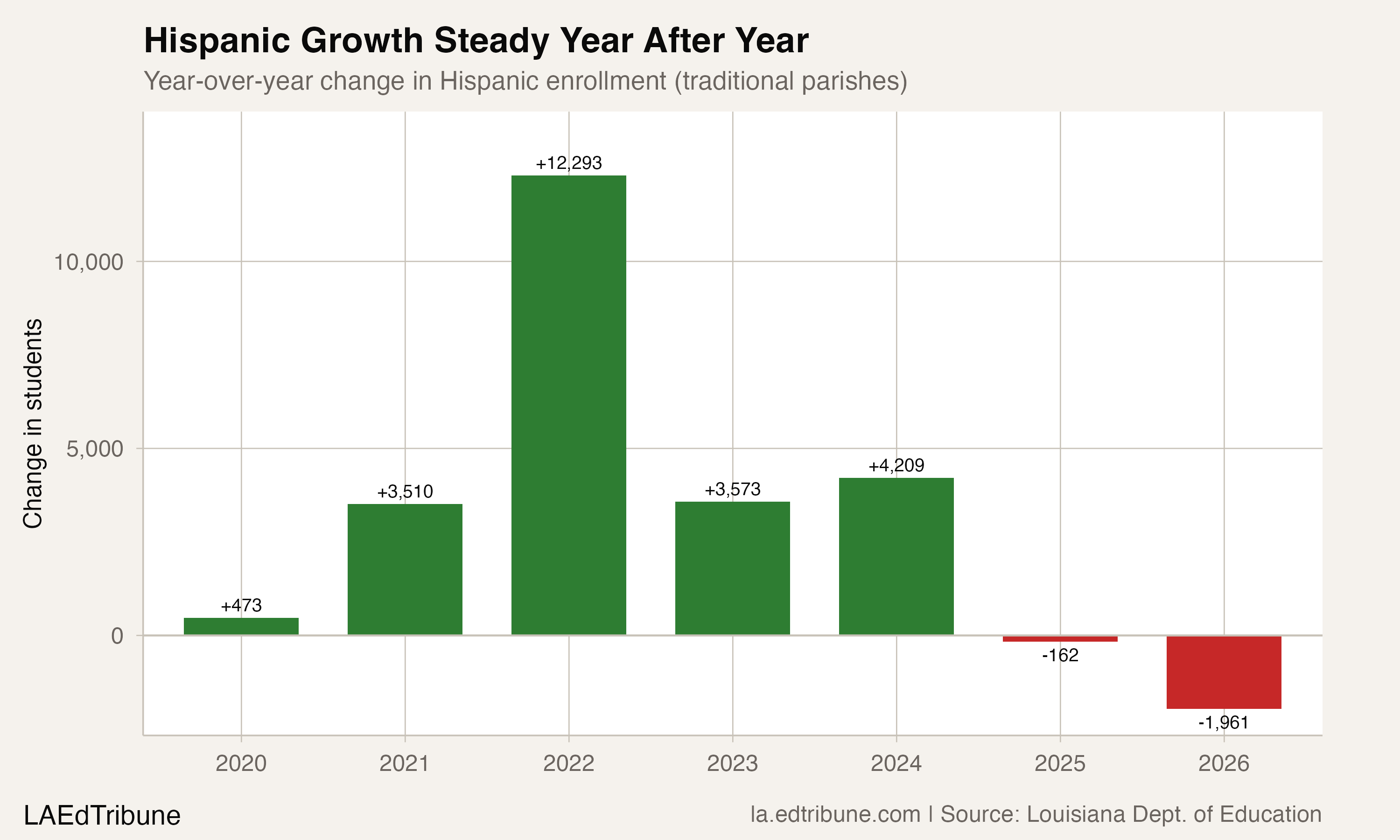
The trajectory is not a straight line. Hispanic enrollment grew modestly in 2020 (+473 students, less than 1%) before accelerating sharply from 2021 through 2024, when it gained between 3,500 and 4,200 students annually. The 2022 figure includes a structural break in state reporting: charter entities began appearing in district-level data that year, adding students who were previously absent from parish-level counts. That reporting change inflates the apparent 2022 gain (+12,293) and means the absolute count before and after 2022 is not directly comparable.
The share trend is more telling. Because both total enrollment and Hispanic enrollment were affected by the same reporting change, the share calculation is consistent across all years: 8.4% in 2019, rising steadily to 11.5% by 2024, where it has held flat through 2026.
The plateau matters. After five years of acceleration, Hispanic enrollment dipped by 162 students in 2025 and fell by 1,961 in 2026. Whether this reflects a genuine slowdown in demographic growth, the effects of federal immigration enforcement, or simply enrollment timing remains unclear.
Jefferson Parish, still the epicenter
Jefferson Parish↗ET is the state's Hispanic enrollment center of gravity, and it is not close. With 17,239 Hispanic students in 2026, the parish accounts for nearly one in four Hispanic students statewide. Their share of Jefferson's enrollment has climbed from 31.4% to 38.0% since 2019, making Hispanic students the largest racial group in Louisiana's biggest school system. For context, Black students make up 33.7% and white students 20.6%.
Jefferson's Hispanic community has deep roots. Hondurans, Mexicans, and Cubans make up the bulk of the local population, with the Honduran share far exceeding the national average: 32% of metro-area Hispanic residents are Honduran, compared to 2% nationally. The community's growth accelerated after Hurricane Katrina in 2005 when Central American construction workers arrived to rebuild the region, and many stayed. The parish's Hispanic population more than doubled between 2000 and 2024, reaching 86,663 residents.
But Jefferson's Hispanic enrollment actually declined by 1,466 students between 2024 and 2026, from 18,705 to 17,239. Its absolute gain since 2019 (+1,351) is now smaller than Livingston Parish's.
Suburban parishes are the new growth corridor
The fastest Hispanic enrollment growth is not in the traditional gateway parish. It is spreading into the Baton Rouge suburbs and Northshore.
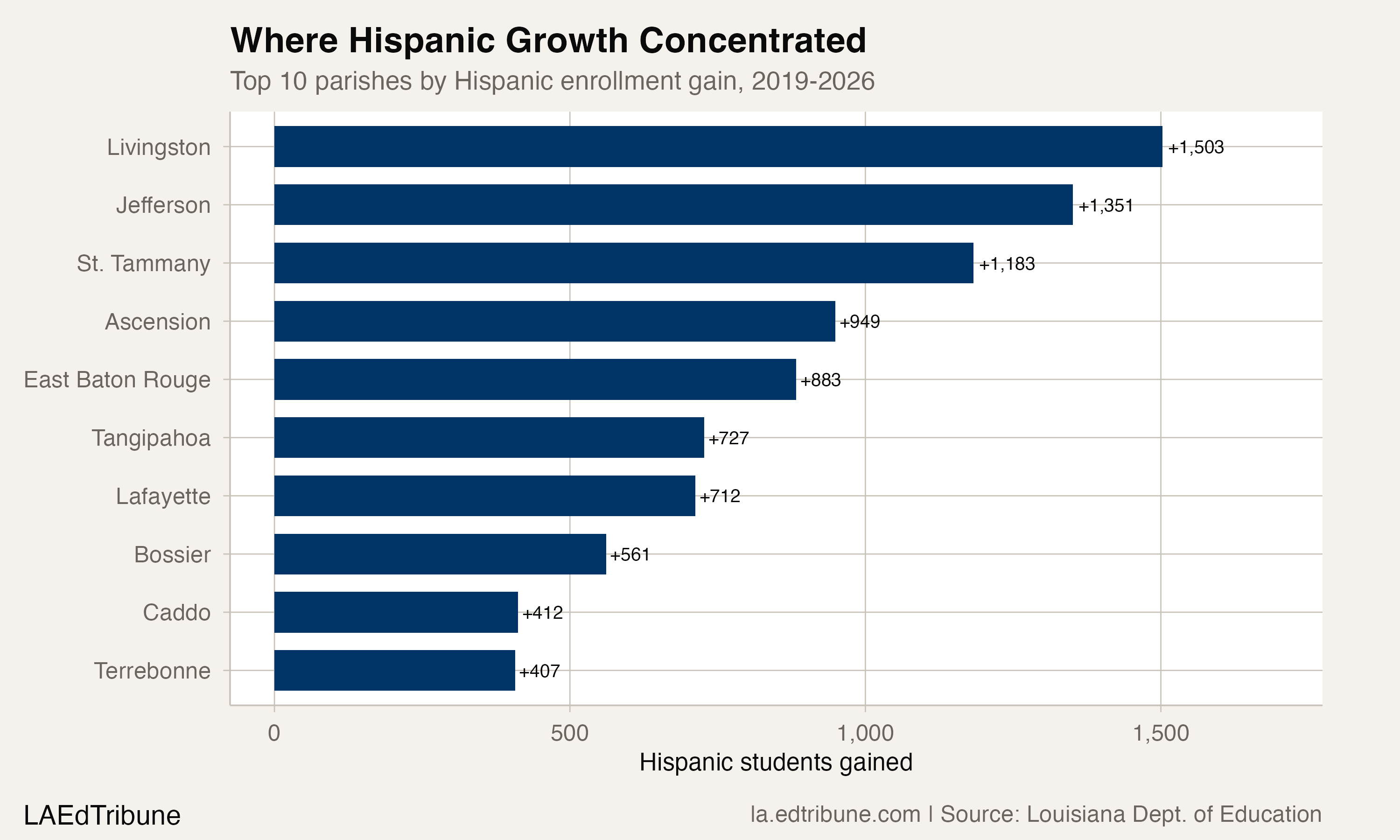
Livingston Parish↗ET leads the state in absolute Hispanic growth: 1,503 new students since 2019, a 68.9% increase that lifted the Hispanic share from 8.3% to 14.0%. St. Tammany Parish↗ET added 1,183 (+39.7%), pushing its share from 7.7% to 11.8%. Ascension Parish↗ET gained 949 (+41.3%), reaching 13.9%.
These are not parishes that had large Hispanic populations a decade ago. They are suburban, predominantly white communities along the I-10 and I-12 corridors that are experiencing the same demographic transformation Jefferson Parish underwent a generation earlier. Tangipahoa Parish↗ET went from 6.8% to 11.1% Hispanic. Lafayette Parish↗ET crossed 12%.
The growth reaches north Louisiana too. Bossier Parish↗ET gained 561 Hispanic students, and Caddo added 412. Even parishes with small base populations saw percentage jumps: Zachary Community School District's Hispanic enrollment rose 160%, from 111 to 289 students. St. Landry Parish grew 84.4%.
East Baton Rouge Parish↗ET added 883 Hispanic students, pushing its share from 11.5% to 15.0%. In a parish where Hispanic students now outnumber white students (15.0% vs. 10.9%), the shift has operational weight. EBR is one of four parishes where Hispanic enrollment exceeds white enrollment, alongside Jefferson, St. John the Baptist, and Baker.
A composition shift, not just a count
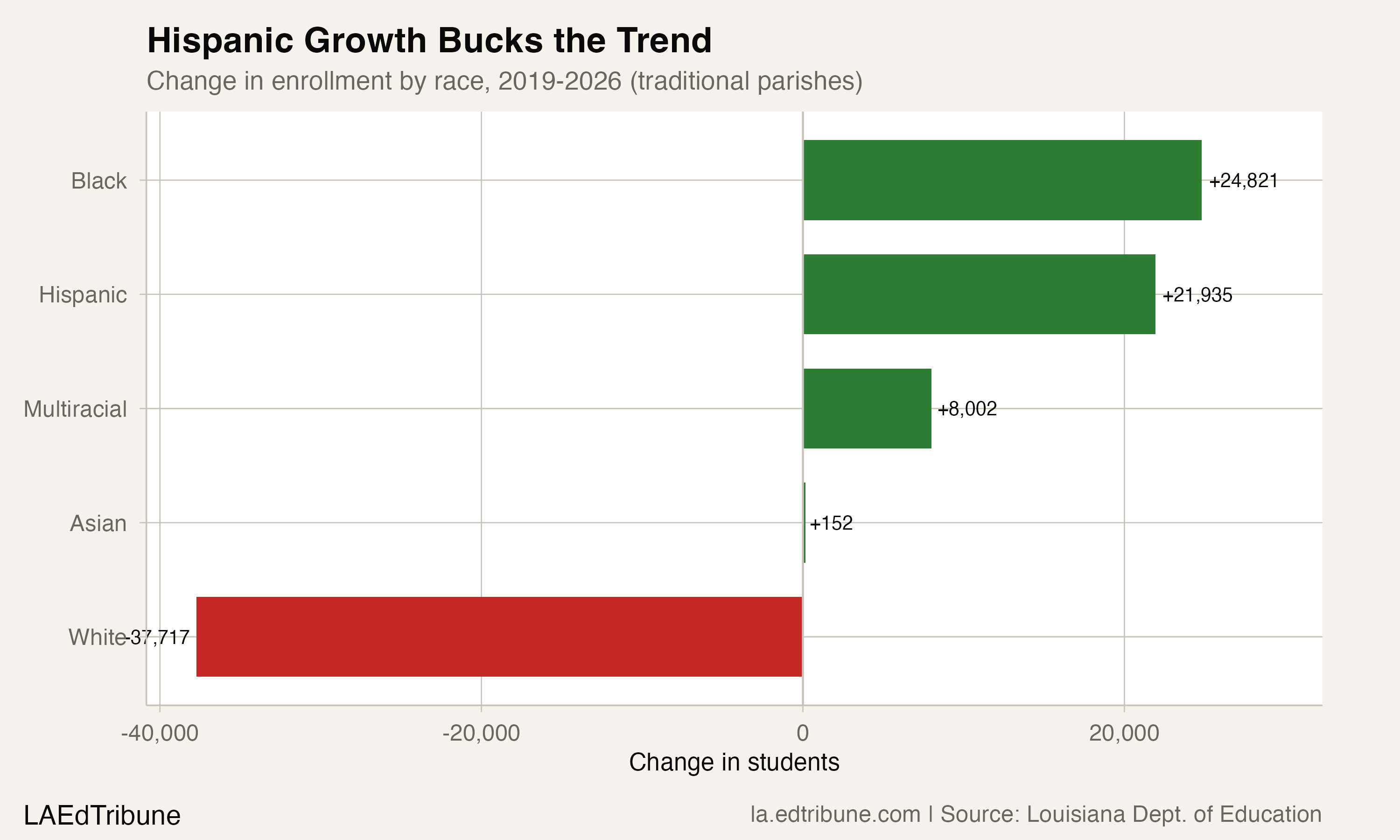
White enrollment fell by 37,717 students statewide, a 12.4% decline that dropped the white share from 47.1% to 40.2%. Hispanic enrollment grew by 21,935. Multiracial enrollment grew by 8,002 (+41.7%). These are the three largest shifts in the racial composition of Louisiana's schools over seven years.
The share trend captures what the absolute count cannot: even at 11.5%, Hispanic students are now a larger presence in Louisiana schools than Asian, multiracial, Native American, and Pacific Islander students combined. And Hispanic births account for 10.2% of all Louisiana births (2021-2023 average), suggesting the school-age share will continue rising as these cohorts enter kindergarten.
Immigration and the teacher pipeline
The most likely driver of Hispanic enrollment growth is immigration, both international and domestic. Louisiana received an estimated 23,000 new international immigrants between 2023 and 2024 alone, and an additional 15,000 between 2020 and 2023 that were not captured in earlier estimates. International immigration is now the only source of population growth in a state that loses more residents to domestic out-migration than it gains.
"As 'natural increase' in the U.S. continues to fall, immigrants will play an increasingly large role in population stability or growth." Source: The Data Center, 2024
Separately, English learner enrollment, which overlaps heavily with Hispanic students, grew by 8,090 students statewide between 2019 and 2026, a 32.5% increase. The state has the largest percentage increase in EL enrollment of any state over the prior decade: 153% between 2010 and 2021, according to New America's analysis of federal data. Louisiana's existing teaching workforce was not built for this. The state's first alternative certification program for EL teachers did not seek approval until October 2025.
The 2025-2026 dip in Hispanic enrollment (-2,123 students across both years) occurred during a period of heightened federal immigration enforcement. Whether this reflects families leaving the state, withdrawing children from public schools, or something unrelated to policy is not determinable from enrollment data alone.
A staffing gap the data can measure
Jefferson Parish, with 38% Hispanic enrollment, has had decades to build bilingual programs and hire ESL-certified teachers. Its Office of Multilingual Learning serves students speaking Spanish, Vietnamese, Arabic, and Korean. The infrastructure exists, even if it strains under a 19.2% English learner rate.
Parishes like Livingston (14% Hispanic), St. Tammany (11.8%), and Ascension (13.9%) have no such runway. These are communities where the Hispanic share was in the single digits five years ago. Louisiana's first alternative certification program for EL teachers did not seek approval until October 2025. The students are already sitting in classrooms. The credentialed teachers to serve them are, in many parishes, still in a pipeline that barely exists.
Detailed code that reproduces the analysis and figures in this article is available exclusively to EdTribune subscribers.
Discussion
Sign in to join the discussion.
Loading comments...