In this series: Louisiana 2025-26 Enrollment.
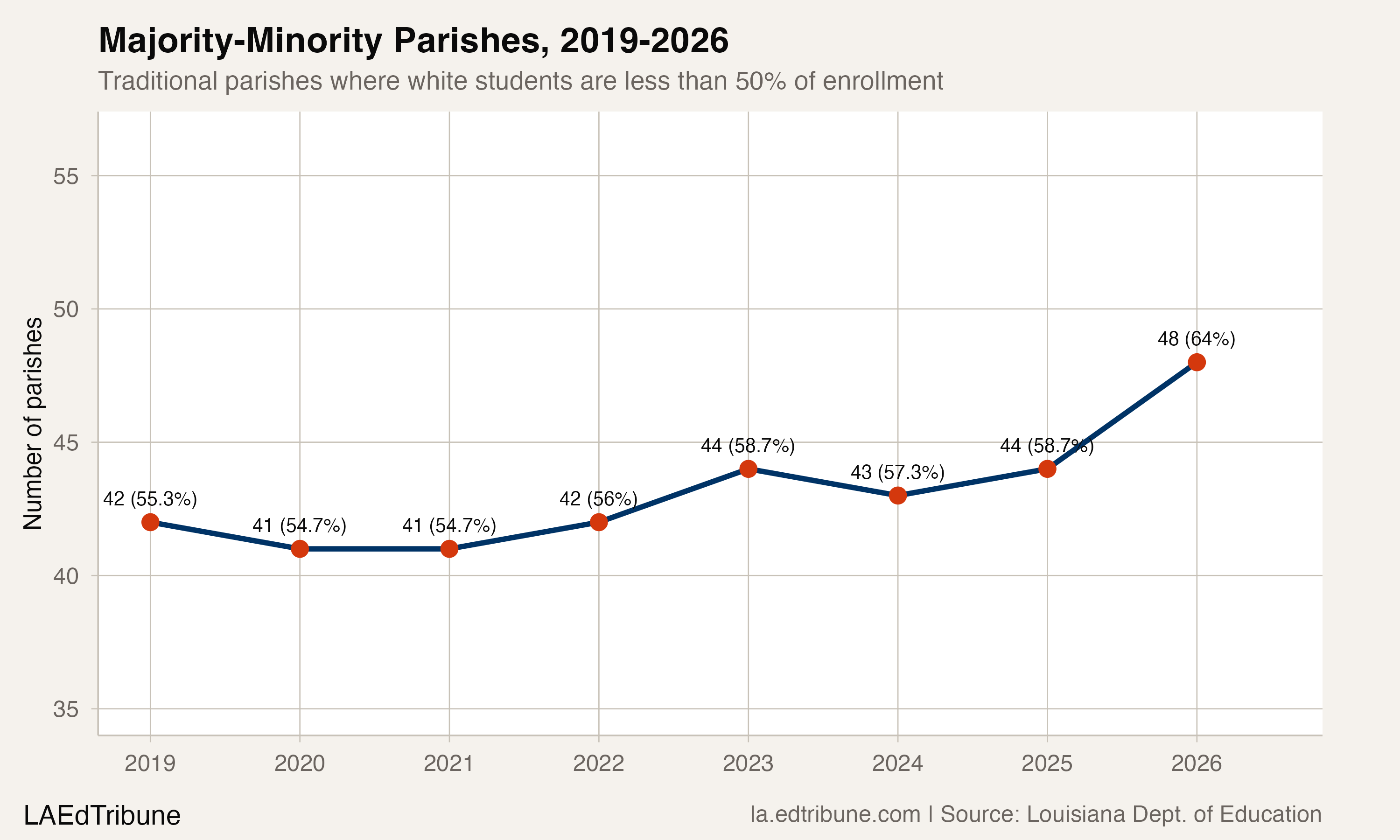
Seven years ago, Bossier Parish↗ET enrolled 22,876 students. White students made up 55.7% of that total. In 2025-26, white enrollment in Bossier has fallen to 49.2%, and the parish has joined a growing list of Louisiana school systems where no single racial group holds a majority. Bossier is not an outlier. It is one of six traditional parishes that crossed the majority-minority threshold since 2019, pushing the statewide count to 48 of 75, or 64.0%.
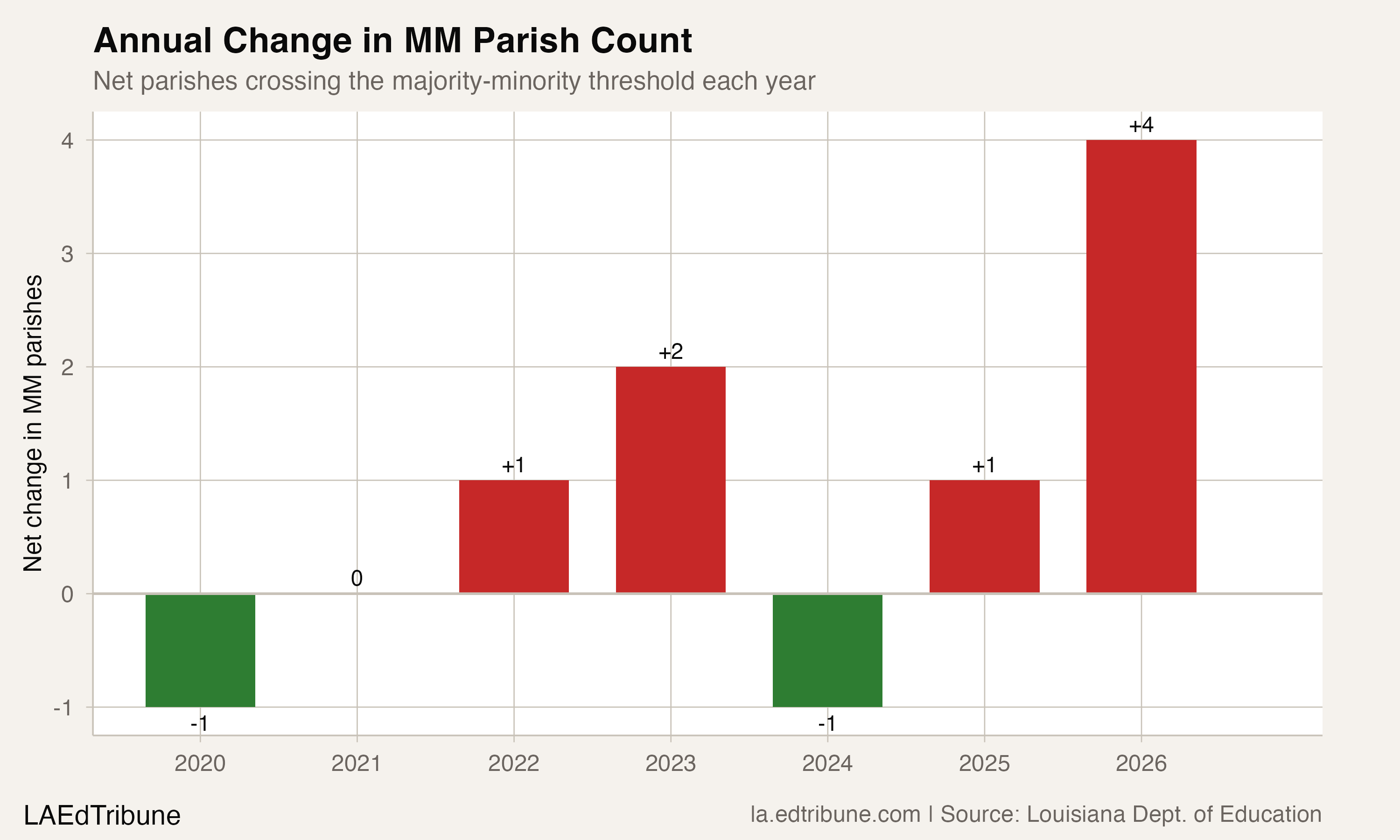
The shift is not subtle. In a single year, four parishes crossed the line, the largest annual jump in the eight-year dataset. Louisiana's public schools, already more diverse than its general population, are diversifying faster than most parish-level decisions account for.
The suburban crossover
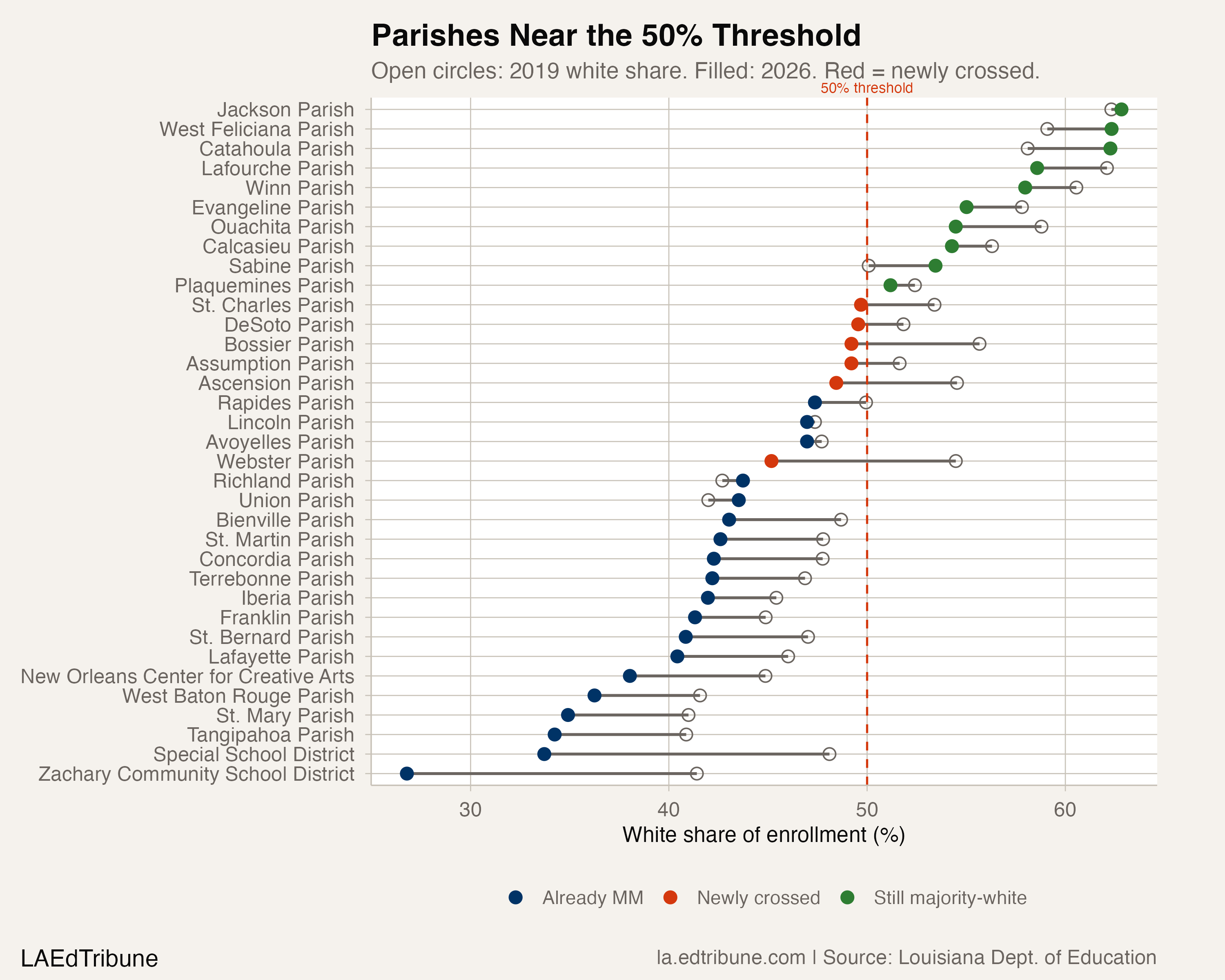
The six parishes that crossed the 50% threshold since 2019 are not the deeply diverse urban centers where the shift happened decades ago. They are suburban and mid-size parishes: Ascension Parish↗ET (54.5% white in 2019, now 48.4%), St. Charles Parish↗ET (53.4% to 49.7%), Webster Parish↗ET (54.5% to 45.2%), DeSoto Parish↗ET (51.8% to 49.6%), and Assumption Parish↗ET (51.6% to 49.2%), alongside Bossier.
The mechanisms differ by parish. In Ascension and St. Charles, Hispanic enrollment growth is the primary driver. Ascension's Hispanic share rose from 9.8% to 13.9% over the period, adding nearly 4 percentage points while white enrollment contracted. In Webster, the shift reflects population loss in a rural North Louisiana parish that lost 10.3% of its total population between the 2010 and 2020 censuses. Bossier, sitting across the Red River from Shreveport, saw Hispanic enrollment climb from 10.0% to 13.1% even as its overall enrollment remained relatively stable.
What 54,000 fewer white students looks like
The parish-level crossings are symptoms of a statewide pattern. White enrollment in Louisiana's traditional parishes fell from 303,149 in 2018-19 to 248,855 in 2025-26: a loss of 54,294 students, or 17.9%. That decline outpaces the total enrollment drop of 10.1% over the same period, meaning the student body is not just shrinking but changing composition.
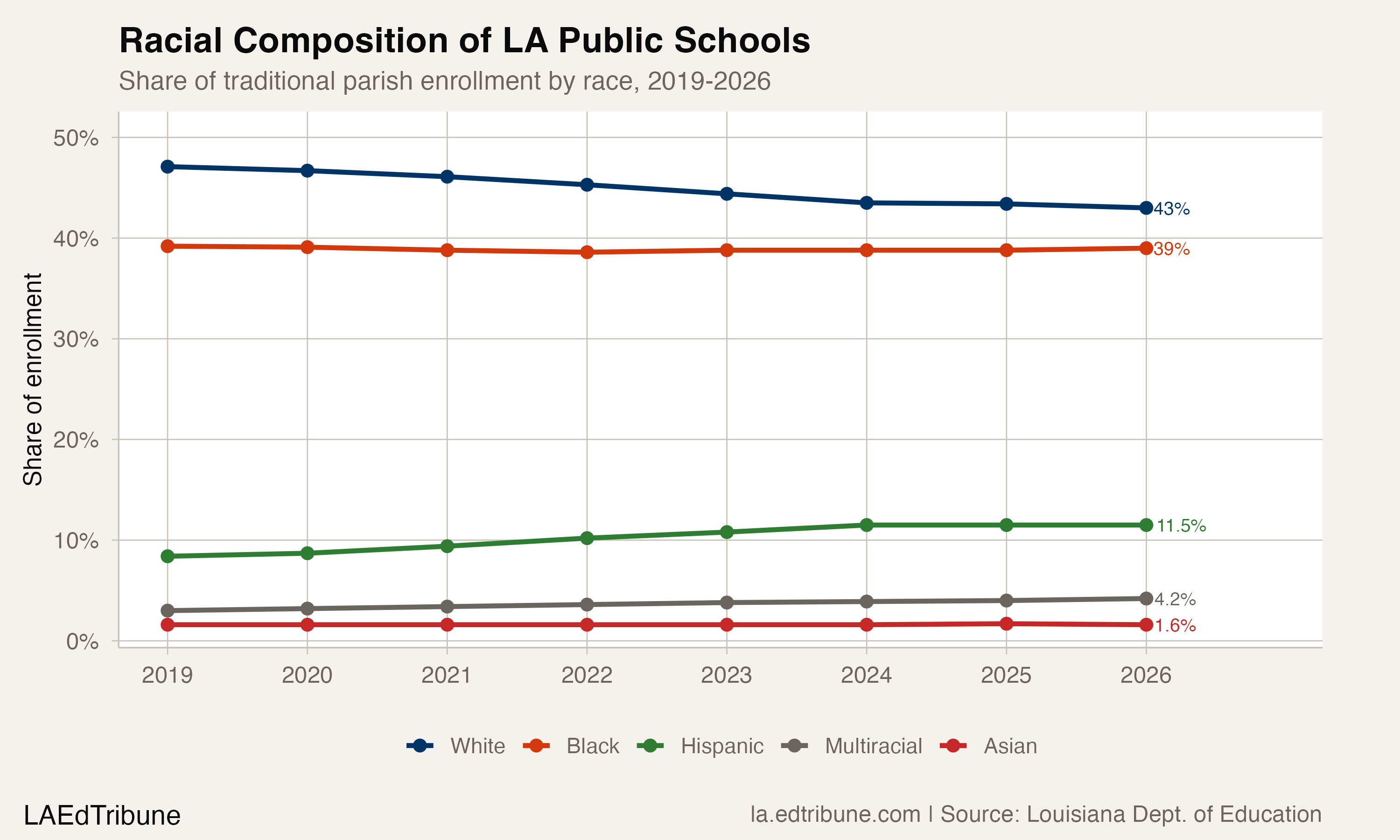
White students now make up 43.0% of traditional parish enrollment, down from 47.1% in 2019. Black enrollment held essentially steady as a share (39.2% to 39.0%) while declining in absolute numbers from 252,683 to 225,920. Hispanic students grew from 8.4% to 11.5%, adding 12,711 students, a 23.6% increase. Multiracial enrollment rose from 3.0% to 4.2%.
The gap between white and Black shares narrowed from 7.9 percentage points to 4.0. At the current rate, Black students will outnumber white students statewide within the next few years.
Birth rates and outmigration
Two forces are compressing white enrollment from opposite directions. Louisiana's population has been shrinking, with two-thirds of parishes losing residents in 2024. The state's chief demographer, Allison Plyer of The Data Center, has attributed the pattern to structural economic weakness:
"Louisiana has had one of the weakest economies in the country for decades now. It's not surprising that we're losing population." Source: Red River Radio, March 2025
International immigration has partially offset the domestic losses. Louisiana's population grew 0.2% in 2024, halting four consecutive years of decline, with the uptick attributed primarily to international immigration rather than domestic gains. That pattern helps explain why Hispanic enrollment is the fastest-growing demographic in public schools while overall enrollment contracts.
Private school enrollment also plays a role. Louisiana had 115,620 students in 360 private schools as of 2021, one of the highest private-school enrollment rates in the country. Private enrollment in the state has historically been concentrated among white families, and the new LA GATOR education savings account program, which began accepting applications in 2025, could widen the gap by giving families public funds for private tuition.
The distribution shift
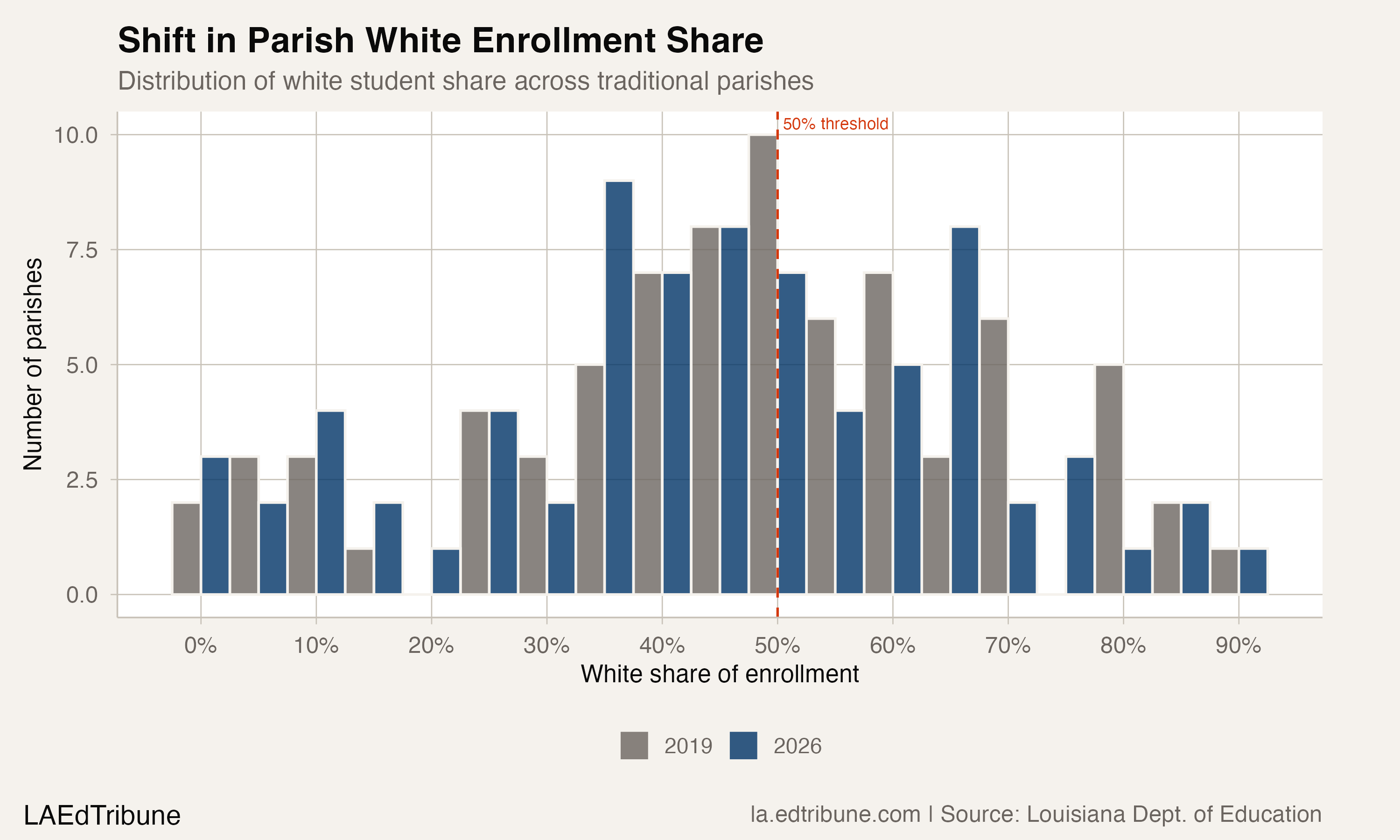
The histogram tells the story the parish count obscures. In 2019, the distribution of white enrollment share was roughly centered around 50%, with substantial clusters on both sides of the threshold. By 2026, the entire distribution has shifted left. The median white share across parishes fell from 47.8% to 43.7%. The number of parishes with less than 25% white enrollment grew from 10 to 14.
The parishes with the lowest white shares are concentrated in the Mississippi Delta and the Interstate 10 corridor through Baton Rouge. East Carroll Parish↗ET enrolls just 1.0% white students. East Baton Rouge Parish↗ET is at 10.9%. Jefferson Parish↗ET, the state's largest suburban system, stands at 20.6%.
At the other end, Livingston Parish↗ET remains the most predominantly white traditional parish at 66.5%, though that figure dropped 13.3 percentage points from 79.8% in 2019, one of the steepest declines of any parish.
Four more parishes are close
Four parishes sit between 50% and 55% white enrollment, placing them within range of crossing the threshold in the next few years: Plaquemines Parish↗ET at 51.2%, Sabine Parish at 53.5%, Calcasieu Parish↗ET at 54.3%, and Ouachita Parish↗ET at 54.5%.
Calcasieu and Ouachita are among the state's 10 largest school systems. If both cross, majority-minority parishes would account for an even larger share of total enrollment than their count suggests. The 48 majority-minority parishes already enroll 379,994 students, or 65.7% of all traditional parish enrollment, compared to 198,638 in the 27 majority-white systems.
The transition is not guaranteed to be steady. The count dipped by one in 2020 and 2024 before resuming its upward march. A single parish flipping back above 50% can reverse a year's net gain. But the underlying demographic trends point in one direction: white enrollment is falling in nearly every parish, and Hispanic and multiracial enrollment is growing in most.
Bossier Parish crossed the threshold in 2026 with a white share of 49.2%. It is the parish that Shreveport families move to when they leave Caddo. Its schools are considered better resourced, its communities more stable. And it just became majority-minority anyway, not because it changed but because the demographics of the entire region shifted under it. Across the Red River, Caddo has been majority-minority for decades. Now the suburban ring is following.
Detailed code that reproduces the analysis and figures in this article is available exclusively to EdTribune subscribers.
Discussion
Sign in to join the discussion.
Loading comments...