In this series: Louisiana 2025-26 Enrollment.
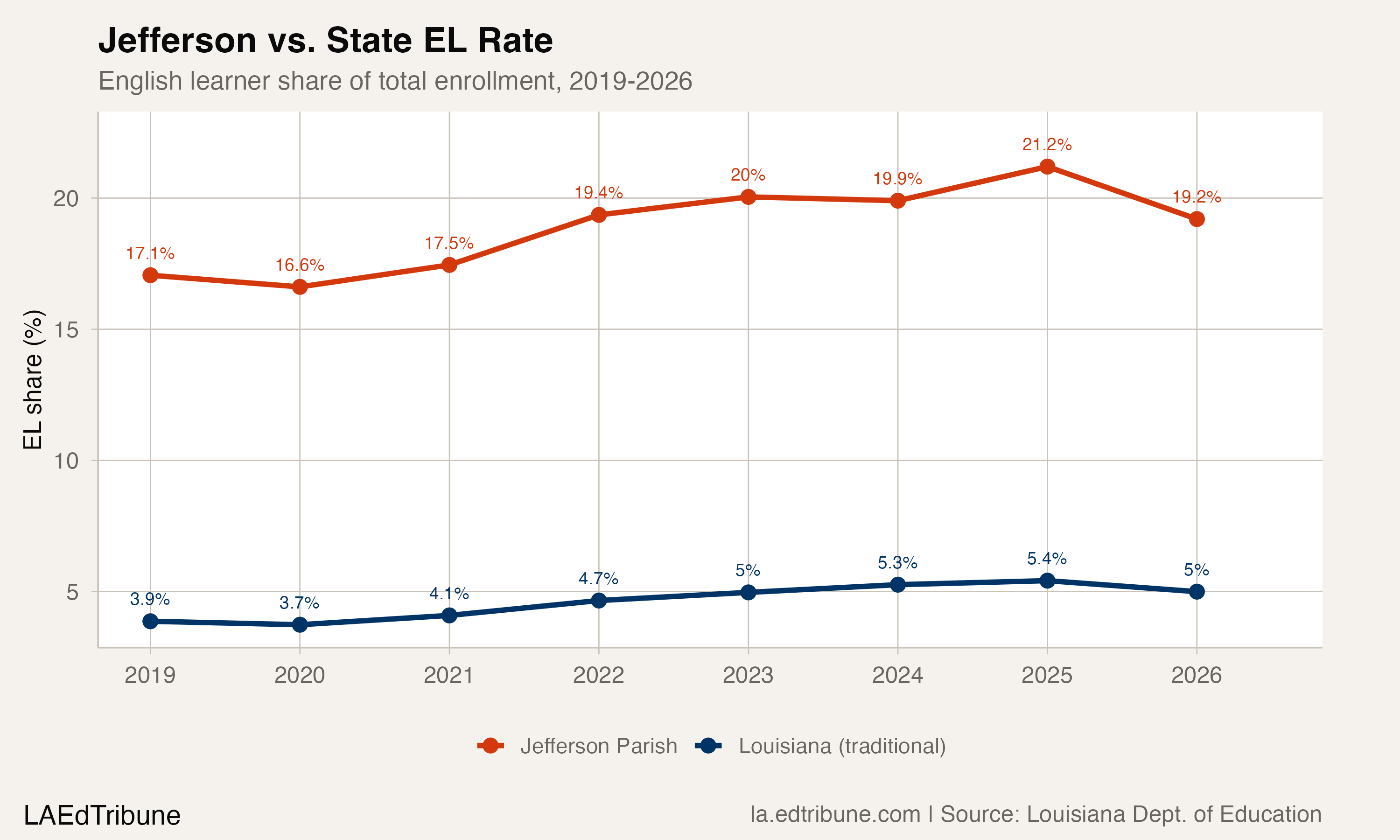
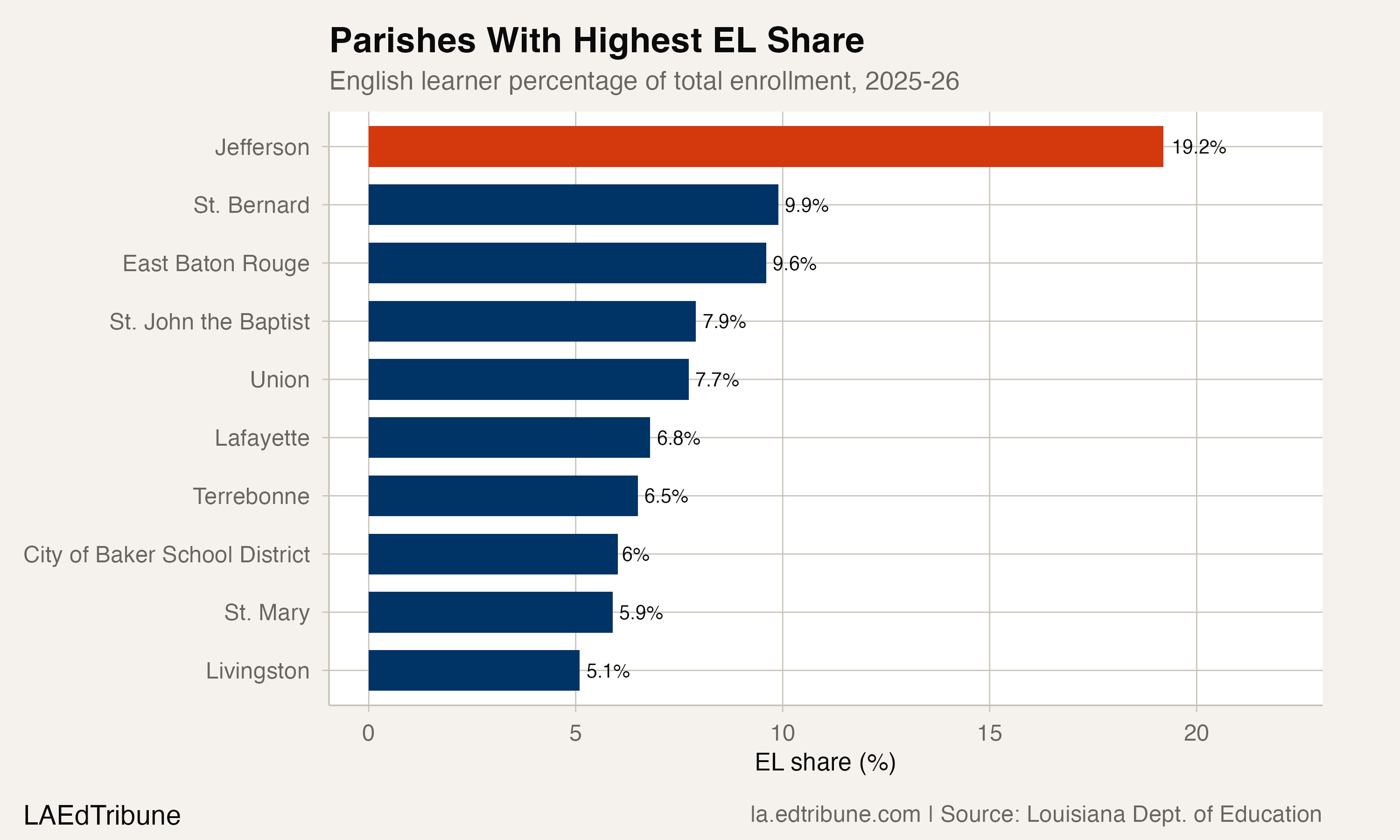
No other parish comes close. Jefferson Parish↗ET enrolls 8,718 English learners in the 2025-26 school year, a rate of 19.2%. The next-highest parish by share, St. Bernard↗ET, is at 9.9%. The statewide average for traditional districts is 5.0%. Jefferson is the only parish in Louisiana where the English learner rate exceeds 10%.
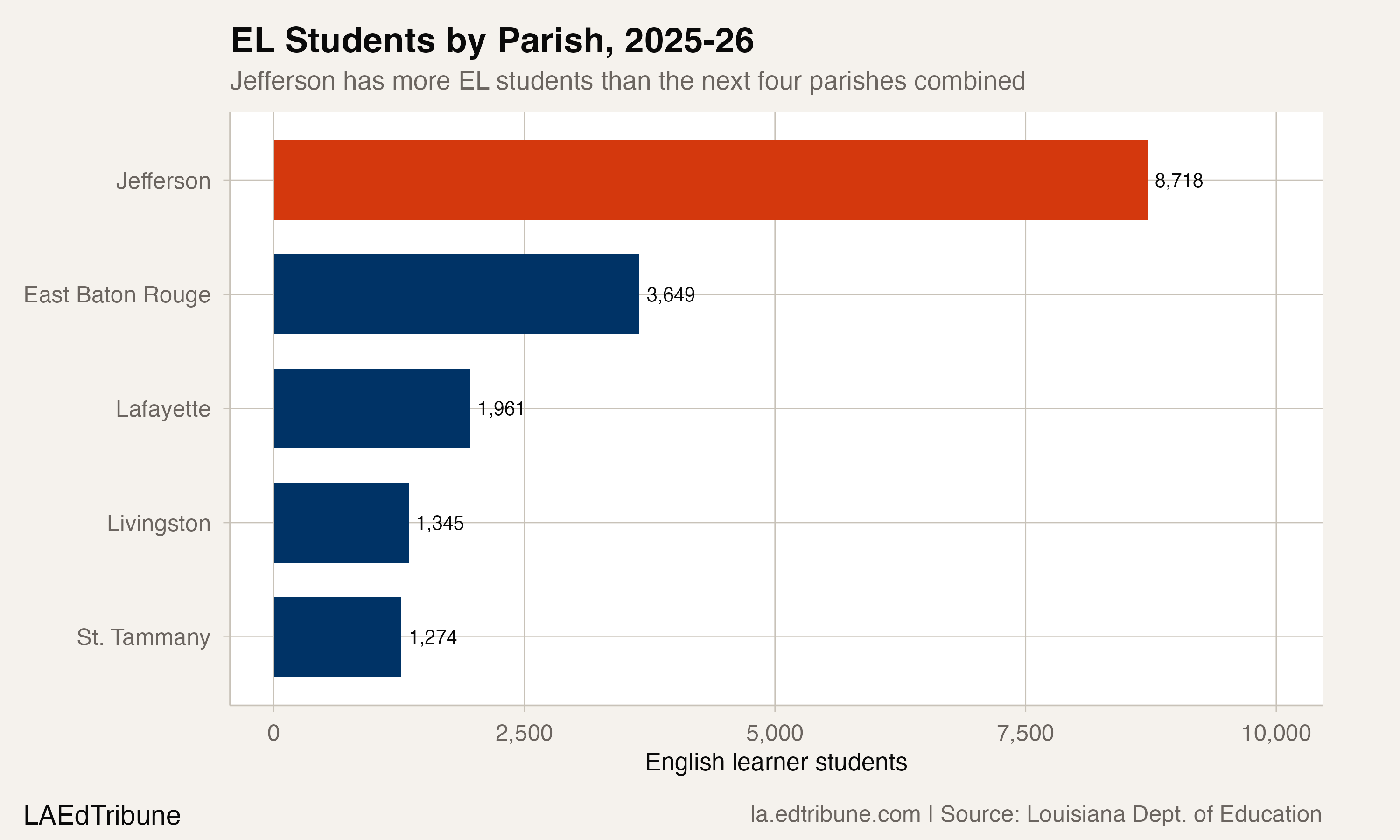
The concentration is even starker in absolute terms. Jefferson's 8,718 EL students outnumber those in East Baton Rouge↗ET, Lafayette↗ET, Livingston↗ET, and St. Tammany↗ET combined. Those four parishes collectively enroll 8,229 English learners. One parish, serving 6.9% of the state's traditional enrollment, accounts for 26.4% of the state's English learner students.
A rate nearly four times the state average
Jefferson's EL share has climbed from 17.1% in 2018-19 to 19.2% in 2025-26, a gain of 2.1 percentage points. Over the same period, the statewide rate rose from 3.9% to 5.0%. The gap between Jefferson and the rest of Louisiana has not closed. It has widened slightly, from 13.2 percentage points to 14.2.
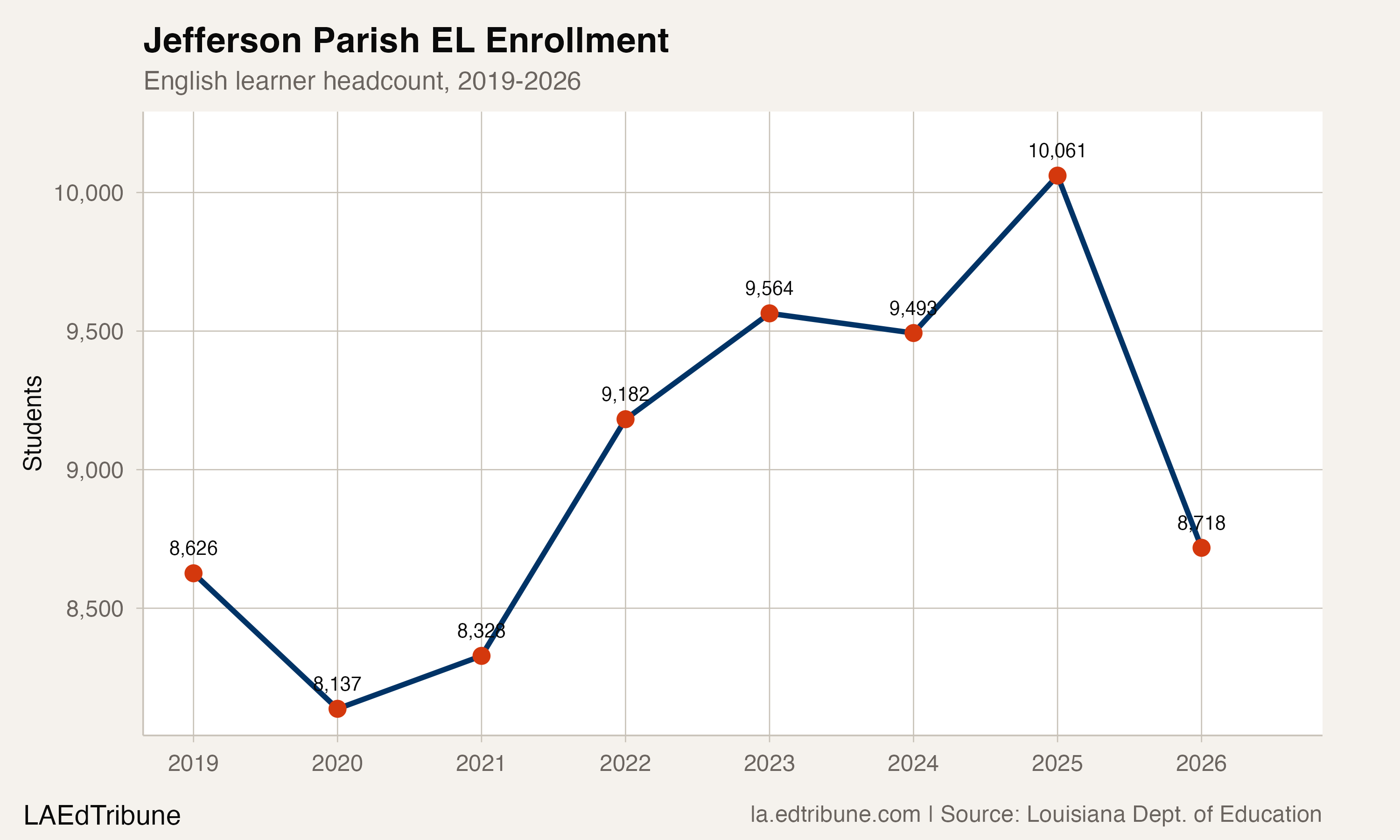
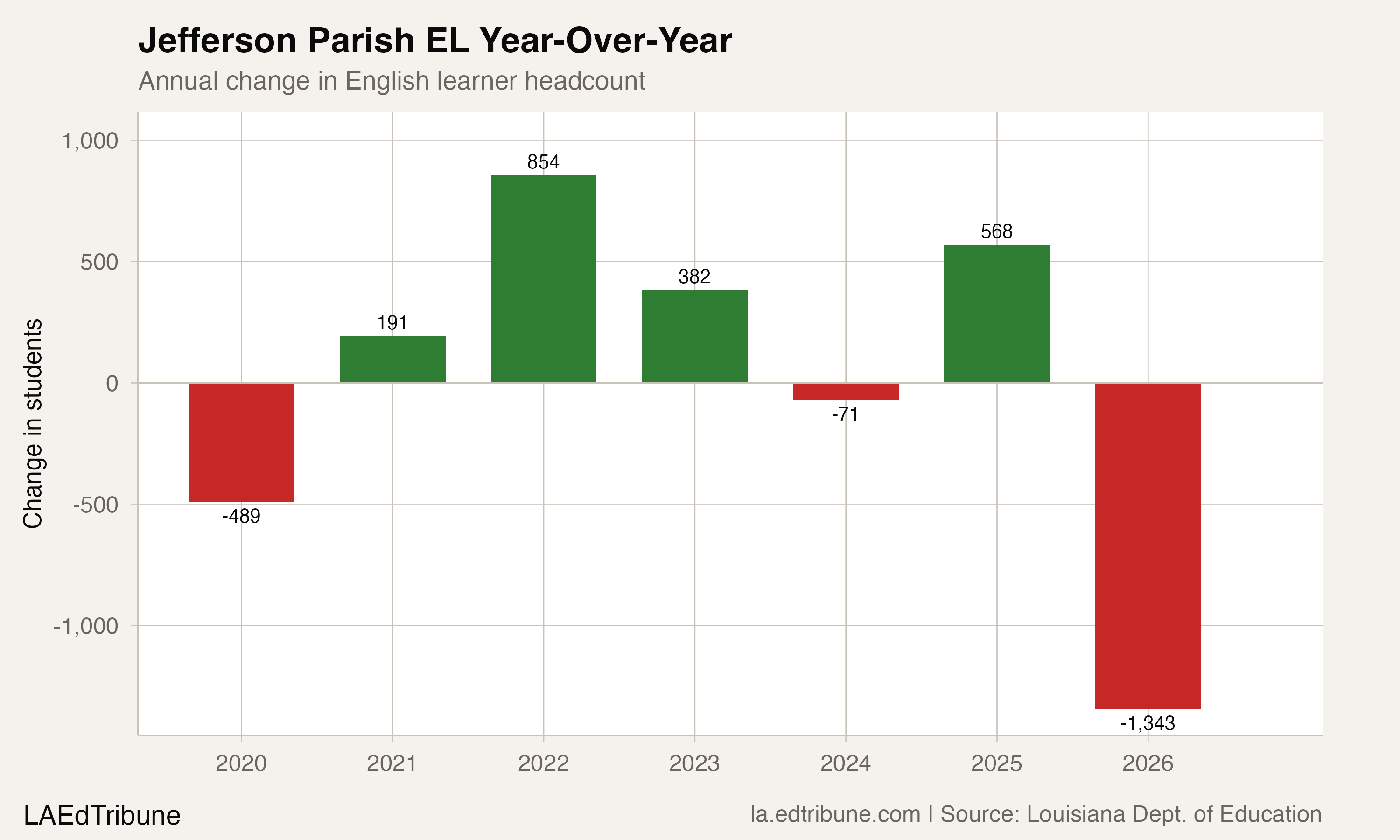
The trajectory, though, is not a straight line. Jefferson's EL headcount peaked at 10,061 in 2024-25, then fell sharply to 8,718 in 2025-26, a single-year drop of 1,343 students, or 13.3%. That decline stands out against the broadly upward run that carried Jefferson from a 2019-20 low of 8,137 to its 2024-25 peak, with the EL count rising in four of the six years in between. Jefferson's total enrollment also fell in 2025-26, from 47,459 to 45,406, but the EL drop of 13.3% far outpaced the overall loss of 4.3%.
The Honduran roots of a school staffing crisis
Jefferson's EL concentration did not appear overnight. It reflects decades of immigration to the Westbank suburbs and Kenner, where Honduran families have settled since the 1980s. Post-Katrina reconstruction accelerated the trend. By 2010, Hondurans were the largest Latin American nationality in the metro area, with a census count exceeding 25,000. Hispanic students now make up 38.0% of Jefferson's enrollment, up from 31.4% in 2018-19, an increase of 1,351 students even as the parish's total enrollment shrank by more than 5,100.
That demographic reality creates a staffing challenge unlike anything other Louisiana parishes face. Jefferson's Office of Multilingual Learning operates ESL programs, a Spanish dual-language pathway, and migrant education services. The district serves students speaking Spanish, Vietnamese, Arabic, French Creole, Chinese, Uzbek, and Korean, among other languages. But the pipeline of credentialed ESL teachers is thin statewide.
"Local districts don't have enough teachers who are trained to provide education to English learners, and resources for such students can be scarce, with ESL programs not effectively staffed or implemented to create a difference in outcome for Spanish-speaking students." Source: Verite News, Oct. 2025
Louisiana launched its first alternative certification program for EL teachers in late 2025, a yearlong online residency through TeachNOLA, in part because the state had no dedicated pipeline before. Jefferson Parish has attempted its own workaround: a teaching apprenticeship program that helped cut overall teacher vacancies from 150 to 70. One participant, a paraprofessional who worked in Jefferson schools for nine years, enrolled specifically to become an EL teacher.
The 2026 drop and what it may signal
The 1,343-student decline in Jefferson's EL count in 2025-26 demands careful interpretation. Three mechanisms could be at work, and the enrollment data alone cannot distinguish among them.
The most visible explanation is immigration enforcement. In December 2025, attendance at Jefferson Parish schools dropped sharply following Border Patrol operations in the metro area. Approximately 5,400 students, nearly 12% of the district, were absent the day after sweeps began. At the 20 Jefferson schools with the highest EL concentrations, attendance fell to 80%, roughly 16 percentage points below the pre-December average. Kenner, where about 30% of residents are Hispanic and the police department has signed 287(g) agreements with ICE, was the epicenter of community anxiety.
A second possibility is reclassification. Students who reach English proficiency benchmarks exit EL status. A large cohort of long-term EL students meeting exit criteria in a single year could produce a headcount drop without any student leaving the district. The data does not distinguish newly arrived EL students from those reclassified out.
A third factor is the broader enrollment contraction. Jefferson lost 2,053 students overall in 2025-26. If departing students were disproportionately EL-classified, the EL decline would exceed the total decline in percentage terms, which is what the data shows.
The statewide pattern adds context: Louisiana's total EL count also fell from 36,492 to 32,998 in 2025-26, a drop of 9.6%. Jefferson's 13.3% decline was steeper, but not uniquely so.
Concentration and its fiscal weight
Jefferson's position is structurally unusual. At 19.2%, its EL rate is nearly double that of the second-highest parish (St. Bernard at 9.9%) and quadruple the state average. Only 10 of Louisiana's 75 traditional parishes exceed 5.0% EL. One parish exceeds 10%.
That concentration carries fiscal consequences. Title III, the federal program dedicated to English learner instruction, currently allocates $169 per EL student nationally, down from an inflation-adjusted $264 in 2007-08. Congress preserved Title III funding in the fiscal 2026 budget after the Trump administration proposed eliminating it entirely, but kept the allocation flat at $890 million even as the national EL population has grown roughly 30% over the past 15 years. For a district where one in five students is an English learner, flat federal funding means a growing gap between the instructional services students are entitled to and the resources available to deliver them.
A letter and its limits
In late 2025, Jefferson Parish sent a letter to parents addressing immigration enforcement uncertainty. Federal law protects schools as sensitive locations, and the district affirmed that ICE would not conduct operations on school grounds. The letter was an attempt to keep families enrolled.
At Terrytown Elementary, 41% of students stayed home the Monday after Operation Catahoula Crunch began. At the 20 Jefferson schools with the highest EL concentrations, attendance fell 16 percentage points below the pre-December average. A district letter cannot undo that kind of fear. Jefferson has spent two decades building an EL infrastructure that no other Louisiana parish can match: bilingual programs, dual-language pathways, a credentialed ESL workforce. The 1,343 students who disappeared from the EL count in 2025-26 represent not just a headcount loss but a potential unraveling of the community that made that infrastructure necessary and viable.
Detailed code that reproduces the analysis and figures in this article is available exclusively to EdTribune subscribers.
Discussion
Sign in to join the discussion.
Loading comments...