In this series: Louisiana 2025-26 Enrollment.
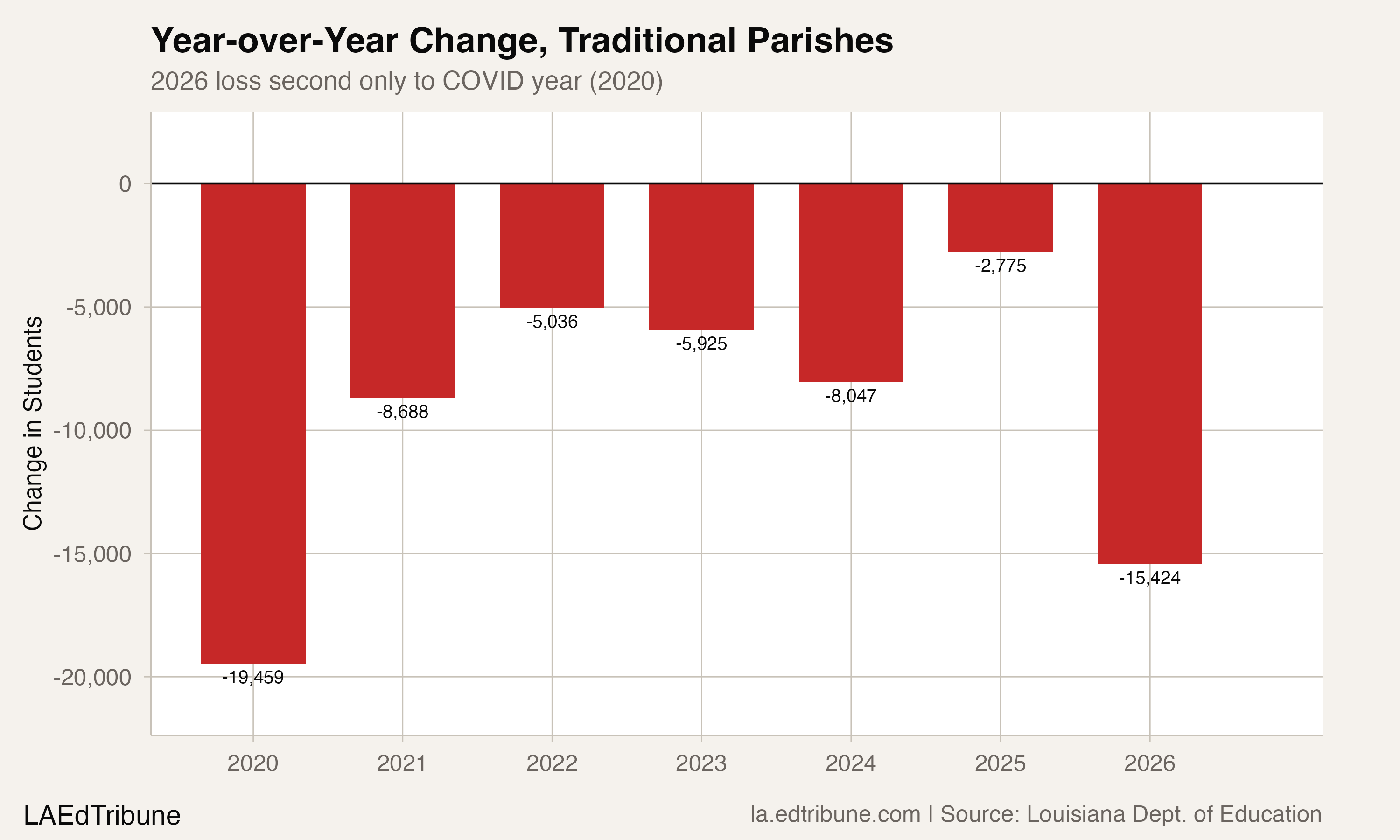
For five years after COVID emptied classrooms across Louisiana, the losses came in waves that seemed to be slowing. Traditional parish enrollment fell by 19,459 in the pandemic year, then 8,688, then 5,036. By 2024-25, the year-over-year decline had eased to just 2,775 students, a 0.5% dip that looked like the beginning of stabilization.
It was not. The 2025-26 school year erased that hope. Louisiana's 75 traditional parish school systems shed 15,424 students in a single year, a 2.6% loss that ranks as the largest non-COVID decline in the eight years of available data. Only the pandemic year itself was worse.
The false plateau
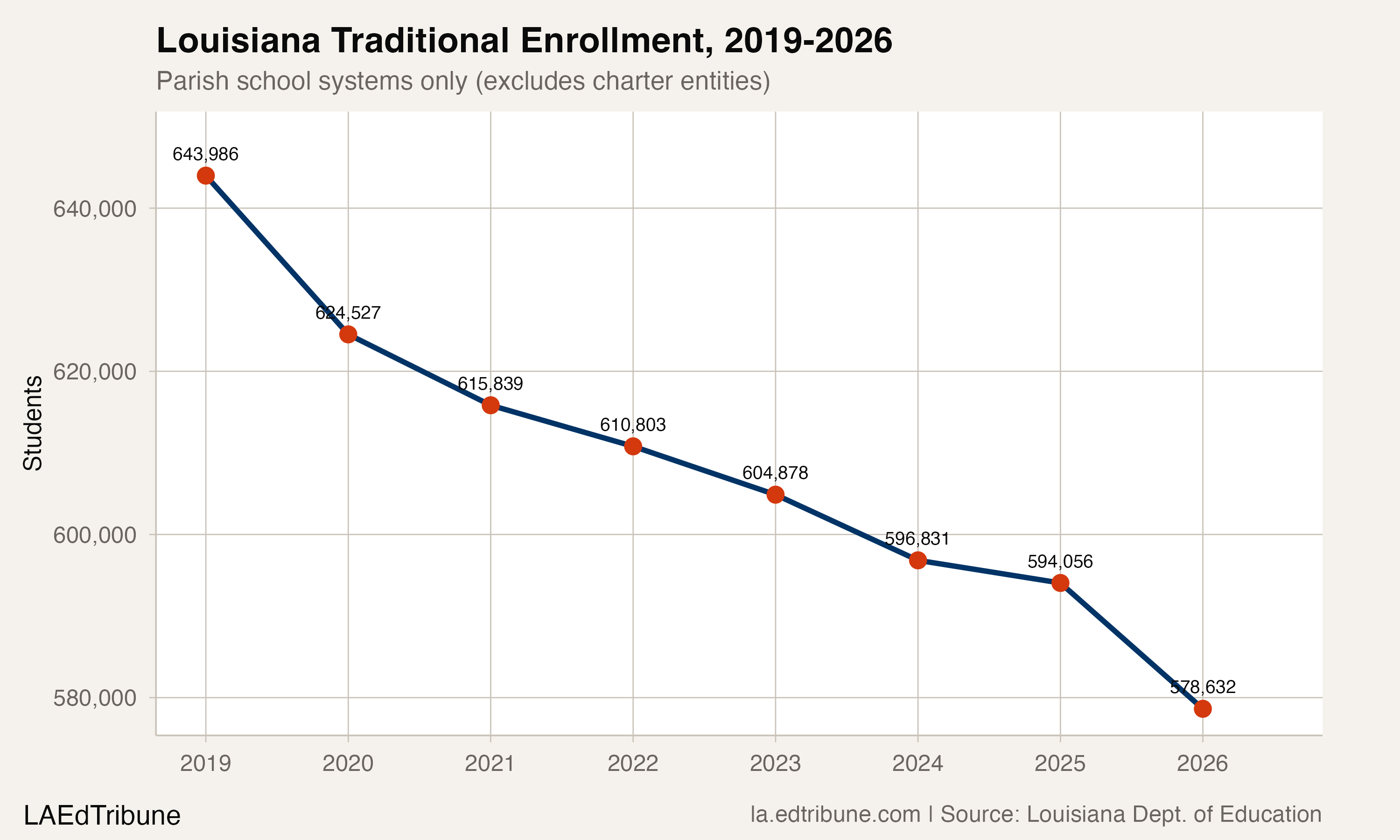
The trajectory since 2019 is unbroken decline: 643,986 students that year, 578,632 in 2025-26, a cumulative loss of 65,354 students, or 10.1%. But the pace of that decline varied in ways that made 2024-25 look like a turning point. After COVID's initial shock, year-over-year losses settled into a range of 5,000 to 8,000 students annually. Then came the 2024-25 reprieve, with just 2,775 lost. Parish superintendents had reason to believe the hemorrhaging was easing.
The 2025-26 data contradicts that reading. The 15,424-student loss is nearly six times larger than the prior year's and more than double the post-COVID annual average. Rather than a gradual deceleration, the seven-year pattern now resembles a saw-tooth: large loss, partial recovery of pace, then an even sharper non-COVID loss.
Nobody was spared
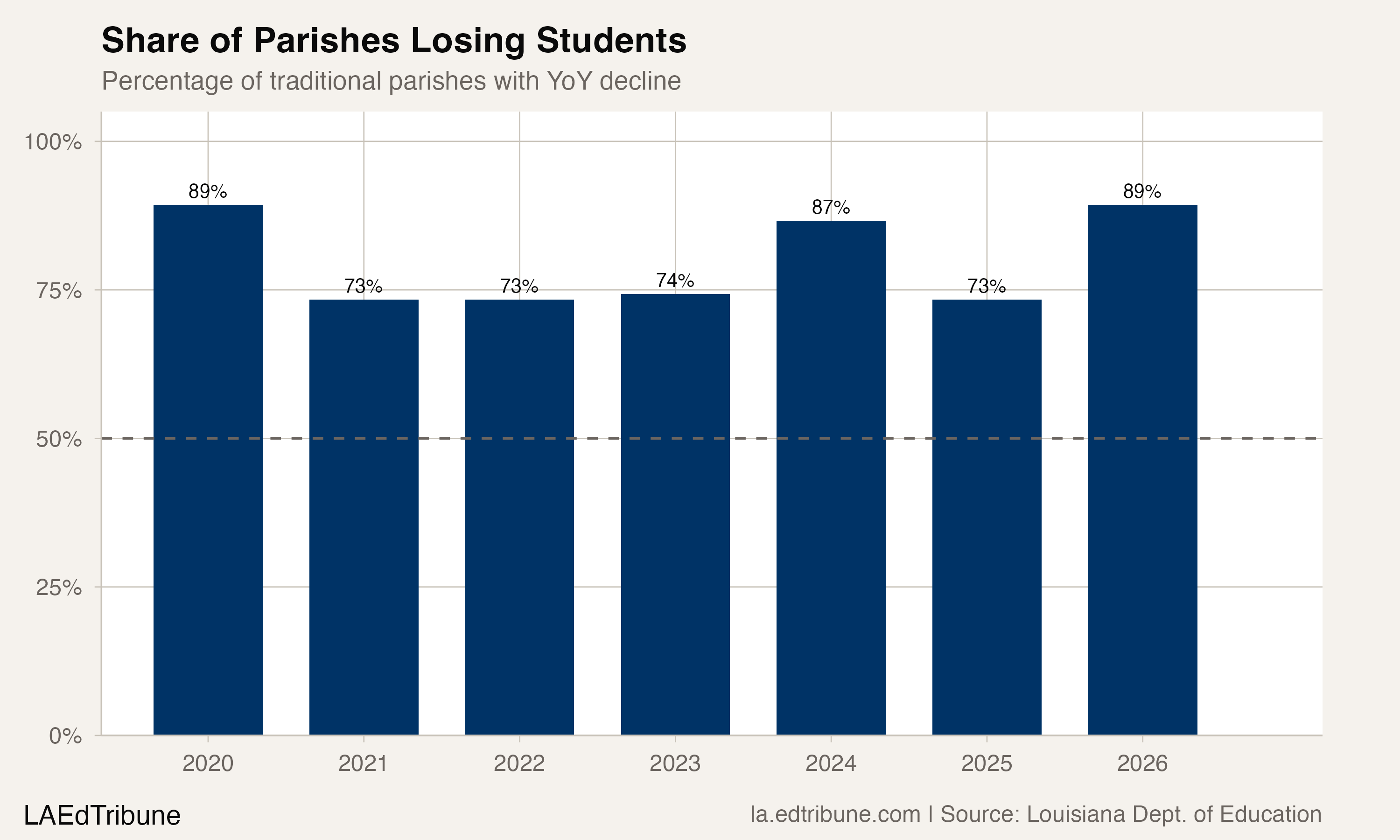
Sixty-seven of 75 traditional parishes, 89.3%, lost students in 2025-26. That matches the COVID year for the highest share in the dataset. Only eight parishes gained enrollment, and only one of those, Calcasieu Parish↗ET, gained more than 30 students.
Six parishes each lost more than 500 students:
| Parish | 2024-25 | 2025-26 | Change | Pct. |
|---|---|---|---|---|
| Jefferson↗ET | 47,459 | 45,406 | -2,053 | -4.3% |
| East Baton Rouge↗ET | 39,711 | 38,008 | -1,703 | -4.3% |
| Rapides↗ET | 21,879 | 20,997 | -882 | -4.0% |
| St. Tammany↗ET | 36,245 | 35,375 | -870 | -2.4% |
| Lafayette↗ET | 29,706 | 28,839 | -867 | -2.9% |
| Ascension↗ET | 23,950 | 23,422 | -528 | -2.2% |
Jefferson Parish alone accounted for 13.3% of the statewide loss. Combined, these six parishes lost 6,903 students, or 44.8% of the state total. The remaining 55.2% was distributed across 61 other declining parishes, most losing between 50 and 400 students each.
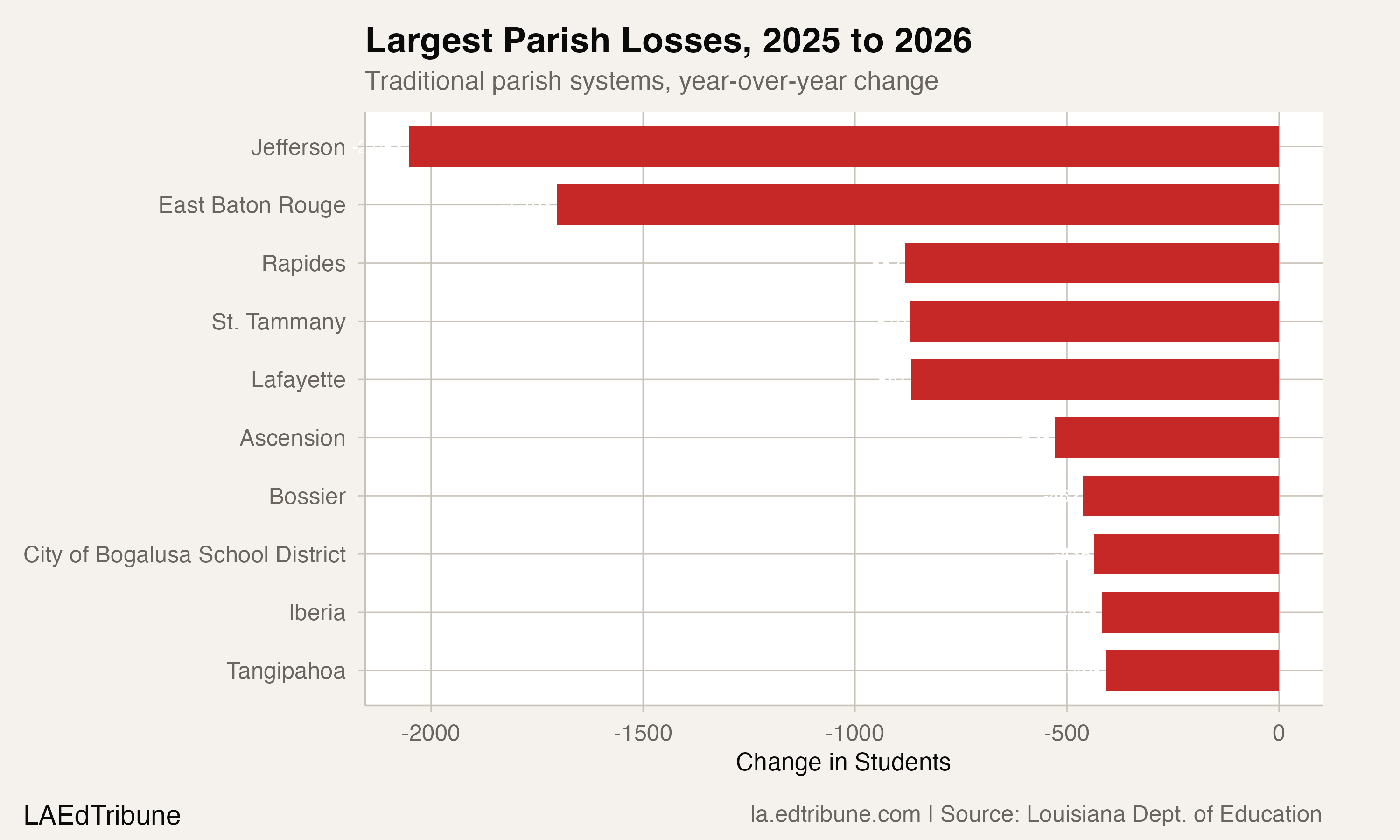
The breadth of the decline is as significant as the depth. This is not a story about one struggling urban system pulling down a state average. St. Tammany, a suburban Northshore parish, and Ascension, one of the state's fastest-growing parishes for much of the last decade, both posted significant losses. When a Baton Rouge suburb and a New Orleans commuter parish are shrinking at similar rates, the underlying force is structural, not localized.
Bogalusa↗ET, a small system in Washington Parish, posted the most extreme percentage loss at 23.7%, dropping from 1,835 to 1,400 students. For a system that small, a loss of 435 students threatens the viability of individual campuses.
Where the pipeline is narrowing
The kindergarten-to-senior comparison offers a preview of what is still coming. In 2018-19, Louisiana's traditional parishes enrolled 48,556 kindergartners and 40,410 seniors, a K-to-12th ratio of 120 to 100. By 2025-26, kindergarten had fallen to 41,885, a 13.7% decline, while 12th grade held at 38,604, a 4.5% drop. The ratio has compressed to 109 to 100.
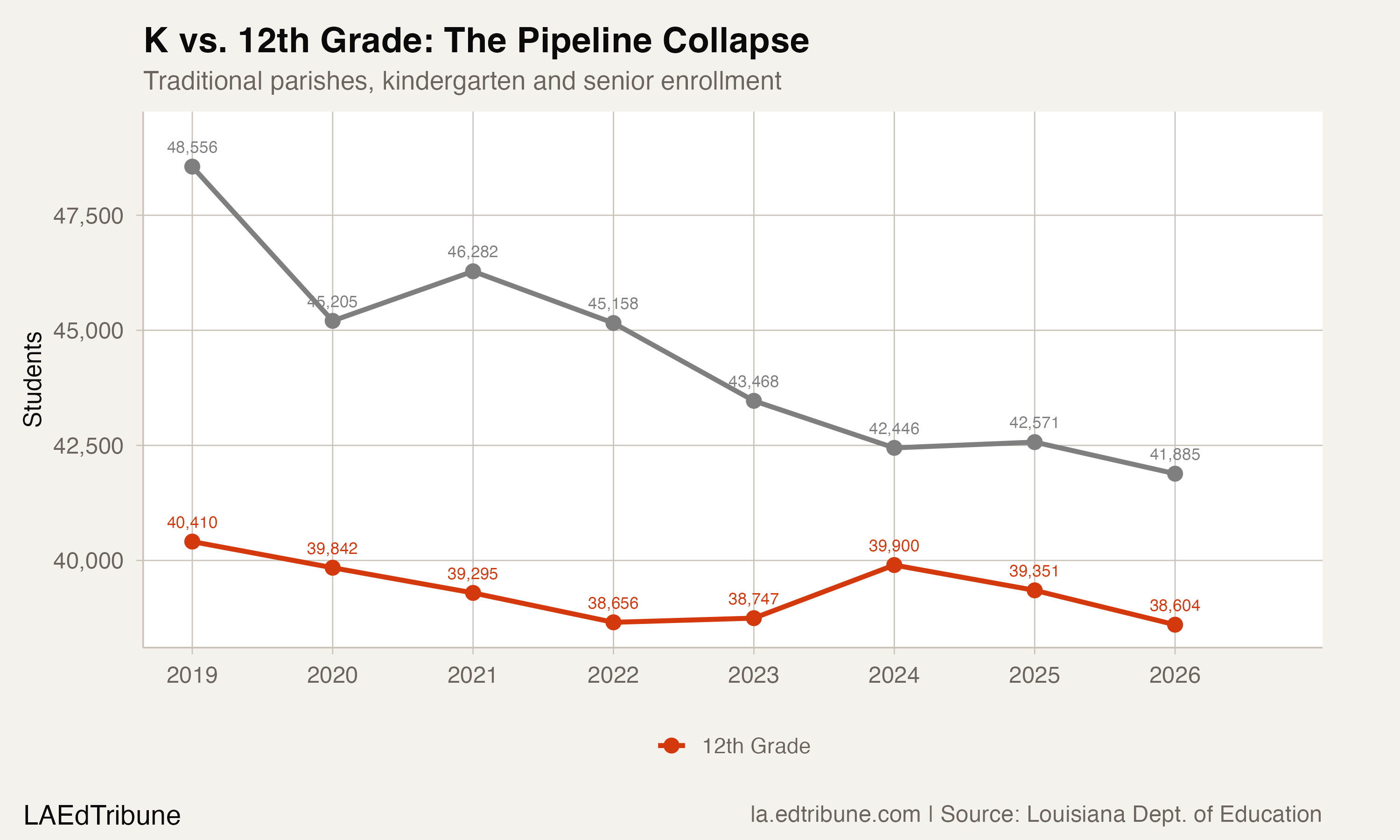
The convergence means that incoming cohorts are substantially smaller than graduating ones. Each year's kindergarten class will take 13 years to pass through the system, carrying its smaller size with it. If 2025-26 kindergarten numbers approximate the trend, the enrollment decline currently concentrated in elementary grades will reach middle schools by 2030 and high schools by 2034.
A state losing its people
The most likely driver of this decline is demographic: Louisiana is losing population. The state shed roughly 50,000 residents between 2020 and 2024, though 2024 brought a slight gain credited largely to international immigration. Domestic outmigration has not stopped: roughly 17,000 more people moved out of Louisiana than moved in during 2024, according to Census estimates.
The population loss maps closely onto the enrollment loss. Two-thirds of Louisiana parishes saw population declines in 2024. Caddo and Orleans parishes ranked among the top five fastest-shrinking large counties nationally.
Birth rate decline compounds the problem. As the Public Affairs Research Council of Louisiana noted in a 2024 report:
"With fewer women of child-bearing age living in Louisiana, there will naturally be fewer babies born in the state. The state has lost about 50,000 people in the last five years, and some of that is certainly among the child-bearing age population." -- Red River Radio, Aug 2024
A competing explanation is the growth of alternatives to traditional public schools. Homeschooling in Louisiana has surged 74% over the past decade, and charter enrollment has expanded, though charter entities are reported separately in this analysis. The two forces, demographic shrinkage and school-choice expansion, are not mutually exclusive. Both can be true simultaneously, and the data cannot distinguish how much of the 15,424-student loss reflects families leaving the state versus families choosing a different kind of school within it.
The funding math
The fiscal consequences are direct. Louisiana funds schools on a per-pupil basis, and the state Department of Education projects that declining enrollment will reduce state spending by approximately $42 million in the coming fiscal year. State Superintendent Cade Brumley has recommended lawmakers approve $47 more per student, nearly a 50% increase, for mandatory costs such as employee health insurance, retirement contributions, and fuel. The base per-pupil funding amount has not changed since 2019.
The structural mismatch is familiar to declining districts nationwide: fixed costs do not shrink with enrollment. Electricity, building maintenance, and transportation routes cost roughly the same whether a school serves 400 students or 350. In New Orleans, which has faced its own enrollment decline within the charter-managed system, nine schools had at least 20% of available seats empty as of early 2025, and nine schools have closed since the enrollment crisis began. The city's district data chief Max Daigh summed it up: "The district can't enroll kids who don't exist."
Fifty-five parishes at record lows
The 2025-26 school year pushed 55 of 75 traditional parishes, 73.3%, to their lowest enrollment in the eight years of available data. That figure understates the severity: for most of these parishes, each of the last several years has set a new record low. The decline is not episodic. It is compounding.
In New Orleans, nine schools have already closed. In Caddo Parish, three more shut down in 2025-26. In East Baton Rouge, nine schools were consolidated, displacing over 10,000 students. Each of these closures followed years of incremental losses that seemed manageable until they were not. The 2025-26 data brought that reckoning to 55 parishes at once.
The Minimum Foundation Program sends roughly $4,015 per student in base funding. The 15,424 students Louisiana lost in 2025-26 represent roughly $62 million in annual state revenue that is not coming back. The buildings those students attended are still there, still requiring heat and maintenance and a principal. For 67 parishes that lost enrollment in a single year, the math is the same in every one: the costs stay and the funding leaves.
Detailed code that reproduces the analysis and figures in this article is available exclusively to EdTribune subscribers.
Discussion
Sign in to join the discussion.
Loading comments...