Correction (July 20, 2026): The 2025 rates and annual white-Hispanic gaps were correct, but an earlier version said the gap had not narrowed despite the Hispanic subgroup's larger endpoint gain. It narrowed by 1.0 point from 2018 to 2025, though it changed direction repeatedly in between. The earlier version also inferred unobserved graduation rates for English-proficient Hispanic students and attributed parish differences to immigrant settlement patterns; the package does not publish the cross-tabulated cohort data needed to support those claims.
Louisiana's white-Black graduation gap has been narrowing. The special education gap collapsed. The poverty gap sits under 5 points.
The white-Hispanic gap has done none of those things.
Hispanic students graduated at 72.8% in 2025, a rate that puts them 16.8 percentage points behind white students at 89.6% and 12.2 points below the state average of 85%. The gap has swung between 13.2 and 18.8 points over seven years without any consistent direction, and it currently sits wider than it was at its narrowest point in 2021.
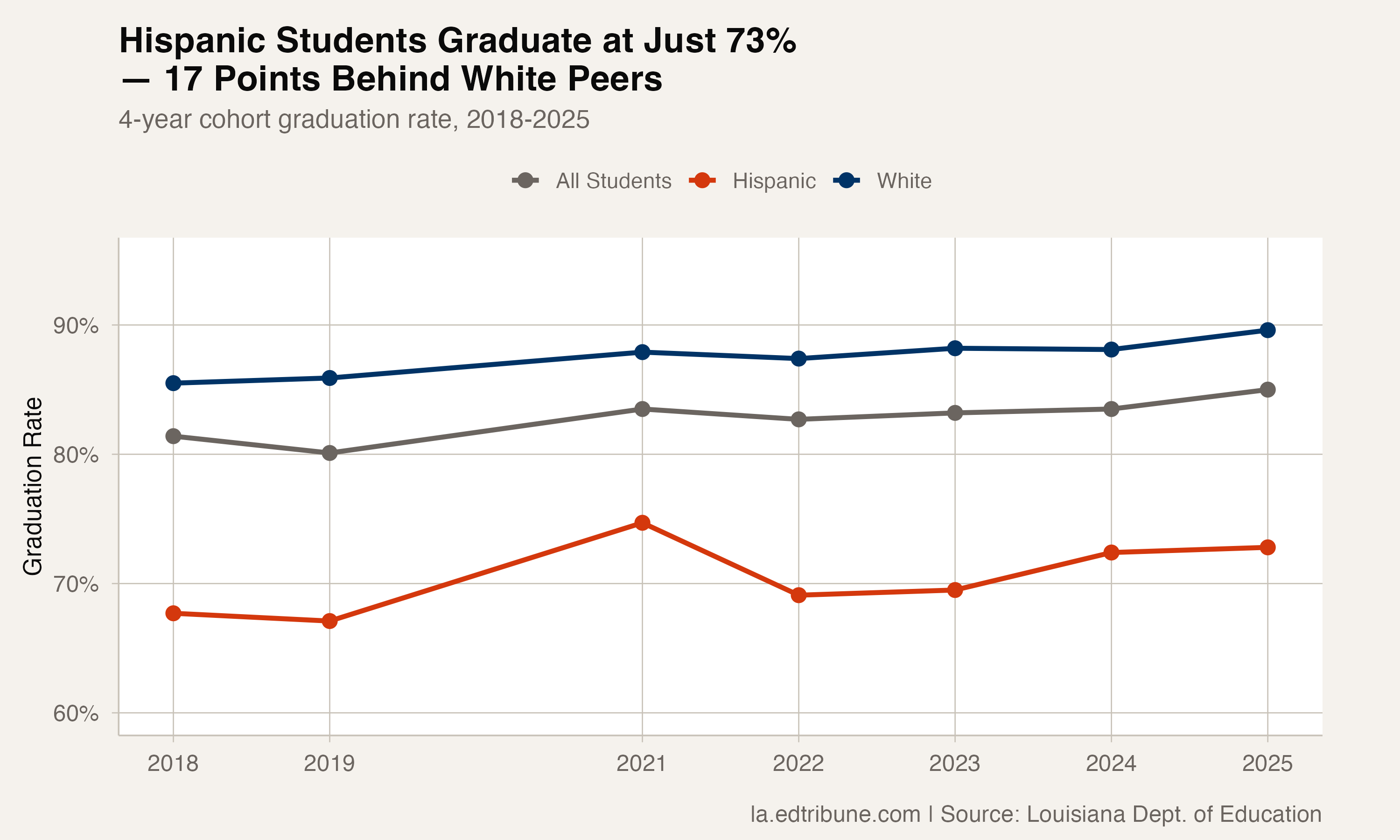
A gap that refuses to close
The white-Hispanic graduation gap has been uniquely erratic:
- 2018: 17.8 points
- 2019: 18.8 points (widest)
- 2021: 13.2 points (narrowest)
- 2022: 18.3 points
- 2023: 18.7 points
- 2024: 15.7 points
- 2025: 16.8 points
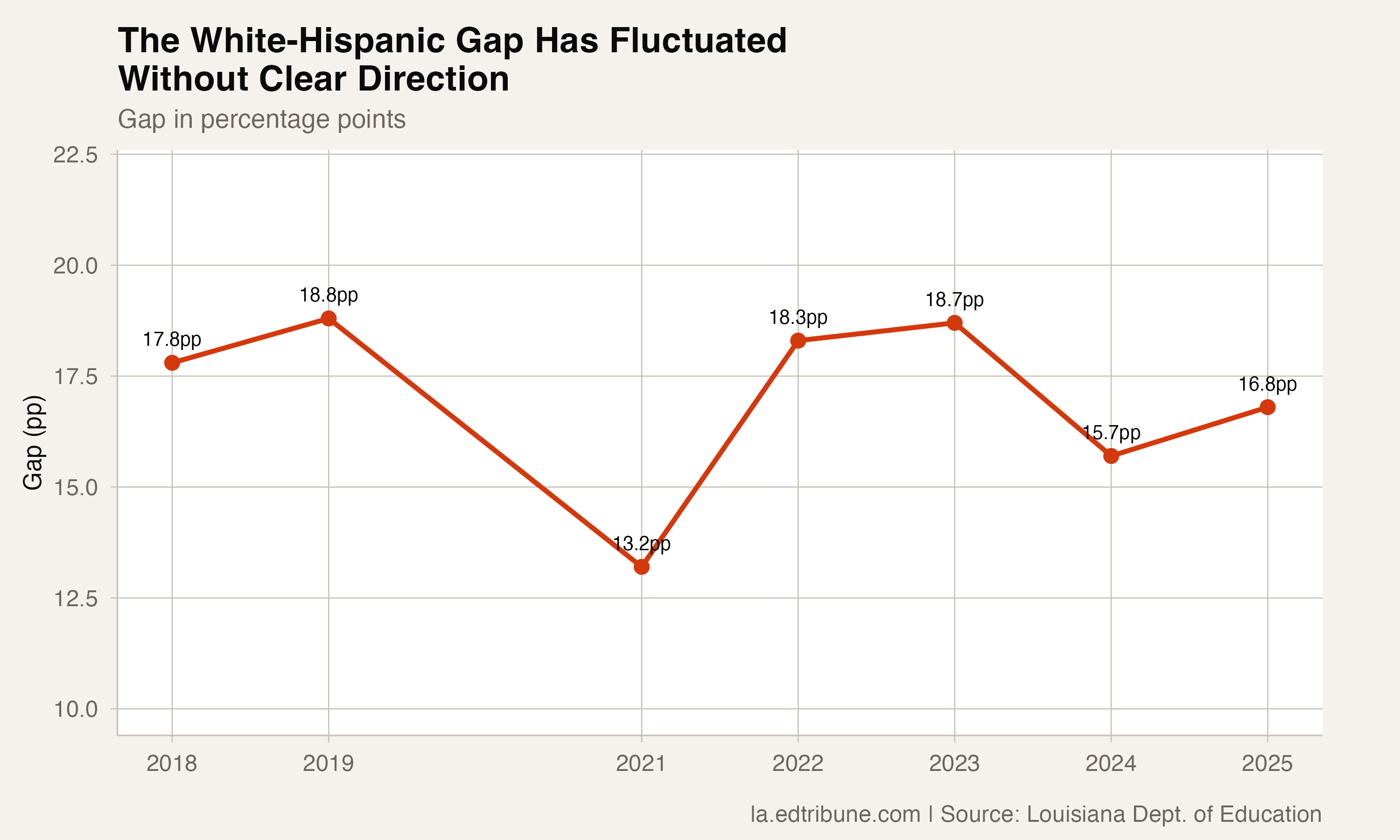
The 2021 narrowing to 13.2 points looked promising, driven by a Hispanic rate that jumped to 74.7%. But the rate fell back to 69.1% in 2022, and the gap ballooned to 18.3 points in a single year. The pattern repeated on a smaller scale: improvement to 72.4% in 2024, a slight widening to 16.8 points in 2025 despite the Hispanic rate ticking up to 72.8%.
The series changed direction repeatedly. The package reports subgroup rates but not the underlying cohort counts, so it cannot establish whether the swings reflect cohort size, composition, policy, or another mechanism.
The LEP connection
Hispanic students graduate at 72.8%. English learners graduate at 51.7%, a 21.1-point difference between two overlapping but distinct groups.
The files do not cross-tabulate race and English-learner status. That means the analysis cannot determine the English-learner share of the Hispanic cohort, calculate an English-proficient Hispanic rate, or attribute changes in the Hispanic rate to English-learner composition.
Where the gap is widest
The statewide figure masks extreme variation at the parish level.
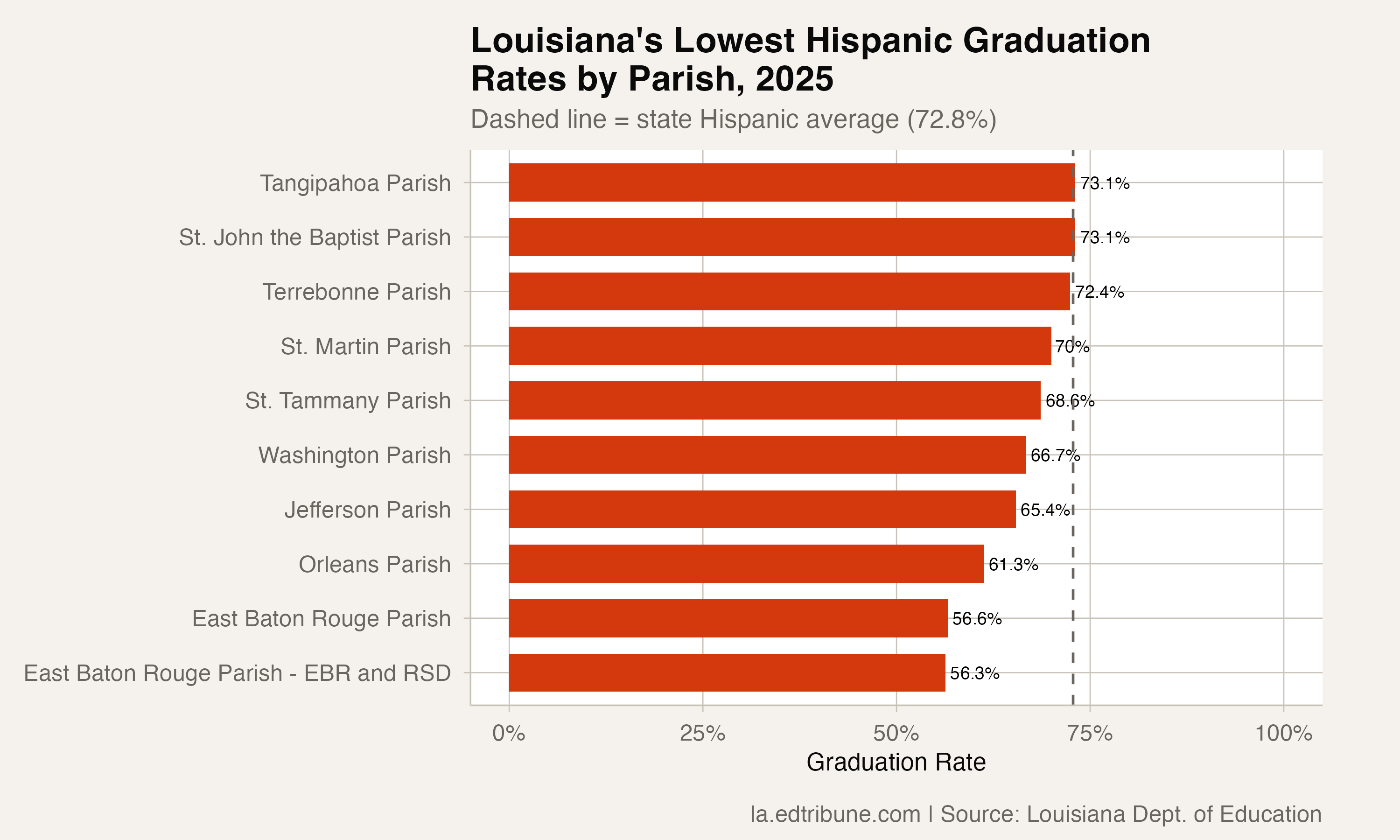
East Baton Rouge Parish↗ET graduated 56.6% of Hispanic students in 2025. Orleans Parish↗ET was at 61.3%. Jefferson Parish↗ET posted 65.4%. Each rate is below the 72.8% statewide Hispanic rate.
The package does not include the cross-tabulated demographic data needed to explain those parish differences.
Improvement without momentum
Hispanic students have gained 5.1 percentage points since 2018 (67.7% to 72.8%), a larger raw improvement than white students (4.1 points) or Black students (4.8 points). The white-Hispanic gap therefore ended 1.0 point narrower than in 2018.
That endpoint improvement was not steady. The 5.6-point drop from 2021 to 2022 (74.7% to 69.1%) interrupted the upward movement, and the gap changed direction several times across the series.
At 72.8%, the implied non-graduation share is 27.2% -- more than one in four Hispanic students. The rate has improved from 67.7% in 2018 and 67.1% in 2019 to the low 70s, but the gap to white peers remains wide and volatile.
Detailed code that reproduces the analysis and figures in this article is available exclusively to EdTribune subscribers.
Discussion
Sign in to join the discussion.
Loading comments...