The gap between white and Black graduation rates in Louisiana narrowed to 6.7 percentage points in 2025, the smallest it has been in the seven years of available data.
White students graduated at 89.6%. Black students graduated at 82.9%. The distance between them has been shrinking because Black students have been improving faster: 4.8 points of gain since 2018 compared to 4.1 points for white students.
The gap had widened to 10.3 points in 2019, its widest recorded level, when Black students fell to 75.6% while white students held at 85.9%. Since then, the trend has moved in one direction.
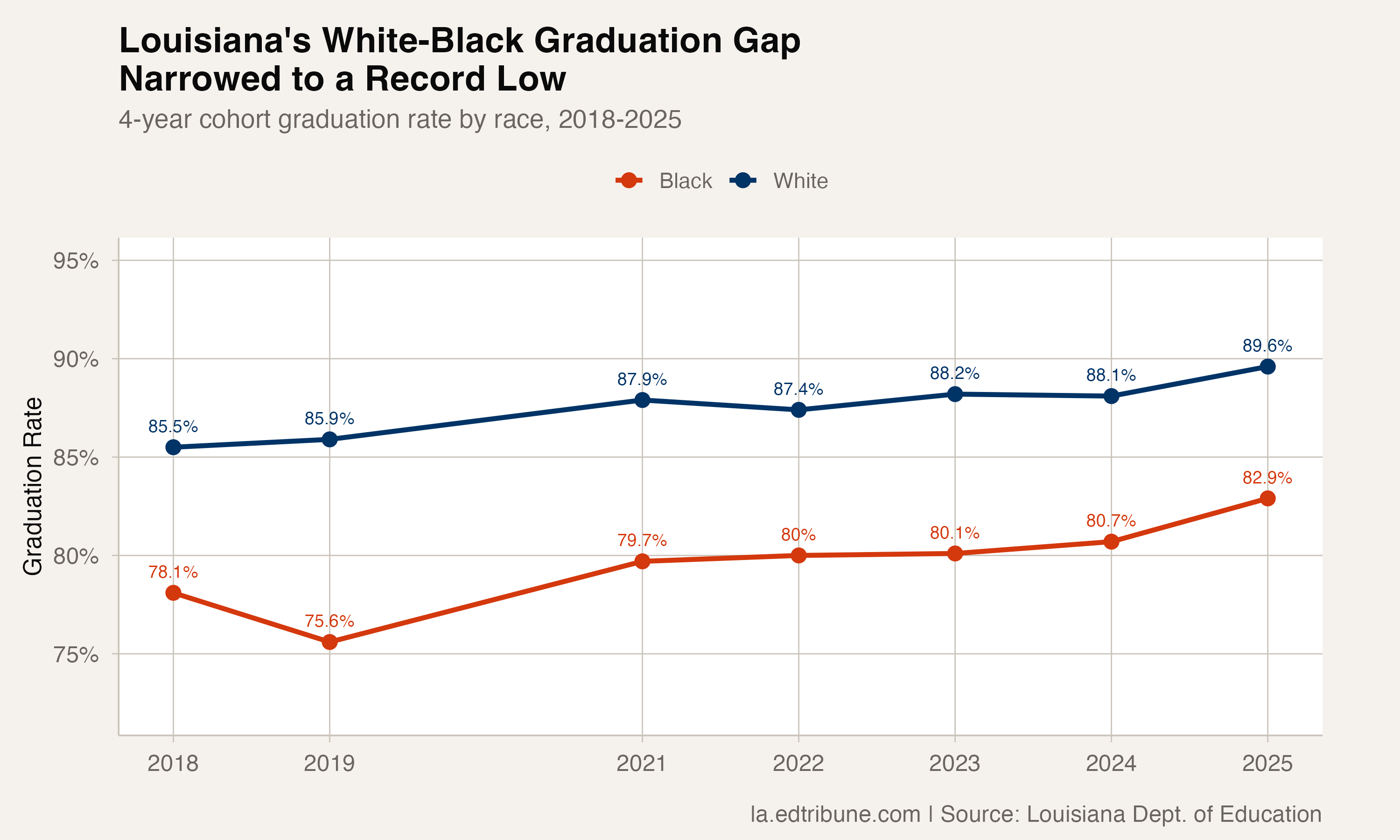
The narrowing is not linear
The gap has not closed in a steady line. It widened from 7.4 points in 2018 to 10.3 in 2019, narrowed to 8.2 in 2021, held at 7.4 in 2022, widened again to 8.1 in 2023, returned to 7.4 in 2024, and then dropped to its record low of 6.7 in 2025.
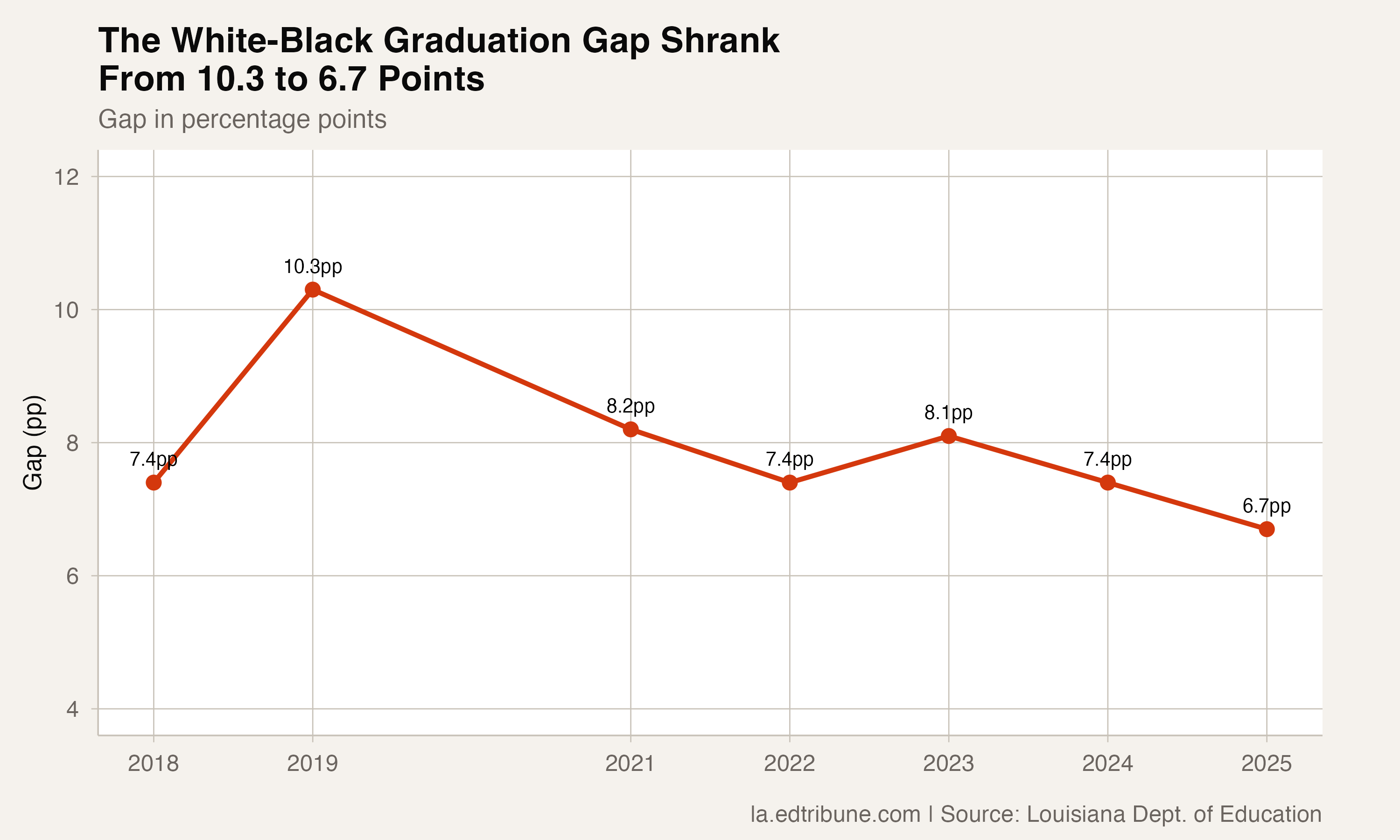
The 2019 spike corresponds to a year when Black students had an unusually poor graduation outcome: 75.6%, down 2.5 points from 2018 while white students actually gained 0.4 points. The 2025 narrowing is driven by a strong Black improvement year: plus 2.2 points (from 80.7% to 82.9%) against a smaller white gain of 1.5 points (from 88.1% to 89.6%).
Black students are now within 2 points of the state average
The gap between Black students and the overall state average tells an even more striking story. In 2019, Black students graduated 4.5 points below the state rate. In 2025, that gap has shrunk to 2.1 points. Black students at 82.9% are closer to the state average of 85% than at any point in the data.
For a state where Black students constitute a large share of total enrollment, this convergence matters structurally. Each point of Black rate improvement lifts the state average more than the equivalent gain among smaller subgroups.
How Louisiana compares
A 6.7-point white-Black graduation gap is narrower than what most states report. Nationally, the typical gap runs between 8 and 15 points. Louisiana's narrower gap partly reflects the state's overall rate distribution: white students at 89.6% are not far above the national white average, while Black students at 82.9% exceed the national Black average in many comparisons.
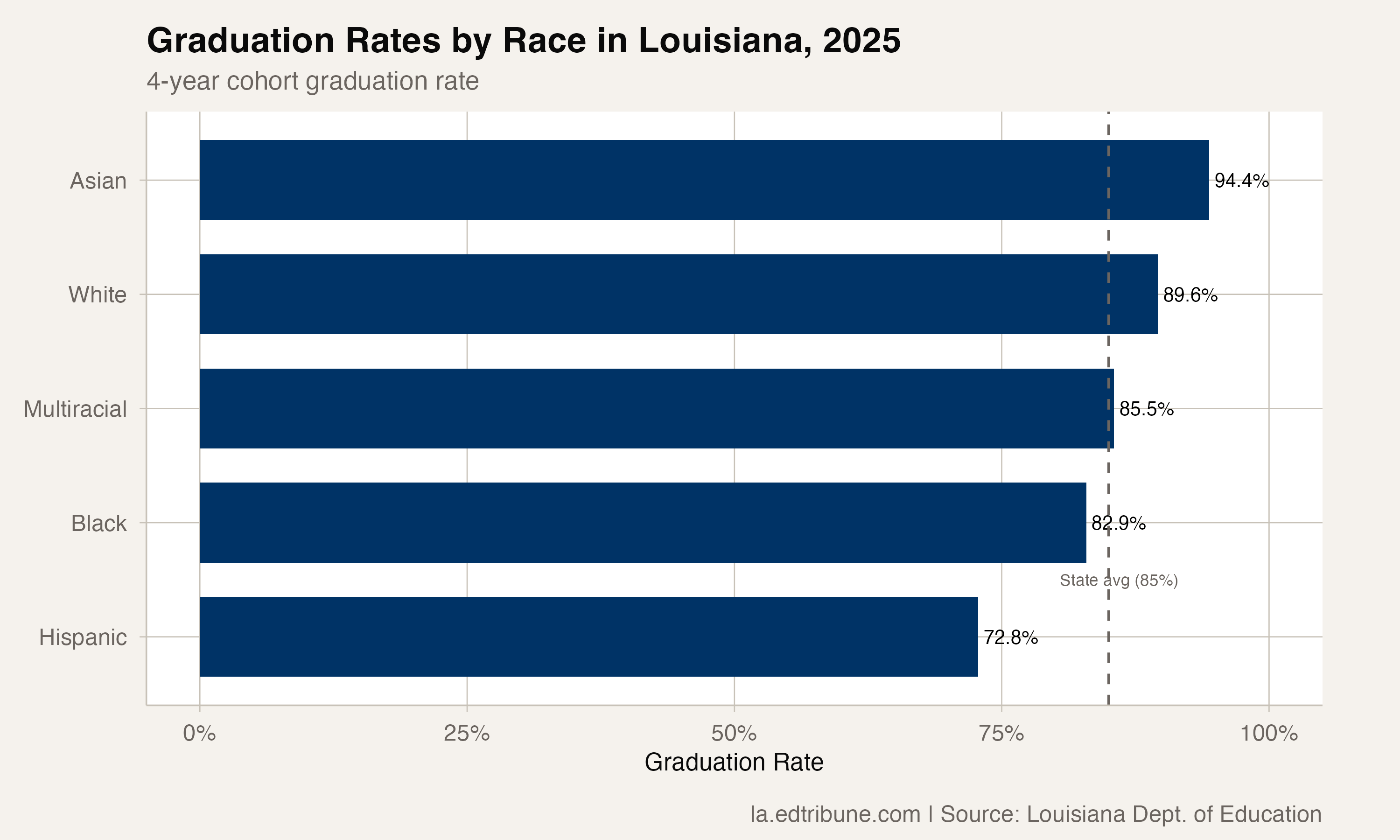
The remaining racial gaps in Louisiana vary widely. The white-Hispanic gap is 16.8 points (89.6% vs. 72.8%), more than double the white-Black gap. Asian students lead at 94.4%. Multiracial students graduate at 85.5%, essentially at the state average.
What it means
A narrowing graduation gap does not mean the underlying conditions that produce it are improving at the same rate. Black disconnection rates, childhood poverty, and school resource inequities in Louisiana remain among the worst in the nation. The graduation rate measures a single four-year outcome, not the quality of the educational experience that produced it.
Still: Black students in Louisiana are graduating at higher rates than at any point in the recorded data, and the gap to their white peers is the smallest it has ever been. Both facts are true at the same time.
Detailed code that reproduces the analysis and figures in this article is available exclusively to EdTribune subscribers.
Discussion
Sign in to join the discussion.
Loading comments...