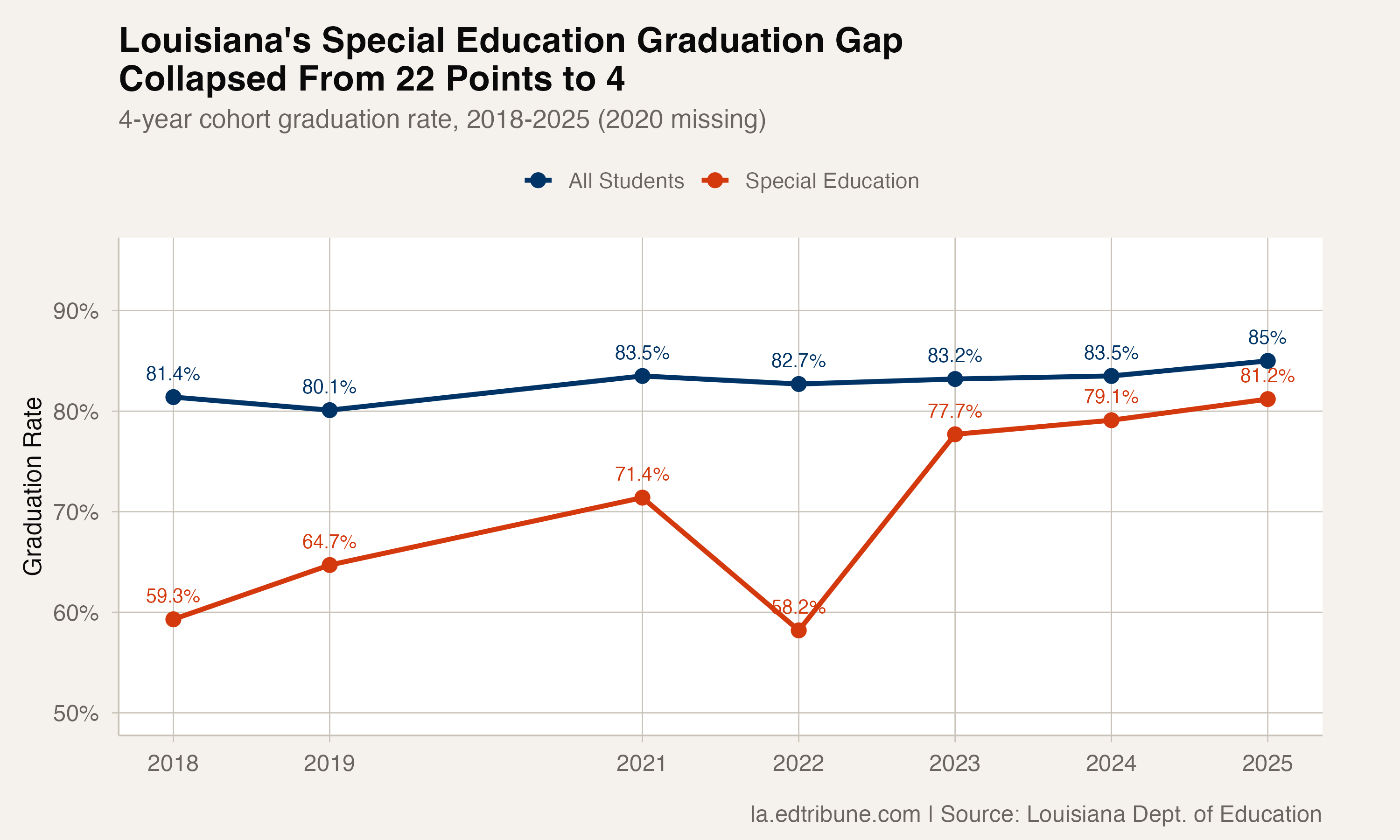
In 2018, barely three out of five students who receive special education services in Louisiana earned a diploma within four years. The 59.3% graduation rate for students with disabilities sat 22.1 percentage points below the statewide average of 81.4%, a gap that looked permanent.
Seven years later, the picture has inverted. Students who receive special education services graduated at 81.2% in 2025, just 3.8 percentage points behind the state's all-time high of 85%. The gap has collapsed by more than 18 points, a pace of improvement that outstrips every other subgroup in the state and most states nationally.
The gains are real. But a closer look at the data reveals a story that is more complicated than a straight upward march.
Two distinct eras of progress
The trajectory splits cleanly into two periods, with 2022 as the dividing line.
From 2018 to 2021, the rate for students with disabilities climbed from 59.3% to 71.4%, a steady 12.1-point gain over four data years. The improvement was consistent: 5.4 points in 2019, then another 6.7 points by 2021 (with 2020 missing due to COVID). The gap narrowed from 22.1 points to 12.1.
Then came 2022. The rate for students with disabilities crashed to 58.2%, erasing nearly all prior gains in a single year. The gap ballooned to 24.5 points, its widest level on record.
What followed was equally dramatic. In 2023, the rate jumped 19.5 points to 77.7%, and it has continued climbing to 79.1% in 2024 and 81.2% in 2025.
What explains the 2022 break?
The 19.5-point swing from 2022 to 2023 is too large to be organic improvement. Nationally, the typical gap between students with disabilities and all students runs between 30 and 40 percentage points. A gap that narrows by 19 points in one year almost always signals a policy or methodology change.
Louisiana revised its accountability system in 2024, placing new emphasis on career education, college preparation, and military readiness pathways. But the graduation rate jump occurred in 2023, a year before the new accountability framework. The most likely explanation is a change in how diplomas or completion credentials for students who receive special education services were counted, potentially broadening which credential pathways count toward the four-year cohort rate.
Whatever the cause, the post-2022 era shows a consistent upward trajectory: 77.7% to 79.1% to 81.2% over three consecutive years. The improvement within the new methodology appears to be genuine.
The gap in context
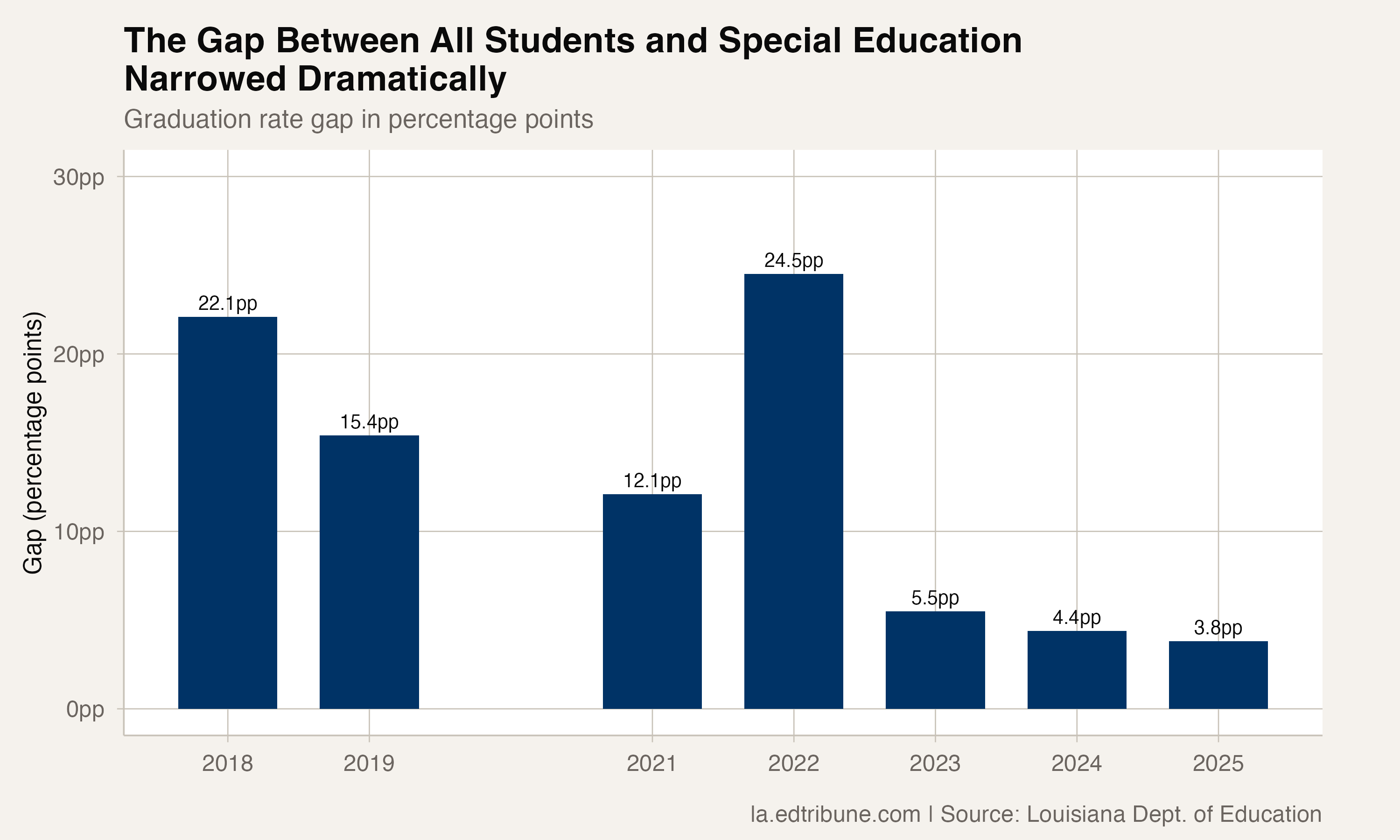
At 3.8 percentage points, Louisiana's 2025 gap for students with disabilities is extraordinary by national standards. Most states report gaps of 30 points or more between their overall graduation rate and the rate for students with disabilities. Even accounting for the likely methodology change, a gap under 5 points places Louisiana in rare territory.
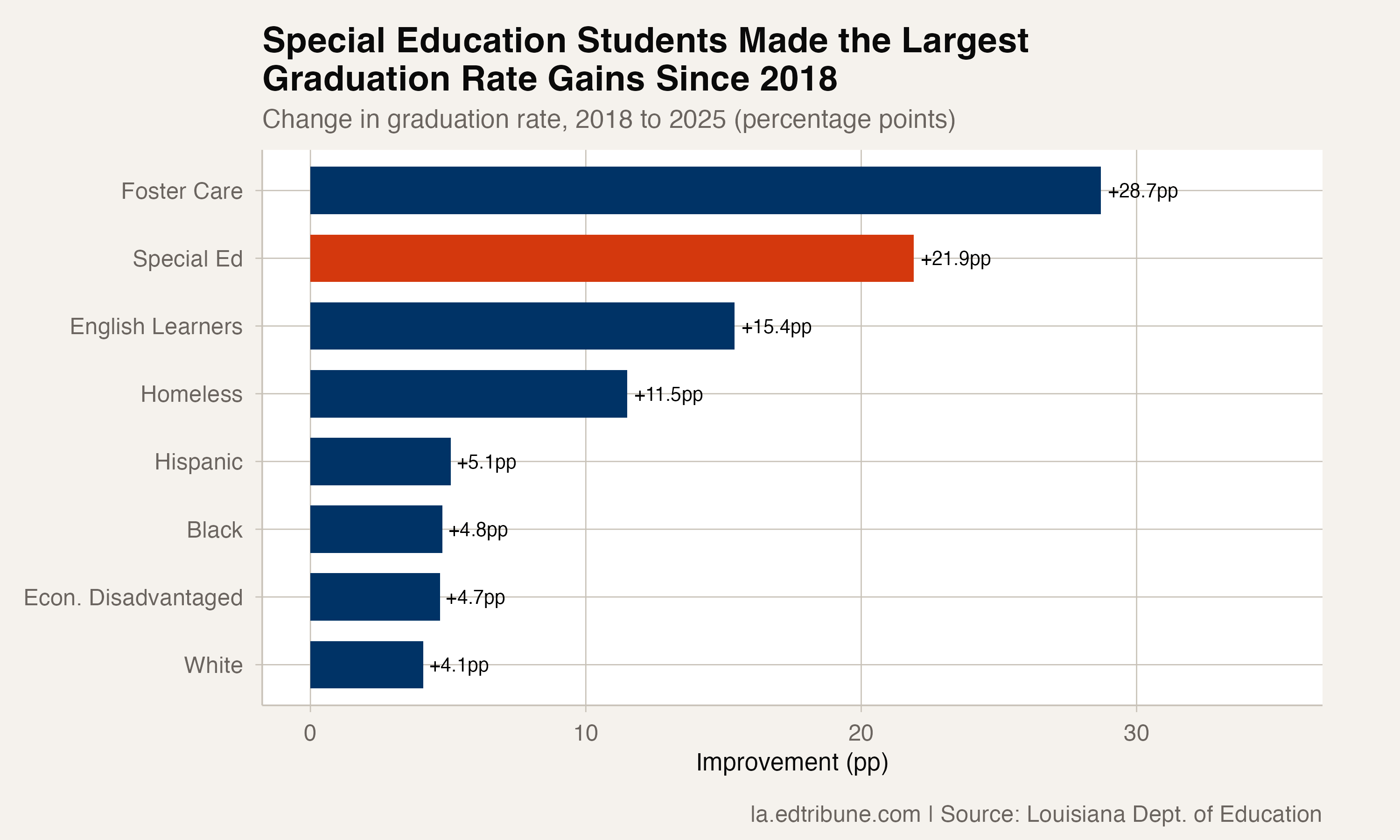
The 21.9-point improvement since 2018 for students who receive special education services is the second-largest subgroup gain in Louisiana, trailing only students who have been in foster care, who climbed 28.7 points (though on a much more volatile path). By comparison, Black students gained 4.8 points, Hispanic students 5.1, and white students 4.1.
What remains uncertain
The data does not reveal how much of the improvement reflects genuinely better outcomes for students with disabilities and how much reflects reclassification of what counts as graduation. Both can be true simultaneously: broader credential recognition can capture real student achievement that a narrower definition missed.
Louisiana does not publish cohort counts in its graduation rate data, making it impossible to determine whether the same number of students are being tracked or whether the denominator has changed. The state also lacks published documentation on any diploma-pathway changes specific to special education.
The 2022 dip followed by the 2023 surge strongly suggests a break in the data series. Trending a single line from 59.3% in 2018 to 81.2% in 2025 overstates the organic improvement, even though the overall direction is unmistakably positive.
Detailed code that reproduces the analysis and figures in this article is available exclusively to EdTribune subscribers.
Discussion
Sign in to join the discussion.
Loading comments...