Louisiana's graduation rate hit 85% in 2025, its highest on record. Every major racial subgroup improved. The special education gap collapsed. The poverty gap narrowed to under 5 points.
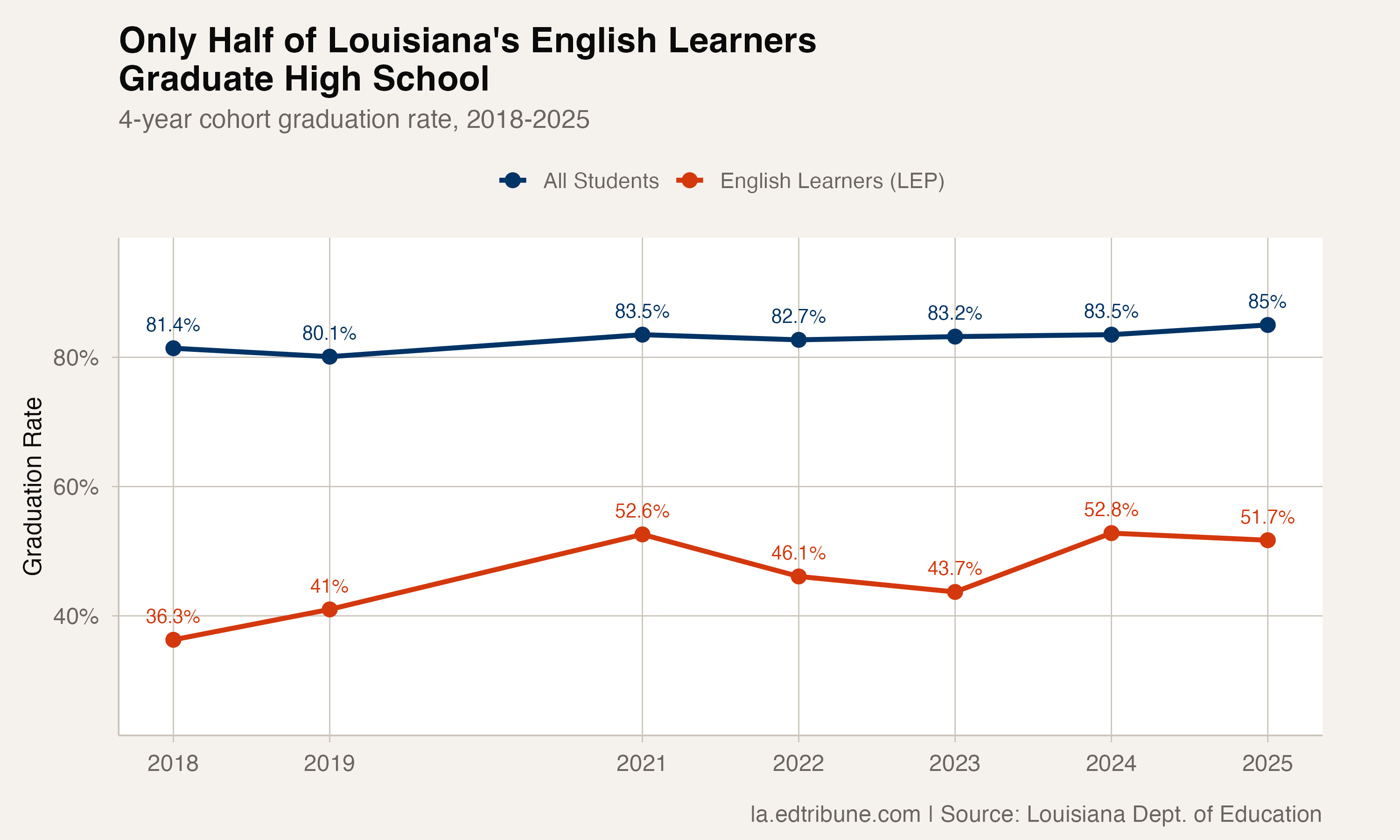
But one group missed the rising tide entirely. Students who are classified as English learners graduated at 51.7% in 2025, meaning nearly half leave high school without a diploma within four years. The 33.3-point gap between English learners and the state average is the widest of any subgroup in the state, dwarfing the poverty gap (4.8 points), the white-Black gap (6.7 points), and even the special education gap (3.8 points).
A volatile trajectory going nowhere
The LEP graduation rate has not followed any discernible trend over seven years. It started at 36.3% in 2018, surged to 52.6% in 2021, crashed to 43.7% in 2023, recovered to 52.8% in 2024, then slipped again to 51.7% in 2025.
The pattern suggests that the LEP cohort is small enough for year-to-year noise to overwhelm any underlying trend. A few dozen additional graduates or dropouts can swing the rate by several points. The 16.5-point difference between the 2018 low and the 2024 peak may reflect real improvement or may reflect compositional changes in who gets classified as LEP.
What is clear: the rate has hovered around 50% for the last five years. That ceiling has proven remarkably sticky.
The widest gap in Louisiana
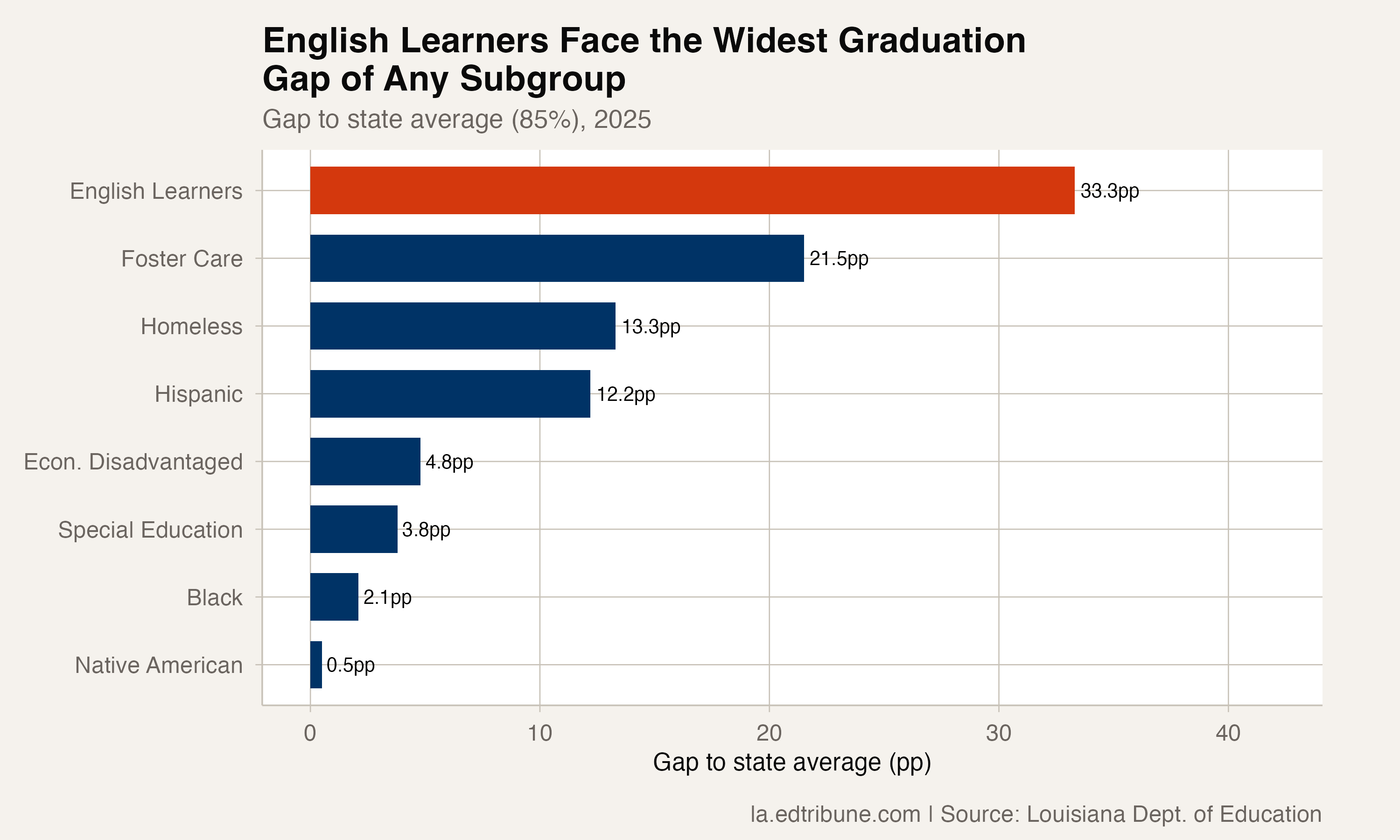
At 33.3 percentage points, the LEP gap is nearly nine times wider than the special education gap (3.8 points) and more than 11 points above the foster care gap (21.5 points). It is about seven times the poverty gap.
The comparison to special education is particularly telling. In 2018, the special education gap (22.1 points) was smaller than the LEP gap (45.1 points), and both groups faced structural barriers to on-time graduation. By 2025, the special education gap had collapsed to 3.8 points while the LEP gap barely budged from 45 to 33 points. Whatever drove the special education improvement did not reach English learners.
Not just a Hispanic issue
Hispanic students graduated at 72.8% in 2025, more than 20 points above the LEP rate. The gap between Hispanic students overall and the LEP subgroup illustrates that language proficiency, not ethnicity, is the binding constraint.
Many Hispanic students are not classified as LEP. They were either born in the U.S. and are proficient in English, or they exited LEP status before their cohort graduation year. The students who remain in the LEP classification through high school are disproportionately recent arrivals who face the structural mismatch at the heart of this problem: a four-year graduation timeline for students who may need years to achieve English proficiency.
A structural problem, not just a performance problem
The four-year cohort graduation rate penalizes students who need more time. For English learners who arrive in U.S. schools during middle or high school, four years may not be enough to learn English, complete required coursework, and pass exit requirements. A five-year or six-year rate for students classified as English learners would likely tell a different story, but Louisiana does not publish extended-year rates by subgroup.
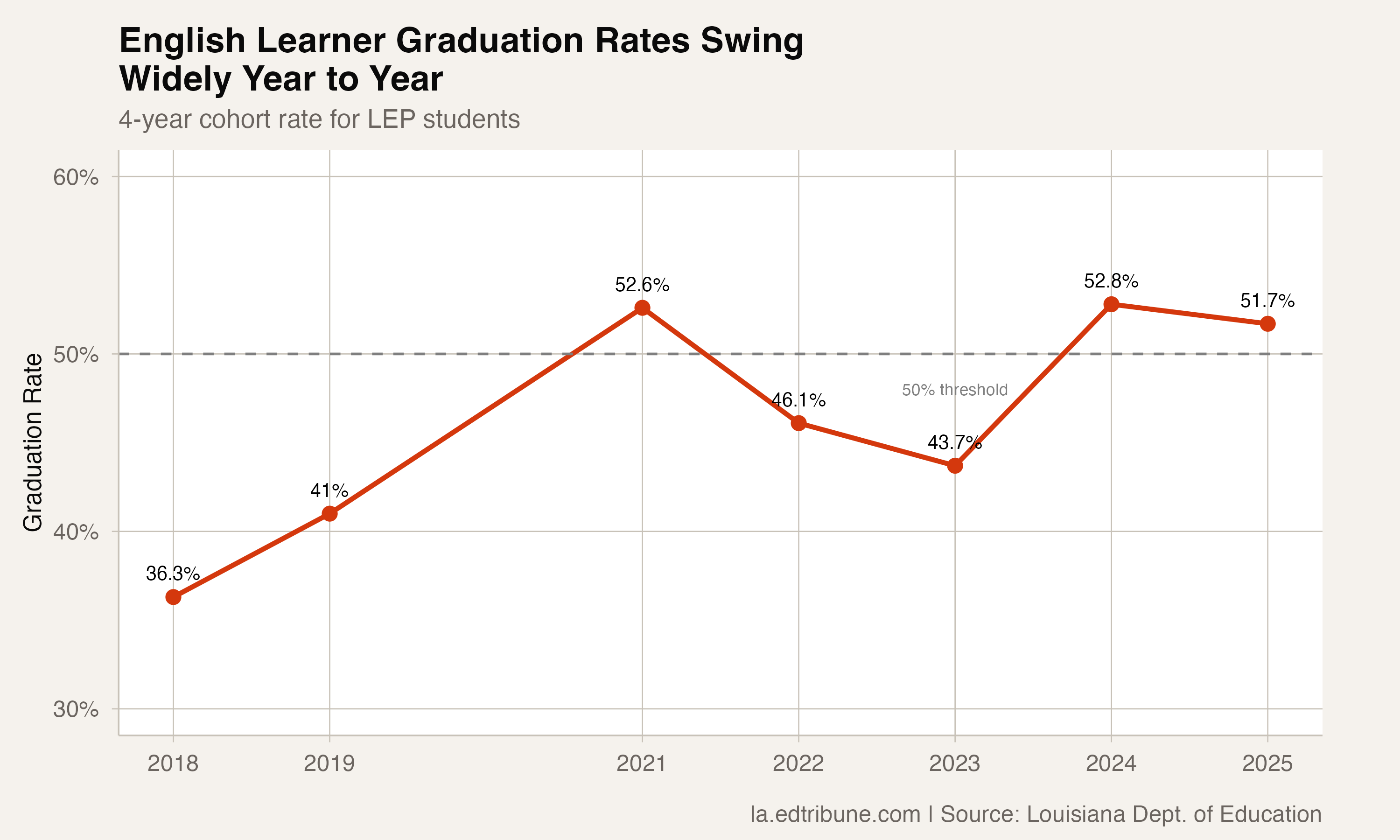
The volatility of the rate points to a structural problem, not a performance one. In systems where outcomes depend primarily on instruction quality, rates tend to move gradually. The wild swings in Louisiana's LEP rate suggest that cohort composition matters as much as or more than what happens inside schools.
None of this diminishes the severity of the outcome. Whatever the cause, nearly half of students who are classified as English learners reach the four-year mark without a diploma each year in Louisiana. The 33-point gap to the state average represents not just an achievement challenge but a question of how the graduation system itself is designed to measure success for students acquiring a new language.
Detailed code that reproduces the analysis and figures in this article is available exclusively to EdTribune subscribers.
Discussion
Sign in to join the discussion.
Loading comments...