In 2018, barely one in three Louisiana students in foster care graduated within four years. The 34.8% rate was the lowest of any subgroup the state tracked, nearly 47 percentage points behind the state average.
By 2025, that rate had climbed to 63.5%. The 28.7-point improvement is the largest gain of any subgroup in Louisiana over the past seven years, outpacing even the special education surge of 21.9 points. Students in foster care gained ground faster than students who are currently homeless (11.5 points), English learners (15.4 points), and students who are economically disadvantaged (4.7 points).
The trajectory, though, was not smooth.
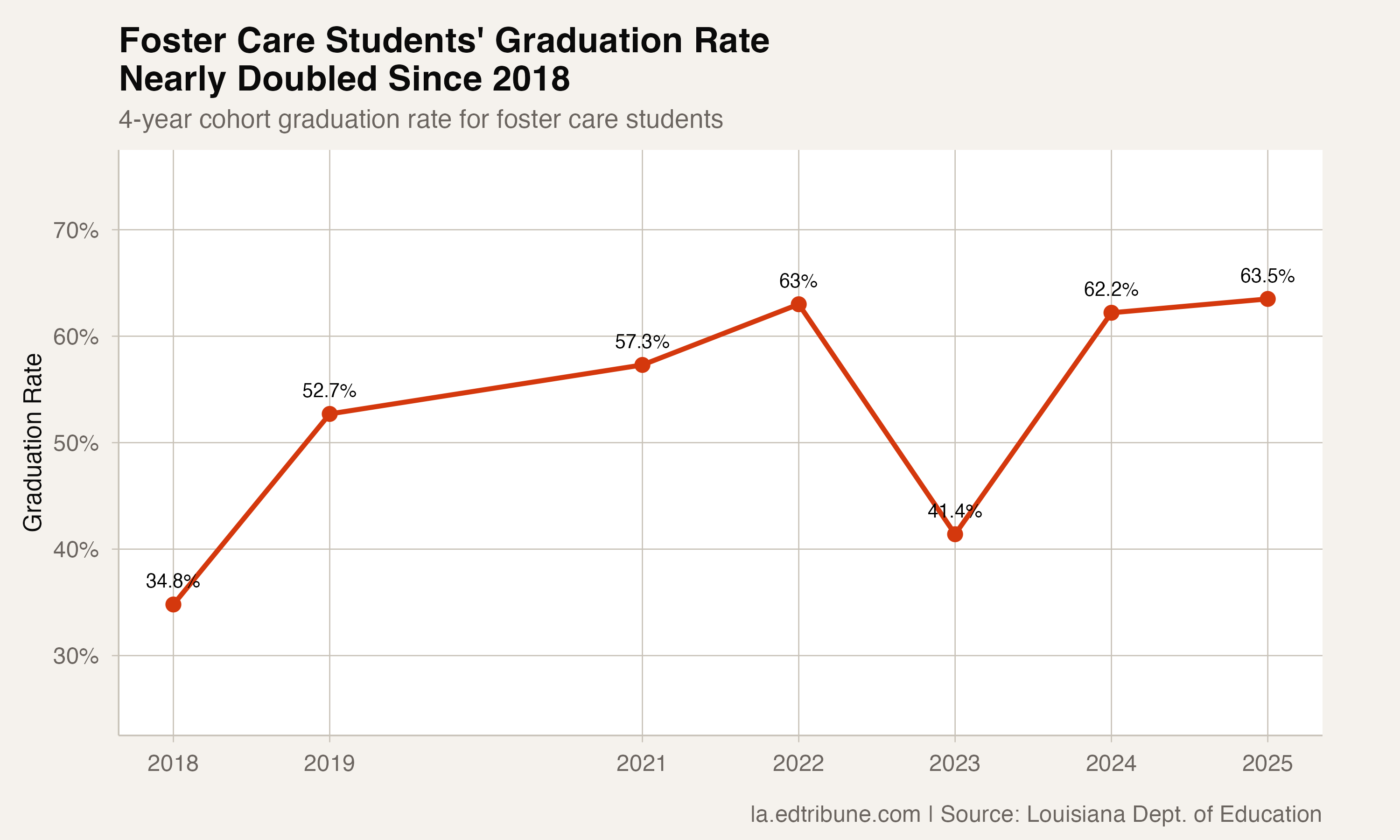
A jagged path upward
The rate jumped 17.9 points in a single year, from 34.8% in 2018 to 52.7% in 2019. It continued climbing to 57.3% in 2021 and 63% in 2022. Then it fell to 41.4% in 2023, erasing more than two years of progress, before recovering to 62.2% in 2024 and 63.5% in 2025.
The 21.6-point swing from 2022 to 2023 and the 21-point recovery from 2023 to 2024 are too large to be explained by changes in instructional quality. The foster care cohort is small, so a handful of additional graduates or dropouts can move the rate by double digits. The 2023 dip is most likely a statistical artifact of small-N volatility rather than a genuine collapse in outcomes.
Excluding the 2023 outlier, the trajectory from 2019 to 2025 shows a consistent upward pattern: 52.7%, 57.3%, 63%, 62.2%, 63.5%.
The gap narrowed dramatically
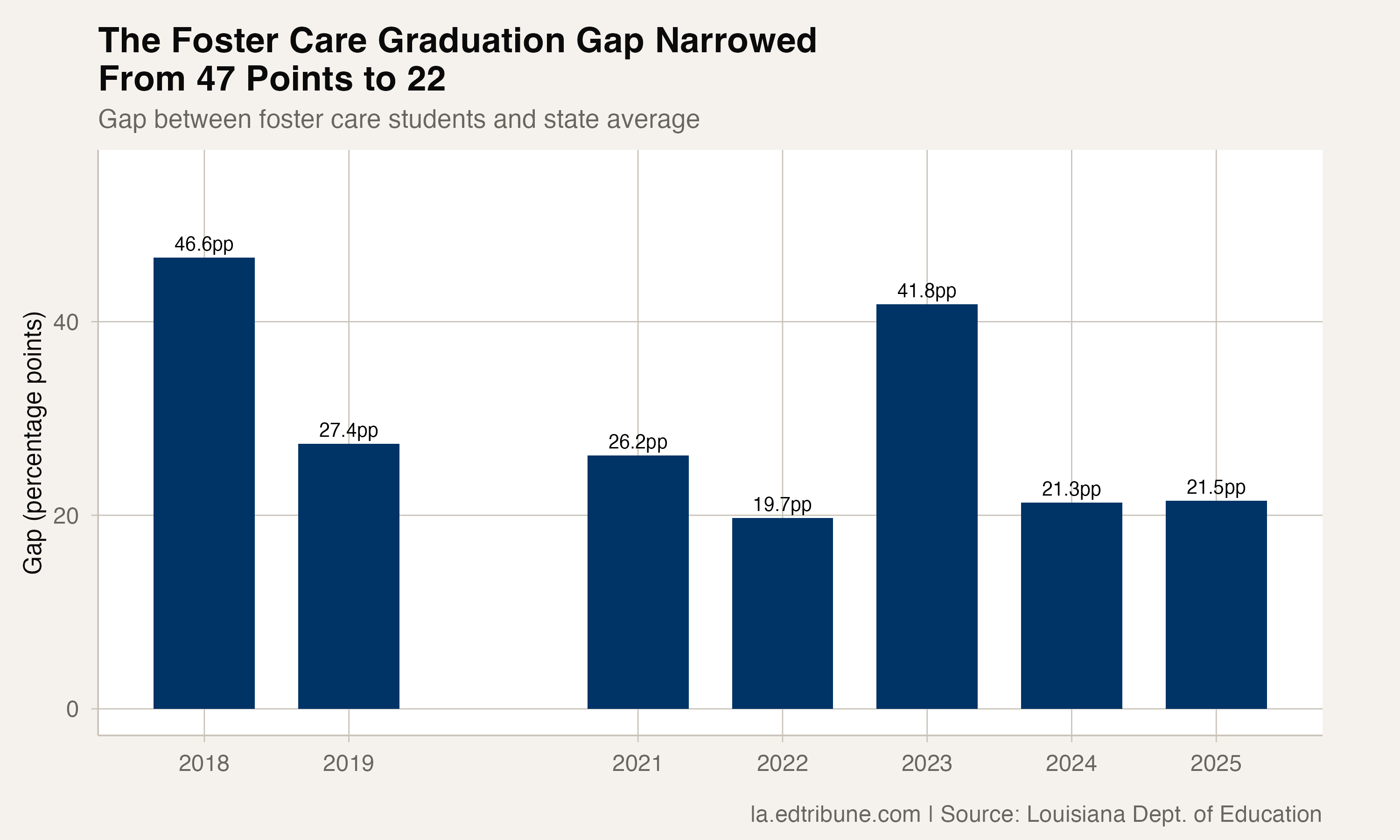
The gap between students in foster care and the state average shrank from 46.6 percentage points in 2018 to 21.5 points in 2025. That gap remains substantial. At 21.5 points, students in foster care are still the second-furthest from the state average, behind only English learners (33.3 points).
But the direction is clear. Students in foster care went from graduating at barely a third the rate of the average student to graduating at roughly three-quarters. The remaining 21.5-point gap represents a different kind of challenge than the 46.6-point gap of 2018.
Outpacing other vulnerable groups
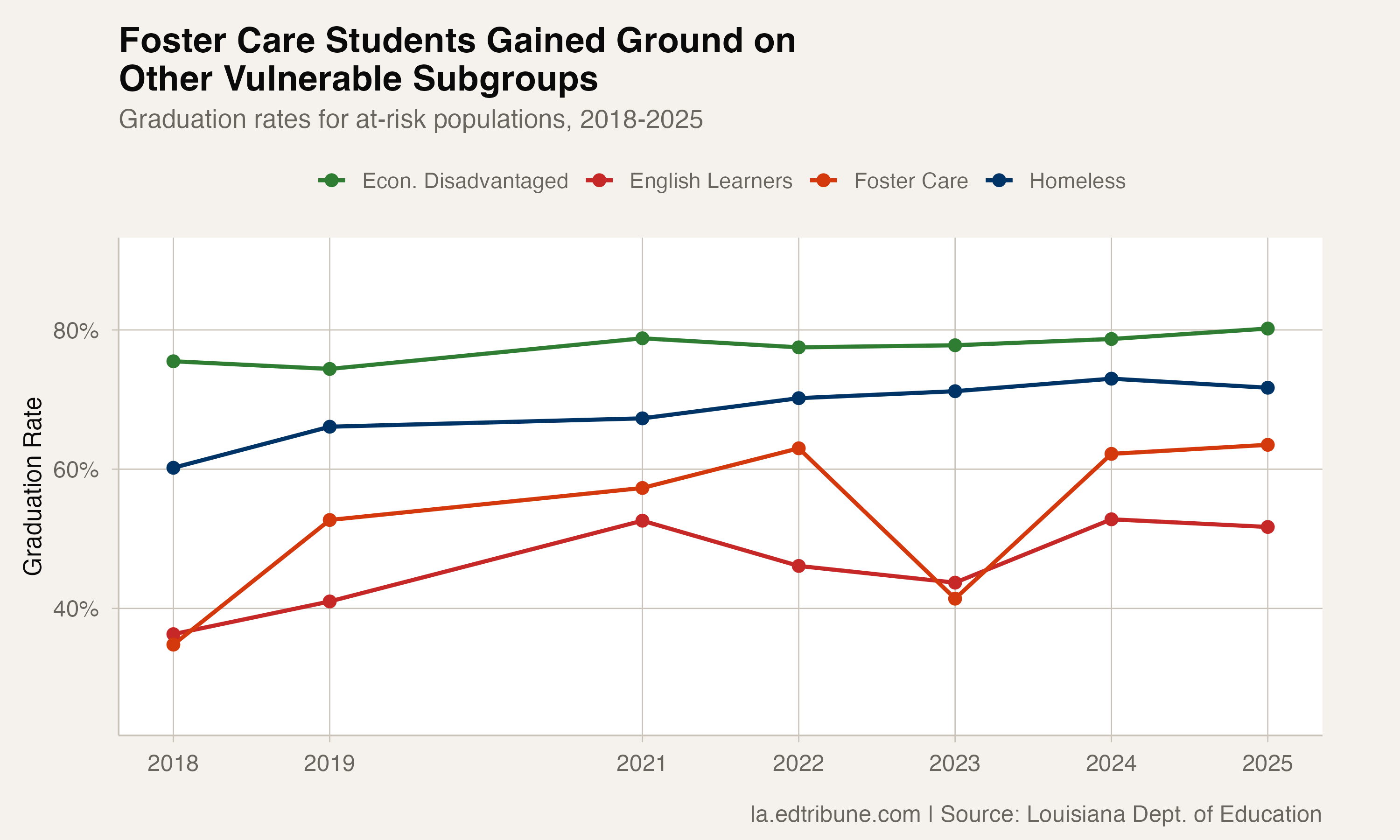
The trajectories of Louisiana's most vulnerable student populations diverged. Students in foster care started lowest and climbed fastest, gaining 28.7 points. Students who are currently homeless followed a steadier path, climbing from 60.2% to 71.7% with fewer swings. Students who are economically disadvantaged, who started highest of the at-risk groups at 75.5%, gained the least (4.7 points) but were already closest to the state average.
English learners present a sharp contrast. Starting at 36.3% in 2018, they reached 51.7% by 2025, a 15.4-point gain that leaves them still below where students in foster care are now. The LEP rate's volatility mirrors the foster care pattern but without the upward trajectory.
The denominator question
Louisiana does not publish the size of the foster care graduation cohort. Without that number, there is no way to know whether the improvement reflects better outcomes for the same number of students or a shifting denominator. If fewer students are in foster care at graduation age, or if the definition of who enters the cohort has changed, the rate could be overstating or understating the actual change.
DCFS and the Louisiana Department of Education collaborate on tracking students in foster care through the education system. The most honest reading of the numbers: graduation outcomes for students in foster care are consistently better than they were seven years ago, even accounting for the 2023 dip. But at 63.5%, roughly four in ten students in foster care still leave without a diploma in four years.
Detailed code that reproduces the analysis and figures in this article is available exclusively to EdTribune subscribers.
Discussion
Sign in to join the discussion.
Loading comments...